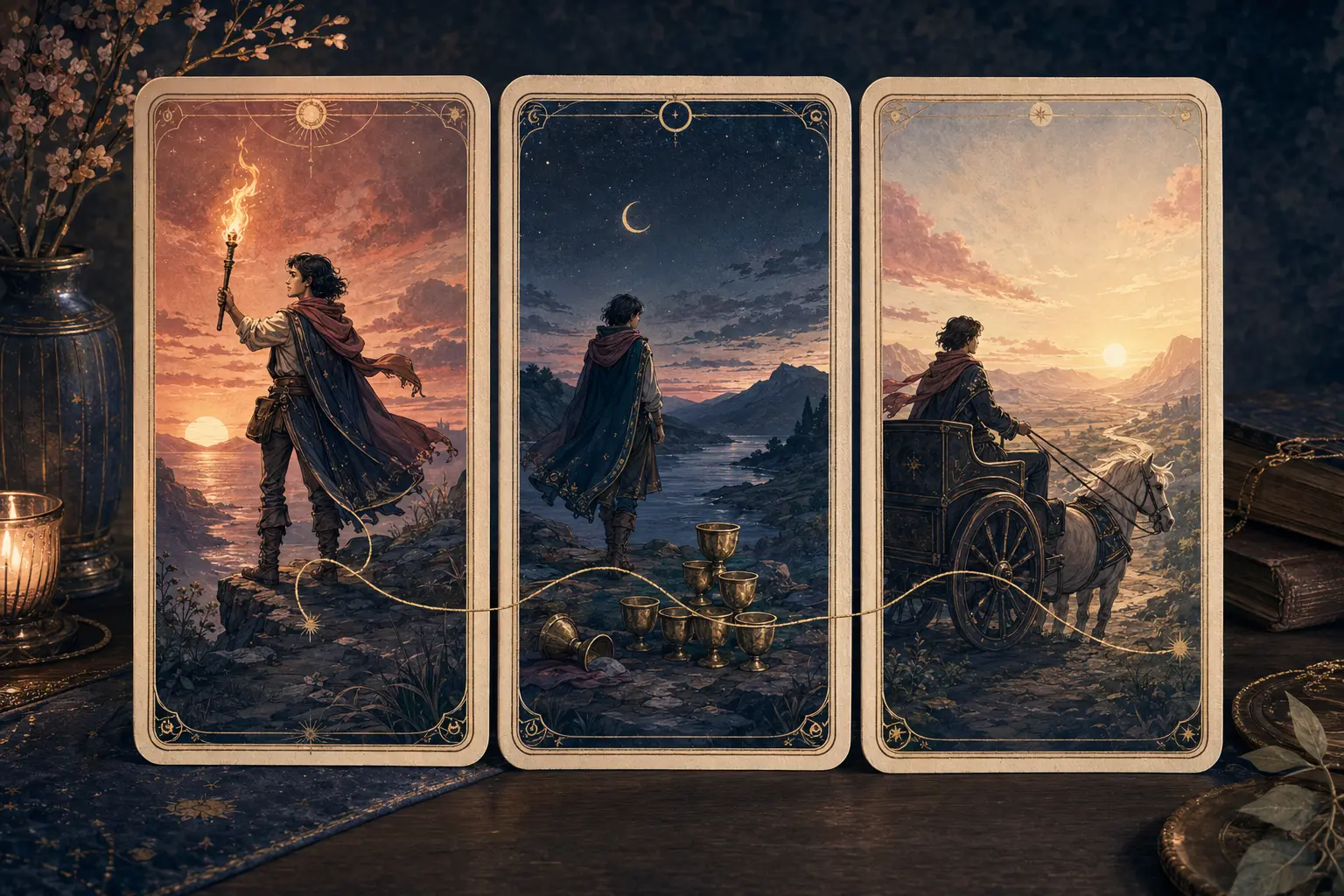
The most common beginner block is not a lack of knowledge. It is too much information with no structure.
You may know the meanings of all 78 cards, yet a three-card spread can still look like three sentences from three different books. You stop reading. You reach for a guidebook. Then you search for the exact combination as if someone else has already written the one correct answer.
There is a better way. You do not need to memorize thousands of tarot card combinations. You need a method for seeing how one card changes the next.
The short answer: give each card a role, reduce it to one idea that fits the question and connect the cards with a word such as because, although or therefore. That is how three definitions become one story.
Why separate card meanings stop working
A card meaning is not a finished sentence. It is a field of options. The Hermit can speak to solitude, study, distance, wisdom, a search for truth or withdrawal. The right layer depends on the question, spread position and cards around it.
If you read each card from a list, your spread can sound like this:
King of Wands means leadership. Eight of Cups means walking away. The Chariot means success.
All three definitions may be valid, but they do not yet tell us what is happening. Who is walking away? What drives the departure? Does the Chariot promise success, or does it ask for discipline and direction?
The meaning lives in the relationship between the cards.
Start with spread positions, not card definitions
Before you shuffle, decide what each position does. A card needs a job. Without positions, three images can compete for attention.
For a simple three-card reading, try:
- Situation: What is at the center of the question?
- Modifier: What shapes, blocks or changes it?
- Movement: What response or direction follows?
This is not a fixed law of tarot syntax. It is a scaffold. Once the story becomes clear, the roles may bend. A person card can become the movement. A Major Arcana card in the middle may dominate the whole spread. The structure gives you a place to begin.
Method 1: Situation + Modifier + Movement
Think of the first card as the main subject. The second tells you what has happened to that subject or what atmosphere surrounds it. The third shows action, consequence or the direction of travel.
Use the spread from the introduction:
King of Wands + Eight of Cups + The Chariot
- King of Wands, Situation: ambition, confidence, leadership or a person ready to take command.
- Eight of Cups, Modifier: leaving what no longer gives enough meaning, even when the choice carries emotion.
- The Chariot, Movement: choosing a direction, gathering opposing forces and moving with focus.
Now connect the cards:
A confident person chooses to leave a path that no longer feels meaningful, then moves toward a new direction that will require focus and self-command.
Notice what the story does not claim. It does not guarantee victory. The Chariot shows the demand for direction as much as the possibility of progress. The cards describe a movement, not a sealed outcome.
Method 2: Desire + Tension + Integration
This method works well for conflict, hard decisions and situations in which two needs pull against each other.
- Desire: What do I want to preserve, gain or create?
- Tension: What pattern interferes with that desire?
- Integration: What quality or response can hold both truths?
Consider:
Ten of Pentacles + Five of Swords + Queen of Swords
- Ten of Pentacles, Desire: lasting security, shared resources, legacy and a stable home or career.
- Five of Swords, Tension: conflict driven by ego, hollow wins or the urge to defeat rather than resolve.
- Queen of Swords, Integration: clean boundaries, honest language and judgment that is not ruled by the heat of the moment.
The combined message becomes:
The stability you want cannot grow while each disagreement becomes a contest. Clear limits and direct speech are needed before the long-term structure can feel secure.
This is stronger than three definitions because the final card responds to the tension between the first two.
Rule 1: Follow the gaze and direction of movement
In scenic decks such as Rider-Waite-Smith-based systems, figures look, turn and travel. Those directions can create a visual sentence.
Two figures facing each other may show exchange, attraction, conflict or recognition. A figure turning away from the next card may show avoidance, departure or a truth that has not entered awareness. A horse or boat moving toward the final card can carry the story into that outcome.
Direction is a clue, not proof. Some deck artists reverse poses or change scenes. Read the image in the deck you have, not a rule learned from another deck.
Rule 2: Notice the dominant suit and missing element
Suits help you identify the field in which the story takes place. If this system is new to you, begin with the four tarot suits and their elements, then return here to connect them across a spread:
- Cups: emotion, bonds, memory and receptivity.
- Swords: thought, speech, conflict and decision.
- Wands: desire, action, courage and creative force.
- Pentacles: work, resources, health, time and the material world.
If two of three cards are Cups, emotion has more weight in the spread. A single Sword may show an attempt to name, judge or cut through that emotional field. It does not mean that emotion defeats thought. It tells you which language has the louder voice.
What is missing can matter as well. A spread about a work offer with no Pentacles may be focused more on fear, ambition or communication than on the offer's material terms. Check the real-world facts before you build a conclusion from absence alone.
Rule 3: Use connecting words
One small word can force the cards into relationship. Try to read the spread as one sentence using:
- because for cause;
- although for tension;
- therefore for consequence;
- until for a condition;
- while for two forces acting at once.
For example:
You move toward a new path with The Chariot, although The Moon shows fear and missing information.
Or:
Communication remains guarded with Four of Pentacles because Five of Swords has made each person expect a fight.
The connecting word tells you what kind of relationship the cards have.
A six-step practice for any three-card spread
- Write one clear question. Avoid asking three questions in one sentence.
- Name the three positions. Give each card a task before the draw.
- Choose one meaning per card. Pick the layer that fits the question and position.
- Look across the images. Notice gaze, movement, repeated colors, numbers, suits and scale.
- Add one connecting word. Use because, although, therefore, until or while.
- Test the sentence. Ask whether it fits the known facts without forcing the question to match the cards.
If the sentence needs a paragraph of excuses to make sense, return to the question. The problem may be a vague position, not a lack of intuition.
If repeated draws or a broad question have filled the table with noise, use the guide to resetting a confusing tarot spread before you add more cards.
What Major Arcana cards do to the story
A Major Arcana card can change the scale of a spread. Two Minor Arcana cards may describe a conversation or choice, while the Major card shows the larger lesson or turning point around it.
If you want to see how those larger themes connect, follow The Fool's Journey through all 22 Major Arcana. It reads the cards as one cycle of beginning, challenge, awakening and return.
For example, Page of Cups + Two of Swords + Judgement may begin with a tentative emotional message, meet hesitation and then reach a point that asks for an honest response. Judgement gives the final movement more weight than a small passing mood.
Do not assume that a Major card cancels the others. It frames them. The Page still speaks. The Two of Swords still shows the pause. Judgement tells us why that pause matters.
When guidebooks help and when they get in the way
A guidebook is not the enemy of intuition. It can teach symbolism, history and layers you would not see on your first look. The problem begins when you copy every keyword into the spread and never choose among them.
Read your first response before you open the book. Then use the guide as a second voice. Ask what it adds, what it challenges and which meaning fits the position.
If you are still building your foundation, How to Read Reversed Tarot Cards gives you another structured method without turning a reversed card into a flat opposite.
You can apply the method to nine tarot combinations that signal a major life change, with examples for endings, relocation, awakening and renewal.
When the spread still looks like chaos
These methods are easier when the question does not carry your whole heart. A spread about your own breakup, business choice or future can pull every symbol toward hope or fear.
That does not mean you lack skill. It means you are inside the story. You may keep changing the positions, draw more cards or choose the meaning that gives the answer you want.
No outside reader is free from perspective. Yet someone who is not attached to your preferred outcome can help hold the question still, keep the card roles clear and notice where the story has been bent.
Need help finding the thread?
If your cards seem to say everything and nothing at once, a personal reading can turn the images into one structured message. We can look at the pattern, the tension and the choices that remain open without treating the spread as a fixed verdict.
Explore personal readingsTarot combinations: quick answers
How do you connect three tarot cards?
Give each card a role before you interpret it. Read the first as the situation, the second as the force that changes it and the third as the movement or response that follows.
Do I need to memorize tarot card combinations?
No. Memorized pairs can help, but spread positions, visual cues, suit balance and the question give you enough structure to build the meaning in context.
What if the tarot cards do not make sense together?
Return to the question, restate each card in plain words and connect them with because, although or therefore. If the spread still feels forced, pause instead of drawing more cards.
Tarot can support reflection and personal insight. It does not prove facts, guarantee events or replace medical, legal or financial advice.