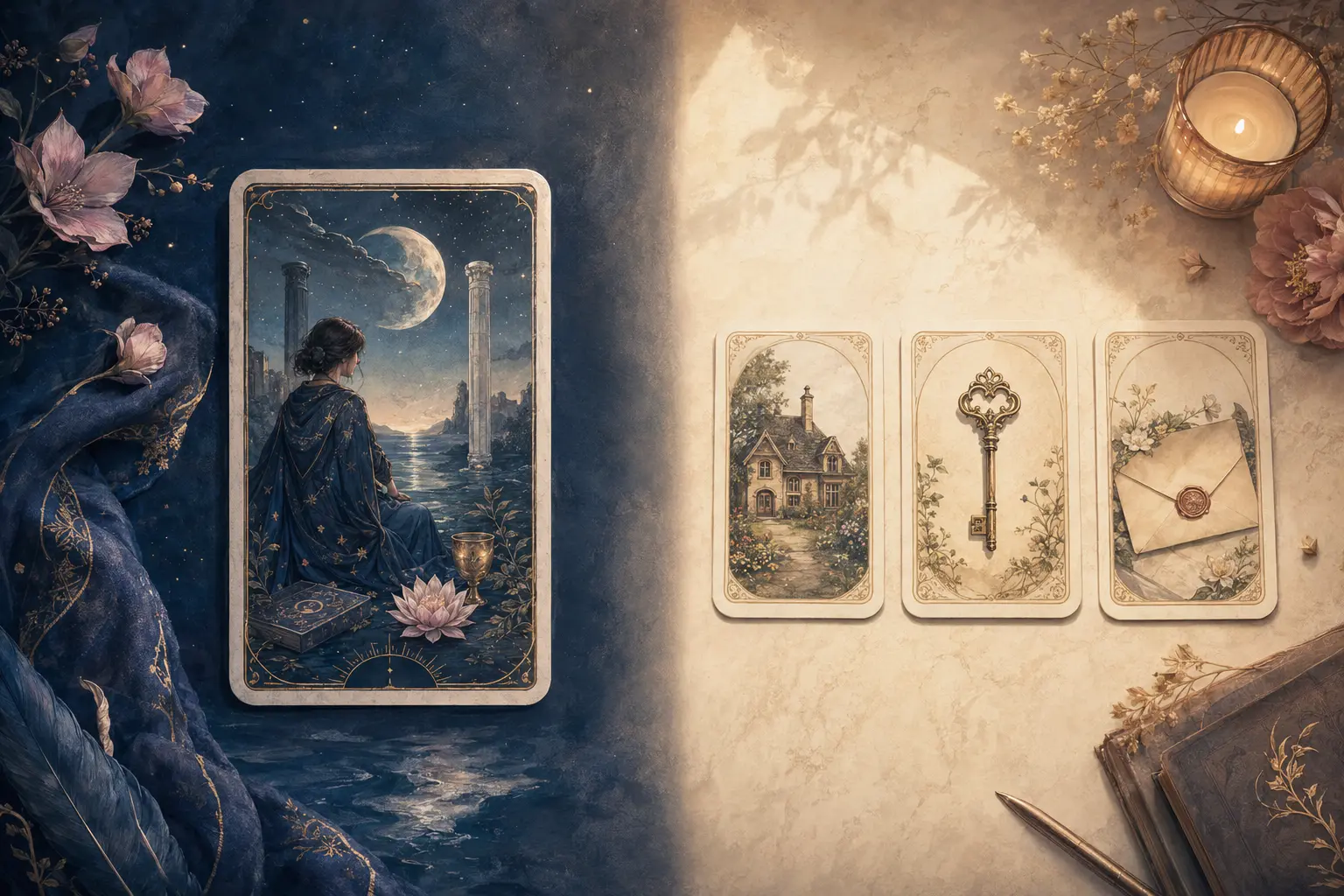
You open a card shop and see hundreds of beautiful decks. Some say Tarot. Some say Lenormand. Others say Oracle. At first glance, they can look like versions of the same idea.
They are not. Tarot and Lenormand have different structures, reading methods and strengths. The deck that feels right depends on the type of question you want to ask and the way your mind works with symbols.
The short answer: Tarot uses 78 cards to explore emotion, archetypes, choices and inner patterns. Petit Lenormand uses 36 concrete symbols that gain precision through combinations. Tarot tends to ask why and how. Lenormand tends to ask what, who and where.
Tarot and Lenormand come from different histories
Tarot appeared in the north of the Italian peninsula in the fifteenth century as a card game. The familiar 78-card form contains 22 trump cards, now called the Major Arcana in occult use, and 56 suit cards. Divination became part of tarot history centuries after the first game decks.
Petit Lenormand traces its structure to a German 36-card game from around 1799 called Das Spiel der Hoffnung, or The Game of Hope. It was designed by Johann Kaspar Hechtel as a game of chance that could be laid out like a board.
The name Lenormand came later. Marie Anne Lenormand was a famous French card reader, but she did not create the 36-card system that now bears her name. Publishers placed her name on card products after her death, drawing on her fame.
This history gives us the first clue. Neither deck arrived as a complete mystical system from one ancient source. Both changed through use, publication and the work of later readers. For more context, see The History of Tarot.
Tarot has 78 cards and a layered visual language
Tarot divides into two broad parts. The 22 Major Arcana cards show large human themes such as choice, power, change, attachment, loss, hope and renewal. The 56 Minor Arcana cards use four suits to explore relationships, thought, action, work, conflict and material life.
A tarot image can hold several valid layers at once. The Hanged Man may speak to pause, surrender, sacrifice, a shift in view or the cost of waiting. The question and surrounding cards decide which layer deserves attention.
This makes tarot strong for questions such as:
- Why do I keep repeating this pattern?
- What part of this choice am I not seeing?
- How can I move through this change with more awareness?
- What does this bond awaken in me?
Tarot does not belong to psychology, and a reading is not therapy. Yet its rich images can support reflection, projection and work with archetypal themes. You can read more about that approach in Why Tarot Works Without Predicting the Future.
Lenormand has 36 cards and reads through combinations
Petit Lenormand uses a compact set of concrete images: Rider, Clover, Ship, House, Tree, Clouds, Snake, Coffin and so on. There are no Major or Minor Arcana. Standard Lenormand practice does not require reversed meanings.
Each card has a core field of meaning. Letter can point to a message, document or written exchange. Ring can point to a bond, promise, agreement or cycle. The card is not empty on its own, but the combination tells us what the symbol is doing.
For example:
- Letter + Ring can point to a written agreement, contract or message about commitment.
- House + Key can point to an important home matter, access to a property or a solution connected with security.
- Scythe + Fish can point to a sharp financial decision, a cut in income or the need to act with care around money.
These are reading options, not proven facts. A Lenormand spread cannot confirm a contract, diagnose a motive or promise an exact date without evidence from real life.
Lenormand works well for focused questions such as:
- What is shaping this work situation?
- Who or what has the strongest influence here?
- What movement can I expect around this plan?
- Where is the obstacle in this process?
If you want to see how the cards form context, continue with What Lenormand Reveals When the Answer Feels Unclear.
Poetry and a news brief
The cleanest difference is language.
Tarot reads like poetry. One image can carry memory, contradiction, mood and several layers of truth. You spend time inside the symbol.
Lenormand reads more like a news brief. The words are concrete, the order matters and the cards beside each other build the message. You watch how symbols modify one another.
Tarot opens the inner landscape. Lenormand maps the visible movement around the question.
This is a useful contrast, not a rigid border. Tarot can describe events. Lenormand can reveal emotional tone. The difference lies in what each system makes easier to see.
Tarot vs Lenormand at a glance
| Feature | Tarot | Lenormand |
|---|---|---|
| Deck size | 78 cards | 36 cards |
| Structure | Major Arcana, Minor Arcana and four suits | One numbered sequence of concrete symbols |
| Reading language | Visual, metaphorical and layered | Concrete, positional and combination-based |
| Main focus | Inner patterns, emotion, choices and meaning | People, events, movement and practical context |
| Strong questions | Why? How? What needs awareness? | What? Who? Where? What is changing? |
| Reversed cards | Optional and common in some traditions | Not part of standard practice |
| Study challenge | More cards and more symbolic layers | Fewer cards, but combinations add complexity |
Choose Tarot if you think through images and inner meaning
Tarot may suit you if art, myth, emotion and open reflection draw you in. It gives you room to stay with one image and ask what it stirs.
Choose Tarot first if you want to:
- journal about emotion and personal patterns;
- study archetypes and symbolic stories;
- explore choices that have more than one layer;
- build a reflective practice around rich visual art.
Tarot asks for patience with ambiguity. If you want one fixed keyword for each card, it may feel wide at first. That width becomes its strength once the visual language starts to settle.
Choose Lenormand if you think through structure and context
Lenormand may suit you if you enjoy patterns, concise symbols and the way words change beside one another. Its images are plain enough to learn, but their relationships take practice.
Choose Lenormand first if you want to:
- work with direct questions about present circumstances;
- read pairs, lines and larger spreads as connected statements;
- study a compact set of recurring symbols;
- focus on movement, people, places and practical obstacles.
Lenormand may look easier because it has 36 cards. The challenge appears in syntax. House beside Key is not the same as House beside Clouds, and a five-card line asks you to hold several relationships at once.
Can beginners learn both systems?
Yes, but learning one first can keep the two languages from blending into a vague middle. Spend time with one deck until you can see how it builds meaning. Then add the second and notice the contrast.
Do not force Tarot meanings onto Lenormand cards. The Tower in Tarot is not the same as Tower in Lenormand. One points toward rupture and revelation in many decks. The other can point to institutions, distance, authority or isolation, based on context.
Keep separate notes for each system. The distinction will make both practices stronger.
Why a reader may use both
The systems can work together when each has a clear job. Tarot may explore the inner pattern around a career choice. Lenormand may then examine the visible people, messages and obstacles around the same situation.
More cards do not guarantee more truth. A combined reading needs restraint. If both decks repeat the same theme through different languages, the pattern gains emphasis. If they seem to conflict, the reader should pause and test the interpretation against the question and known facts.
No outside reader is free from perspective, and cards do not establish facts on their own. The value of experience lies in structure, context and the skill to know which system fits the question.
If Lenormand is the language you want to learn next, begin with the complete guide to all thirty-six Lenormand cards, then continue with the combination method.
Need both depth and practical context?
If your question has an emotional layer and a real-world decision, a personal reading can examine both without turning either deck into a verdict. We can look at the inner pattern, the visible circumstances and the choices that remain in your hands.
Explore personal readingsTarot vs Lenormand: quick answers
Is Lenormand easier to learn than Tarot?
Lenormand has fewer cards and a compact set of core symbols, but combinations add a new layer of study. Tarot has more cards and more visual detail, yet one image can give a beginner a strong point of entry.
Can you use Tarot and Lenormand together?
Yes. Tarot can explore the inner pattern around a question, while Lenormand can add context about visible events, people and movement. Keep a clear role for each deck so the reading does not become crowded.
Which is more accurate, Tarot or Lenormand?
Neither system is accurate in every reader's hands or for every question. The better choice is the system that fits the question, the reader's skill and the amount of context available.
Source note: The historical sections draw on museum records and card-history research concerning fifteenth-century Italian tarot, the German Game of Hope and card products issued under the Lenormand name after Marie Anne Lenormand's death.
Tarot and Lenormand can support reflection and personal insight. They do not prove facts, guarantee events or replace medical, legal or financial advice.