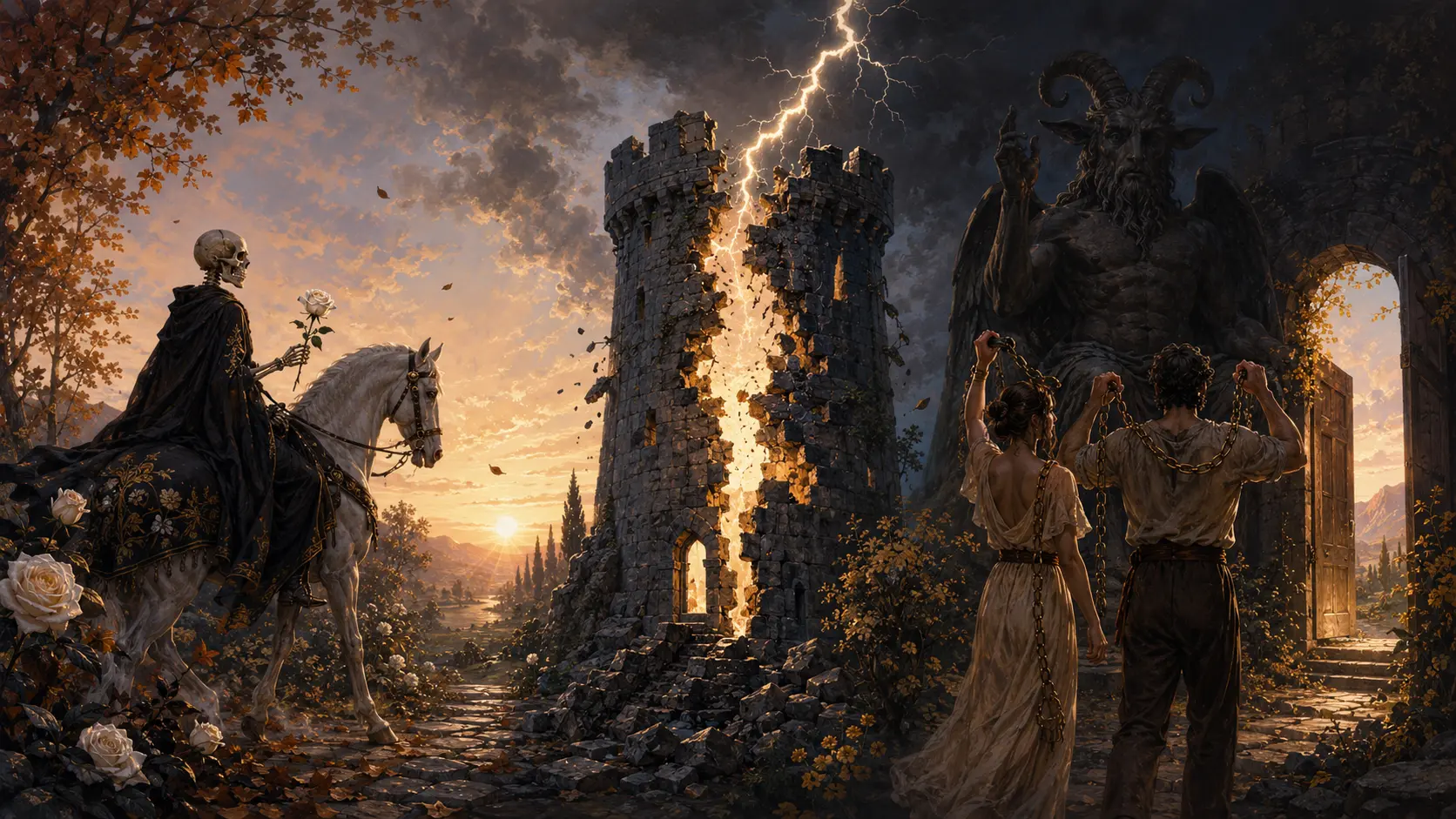
A skeleton, a tower split by lightning and two people in chains can make a new tarot reader forget every calm thought they had before the draw.
Film and popular culture have trained us to read these images as doom. The card turns over, the music changes and someone whispers that disaster is near. A real tarot reading does not need that script.
Death, The Tower and The Devil can describe hard parts of life. They should not be made soft or sweet. Yet none of them is a sentence passed on you. A card is a symbol read in relation to a question, a spread position and the cards around it.
The short answer: Death asks what has reached its end. The Tower asks what truth has broken through. The Devil asks where desire, fear or control has narrowed your sense of choice.
Are there bad tarot cards?
There are cards that name grief, conflict, loss, shock and harmful patterns. Calling every card positive can dismiss what a person faces. Calling one card a curse creates fear without context.
A sound reading makes room for both sides. The image may name a hard fact, yet the outcome is not sealed. Tarot can help you examine a pattern and choose a response. It cannot prove that an event will happen or replace evidence from real life.
If fear around tarot has kept you from learning, start with 5 Toxic Tarot Myths That Stop Beginners. The cards are paper and ink. The meaning comes from the reading process, not a force trapped inside the deck.
Death: the end that makes change possible
Death is card XIII in the Major Arcana. Its name is direct, so the first fear is clear: does it predict physical death?
No. A responsible reader does not use this card to predict a death. In most readings, it points to an ending, a transition or a change of identity. The old form cannot continue as it was.
Death may appear when:
- a role or relationship has run its course;
- a habit no longer fits the person you are becoming;
- you are between an old identity and a new one;
- grief asks you to accept that life will not return to its prior shape.
Think of autumn rather than a horror scene. The leaf falls because its season is complete. The tree does not bargain with the branch. It releases what cannot remain, then holds its energy for what comes next.
This does not mean every ending feels welcome. A breakup, a move or the loss of a job can hurt even when change becomes useful in time. The card does not ask you to celebrate loss. It asks you to face what has ended so you can stop spending energy on denial.
Ask Death: What has ended in substance, even if I still maintain it in form?
The Tower: the truth that changes the structure
The Tower is one of the most intense images in tarot. Lightning opens a stone building. A crown is thrown from the top. In some decks, people fall from the structure.
The card can point to shock, disruption, revelation or the collapse of an assumption. It may describe an event you did not choose. It may also show the instant when a fact becomes too clear to ignore.
The Tower may appear when:
- new information changes how you see a relationship;
- a plan meets a flaw that was built into its foundation;
- a public role or private belief can no longer hold;
- a sudden event demands a new response.
It is tempting to say that every collapse happens for a good reason. Real life is not that neat. A crisis is not proof that you deserved it, attracted it or needed it. The Tower can describe what has been disrupted without turning harm into a spiritual reward.
Its useful question is structural: what is still standing, what has failed and what fact is now visible? If the answer concerns money, health, housing or safety, check the facts and seek the right support. Do not make the card your source of evidence.
Ask The Tower: What truth changes the plan, and what needs a safer foundation now?
The Devil: the pattern that narrows choice
The Devil can speak to attachment, temptation, shame, control, excess and the stories that make a person feel trapped. In the Rider-Waite-Smith image, the chains around the two human figures appear loose. That detail can invite a question about agency: which part of the pattern can be changed?
That symbol has limits. Loose chains in a card do not mean that every bond is easy to leave. Abuse, coercive control, debt and addiction can restrict choice in severe ways. Addiction is not a moral failure or a simple lack of will. Tarot cannot diagnose it, and a person who needs help deserves trained support, not blame.
The Devil may appear when:
- short-term relief keeps a harmful cycle in place;
- fear of rejection drives a need for approval;
- money, status or desire has become the sole measure of worth;
- shame makes a pattern harder to name;
- a power imbalance needs attention in the real world.
The aim is not to judge desire. Pleasure, ambition and material needs are part of human life. The question is whether you can choose with awareness, or whether the pattern seems to choose for you.
Do not use The Devil as proof that a partner is toxic, possessed or abusive. Look at conduct, boundaries, threats, control and other facts. If you feel unsafe, contact a trusted person or a qualified service in your area.
Ask The Devil: What do I keep choosing for short-term relief, and what support could widen my options?
Why these three cards cause such strong fear
Each card touches a core human fear:
- Death: change, loss and the point of no return.
- The Tower: uncertainty and the loss of a structure we trusted.
- The Devil: shame, desire and the fear that we have less choice than we thought.
The image reaches us before the guidebook does. That fast response can make a symbol feel like a fact. Pause long enough to separate the picture, the feeling and the claim you are about to make.
A calm five-step method for a feared card
- Name your first response. Write one sentence: “This image makes me fear that...” Fear becomes easier to examine when it has words.
- Return to the position. A card in “what to release” does a different job from the same card in “what supports me.”
- Describe before you interpret. Note what you can see: a fallen crown, a white rose, a chain, an open path. This slows the jump from image to verdict.
- Choose one grounded meaning. Link it to the question and known facts. Avoid adding a disaster that the spread does not show.
- Ask for one useful response. What can you end, verify, change, discuss or seek support for?
Then stop. Do not draw five more cards to cancel the first one. More images can feed fear when the mind is seeking reassurance instead of insight.
If the feared card is reversed, do not turn it into a worse version of itself. It may show resistance, delay, an inner process or the easing of a pattern. The guide to reversed tarot cards offers a four-lens method for that question.
Read the card in context, not in isolation
The cards beside a feared Major Arcana card can show where the issue lives and how a response may unfold.
- Death + Eight of Cups: a conscious departure from an emotional chapter that has reached its end.
- The Tower + Ace of Swords: a fact or conversation breaks through a false assumption.
- The Devil + Four of Pentacles: fear of loss may tighten control around money, time or security.
- The Devil + The Star: honest recognition of a bind opens space for hope, care and repair.
These are examples, not fixed formulas. The question and spread positions still lead. If card combinations feel like separate definitions, use the guide to reading tarot cards as one story.
For a seasonal way to practice context, use the guide to seven Halloween tarot spreads, including layouts for hidden truths, protection and the turning year.
When the cards speak louder than you can think
A feared card can become hard to read when the question concerns your relationship, work, home or health. Hope pulls the meaning in one direction. Fear pulls it in another. You may draw again, change the question or search until you find the answer that calms you.
This is an emotional blind spot, not a sign that you have failed at tarot. An outside reader still has a point of view, but a reader who is not attached to your preferred result can keep the question stable and help separate symbol from fact.
Turn fear into a clear next step
If Death, The Tower or The Devil has left you stuck, a personal reading can examine the card in context. We can name the pattern, check what the spread does and does not say, and find the choices that remain open.
Explore personal readingsScary tarot cards: quick answers
Does the Death card mean physical death?
No. In most tarot readings, Death points to an ending, transition or change of identity. A tarot card must not be used to predict a death or make a medical claim.
Is The Tower always a bad tarot card?
No. The Tower can mark shock, disruption or a truth that changes the structure of a situation. Its meaning depends on the question, position and cards around it.
What does The Devil mean in tarot?
The Devil can point to attachment, temptation, shame, control or a pattern that limits choice. It invites honest attention, but it does not diagnose addiction or prove that another person is abusive.
Source note: Historical meanings were checked against A. E. Waite's The Pictorial Key to the Tarot. The health note reflects addiction guidance from the US National Institute on Drug Abuse.
Tarot can support reflection and personal insight. It does not prove facts, guarantee events or replace medical, legal or financial advice.