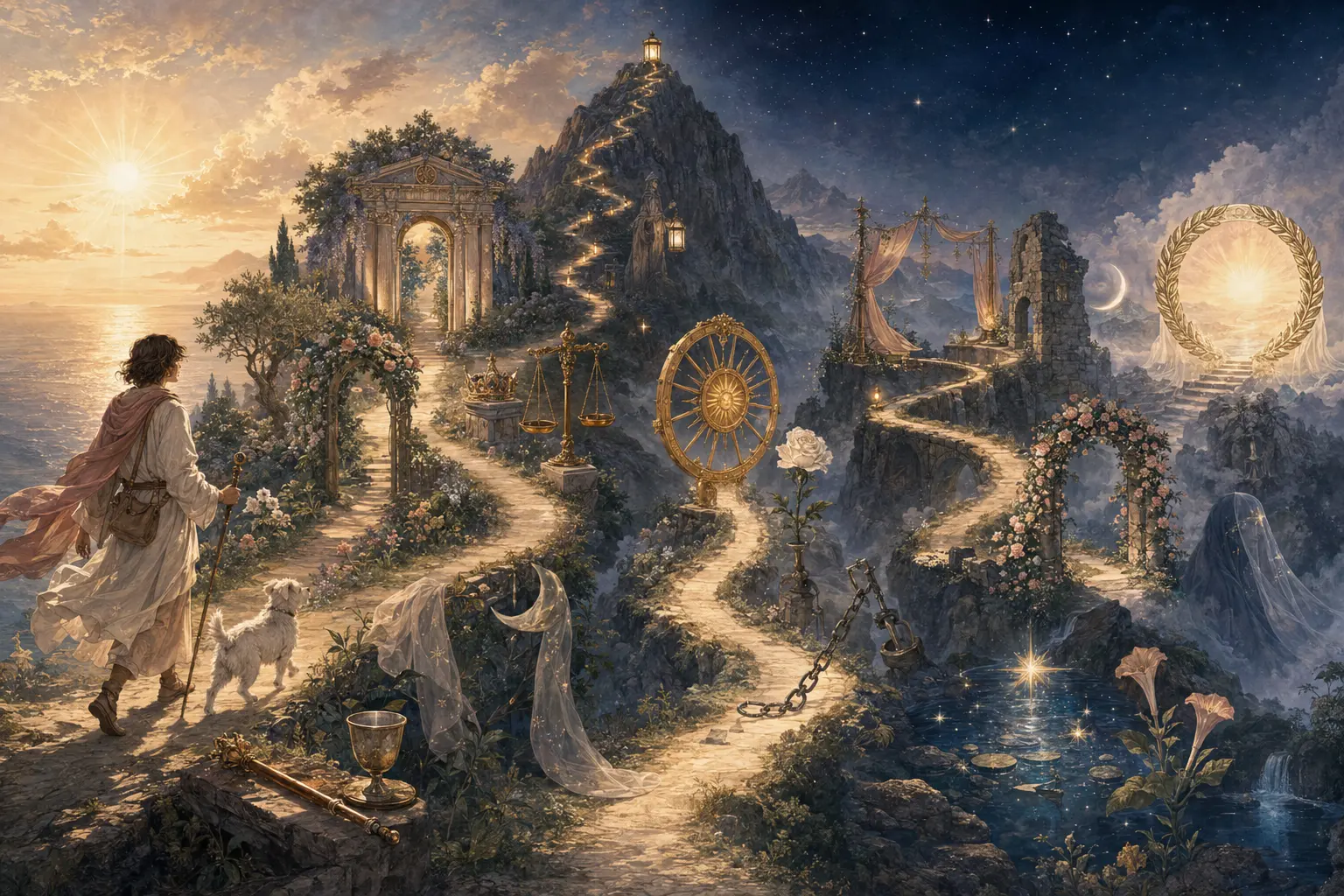
Every life moves in cycles. We begin with hope and little experience. We meet teachers, test our will, lose structures we thought would last and return with a deeper sense of who we are.
Tarot gives this pattern a memorable form. When the 22 Major Arcana are read in sequence, The Fool becomes a traveler who meets each archetype from The Magician to The World. This is known as The Fool's Journey.
The short answer: The Fool's Journey reads the Major Arcana as a map of growth. The Fool begins as open potential, learns to act and choose, faces limits and shadow, wakes to a larger purpose and reaches integration in The World. That ending is not final. A new cycle can begin from a wiser place.
Is The Fool's Journey the original meaning of tarot?
No. The first tarot packs were made for card games. The 22 picture cards were trumps, not chapters in one ancient spiritual tale. The history of tarot shows how divination and occult systems entered much later.
The trumps were also the newer layer of the deck. The history of the Minor Arcana follows the older four-suit structure from medieval card culture to Pamela Colman Smith's illustrated scenes.
The Fool's Journey is a modern interpretive framework. It brings the cards into a sequence that resembles a quest, a life cycle or a path of inner development. That does not make it false. It means we should use it as a lens, not present it as the hidden plan behind the first tarot decks.
The framework is useful because the images hold human themes that recur across many lives: care, authority, desire, loss, temptation, hope and completion. A person can recognize these themes without believing that growth follows a neat line.
Stage 1: Open potential
0. The Fool: the first step
The Fool stands at the edge with a small bundle and a white dog. In the Rider-Waite-Smith image, the face turns toward the sky while the ground falls away ahead. The card holds freedom, trust, risk and lack of experience in one scene.
At this point the traveler has no formed identity and no proof that the road will work. This is the move to a new city, the first day of a new craft or the moment you admit that an old life can no longer contain you. The Fool asks, What would I begin if I did not need to know the whole path first?
Stage 2: Teachers, tools and the outer world
1. The Magician and 2. The High Priestess
The Magician discovers agency. The tools are on the table, and intention can become action. The High Priestess adds the unseen layer: instinct, silence, memory and knowledge that has not reached speech. Together they teach the traveler to use both will and inner attention.
3. The Empress and 4. The Emperor
The Empress introduces nurture, embodiment, creativity and abundance. The Emperor brings order, limits, duty and structure. These cards are often described as mother and father principles, but their work is broader than gender. One grows life. The other gives it a frame.
5. The Hierophant
The traveler enters a shared system of belief. The Hierophant can be a teacher, tradition, ritual, school or social rule. Its gift is inherited knowledge. Its question is whether the rule still carries meaning or has become obedience without thought.
6. The Lovers
The Lovers is more than romance. It is the point where attraction becomes choice and choice reveals values. The traveler can no longer follow every path. A bond, promise or moral decision asks for a more conscious yes.
7. The Chariot
With a direction chosen, The Chariot moves into the world. Opposing drives must be held under one purpose. This is a first victory, ambition and self-command, but it also carries a warning: speed without inner agreement can pull the vehicle apart.
Stage 3: Inner tests and the surrender of control
In Rider-Waite-Smith order, Strength is numbered 8 and Justice 11. Some older traditions reverse those positions. The journey still works as a reflection tool, but the numbering is not the same in every deck.
8. Strength and 9. The Hermit
Strength replaces force with steady presence. The lion is not destroyed. It is met, held and brought into relationship. Then The Hermit turns away from applause and carries one lamp into the dark. The traveler learns that self-command and self-knowledge need patience, solitude and honest attention.
For a focused practice with The High Priestess, The Empress and Strength, explore how three Major Arcana archetypes can help you build personal boundaries.
10. Wheel of Fortune and 11. Justice
The Wheel shows change that no person can command. Fortune rises, turns and passes. Justice asks what remains in our hands: choices, consequences, evidence and repair. One card teaches respect for change. The other asks for a clear account of our part within it.
12. The Hanged Man
The road stops. The old angle no longer reveals the answer, so the traveler must release movement and see from another position. This pause can feel like failure when the mind wants action. Yet The Hanged Man is not empty delay. It is surrender in service of a new view.
13. Death and 14. Temperance
Death closes the form that cannot continue. It can mark an ending, transition or identity that has reached its limit. Temperance follows with the slow art of integration. What survived the ending must now be mixed into a new way of living. If these images stir fear, the guide to Death, The Tower and The Devil offers a grounded way to read them.
Stage 4: Shadow, collapse and renewed vision
15. The Devil
The Devil reveals attachment, shame, appetite, control and the stories that make a choice feel absent. In the card image, loose chains can point to agency. In life, addiction and coercion can require real support, so the symbol must never become blame. The question is, What has power here, and what form of help or choice can return some freedom?
16. The Tower
The Tower breaks a structure and exposes what it could no longer hold. The event may be chosen or unwanted. It is not proof that a crisis was deserved, sent for a reason or certain to improve us. The card asks what has been revealed and what must be built with greater truth now.
17. The Star and 18. The Moon
After the rupture, The Star offers a bare, tender form of hope. Water moves again. The future can be imagined. The Moon then reminds the traveler that hope does not erase uncertainty. Old fears, dreams and projections rise in the half-light. The task is to move with care without turning every shadow into a fact.
19. The Sun
The Sun brings warmth, visibility and life back into the body. What felt divided can now be expressed with less defense. This card is joy, but not innocence untouched by experience. It is openness after the traveler has seen the night and chosen to stand in the light again.
20. Judgement
Judgement is the call to rise into a changed life. The past is reviewed, not erased. The traveler hears what must be answered now and sees the old story from a larger view. Forgiveness may be part of that process, but it cannot be forced. The deeper theme is response: the moment when insight asks for action.
Stage 5: Integration and return
21. The World
The World gathers the journey into one living whole. The wreath forms a boundary and a gateway. Completion does not mean a perfect life with no more conflict. It means the traveler can hold more of the experience without splitting it into acceptable and rejected parts.
The Fool has become The World, yet the zero still waits beyond 21. A completed project opens a new level of work. A healed relationship pattern changes what love asks next. A hard-earned identity becomes the starting point for another unknown path.
How to use The Fool's Journey in a reading
When a Major Arcana card appears, move beyond the question of what it predicts. Ask what part of the journey it names.
- Name the stage. Is this a beginning, outer lesson, inner test, shadow encounter, awakening or completion?
- Find the active verb. The Fool begins. Justice accounts. Death releases. Temperance integrates. Judgement answers.
- Return to the question. What does that action mean in this job, bond or decision?
- Check the surrounding cards. A Major Arcana card frames the story, but it does not erase the other cards.
- Choose one grounded response. Turn the archetype into a question, boundary, conversation or next step.
For example, The Hermit in a career spread does not mean that you must leave society. It may ask for study, distance from group pressure or a period of private assessment. The same card in a relationship spread may point to space, self-inquiry or emotional withdrawal. Context keeps the grand story connected to real life.
If several cards appear and you cannot see how they interact, use the method for reading tarot cards as one story. The Fool's Journey gives you the larger arc. Spread positions and connecting words show what the cards are doing in this moment.
Where are you on the journey now?
You are not assigned one card for life. You may be The Fool in love, The Emperor at work and The Hanged Man within a home question, all in the same week. Human growth does not pass through 22 sealed rooms in order.
Use the sequence as a mirror. Which archetype describes the demand in front of you? Which one describes the response you keep avoiding? Which card comes next in the traditional order, and what quality might it invite?
The answer is not a verdict from outside you. It is a way to see the shape of the chapter you are living and the choice that remains yours.
Which chapter are you living?
A personal reading can place the cards around your real question, reveal the larger pattern and bring the message back to choices you can use. We can explore the stage without treating it as a fixed fate.
Explore personal readingsThe Fool's Journey: quick answers
What is The Fool's Journey in tarot?
The Fool's Journey is a modern interpretive framework that reads the 22 Major Arcana as one path of human growth, from open potential in The Fool to integration in The World.
Do the Major Arcana tell one fixed story?
No. The sequence offers a useful map, but each card can take on another role in a reading. The question, spread position and surrounding cards still shape the message.
Which Major Arcana card shows where I am in life?
A card can name the theme that asks for attention now, but it is not a permanent label or a fixed stage. Use it to form a question about your present choices and experience.
Sources and further reading
- Victoria and Albert Museum: A history of tarot cards
- The Metropolitan Museum of Art: Before Fortune-Telling
- A. E. Waite: The Pictorial Key to the Tarot
Tarot can support reflection and personal insight. It does not prove facts, guarantee events or replace medical, legal or financial advice.