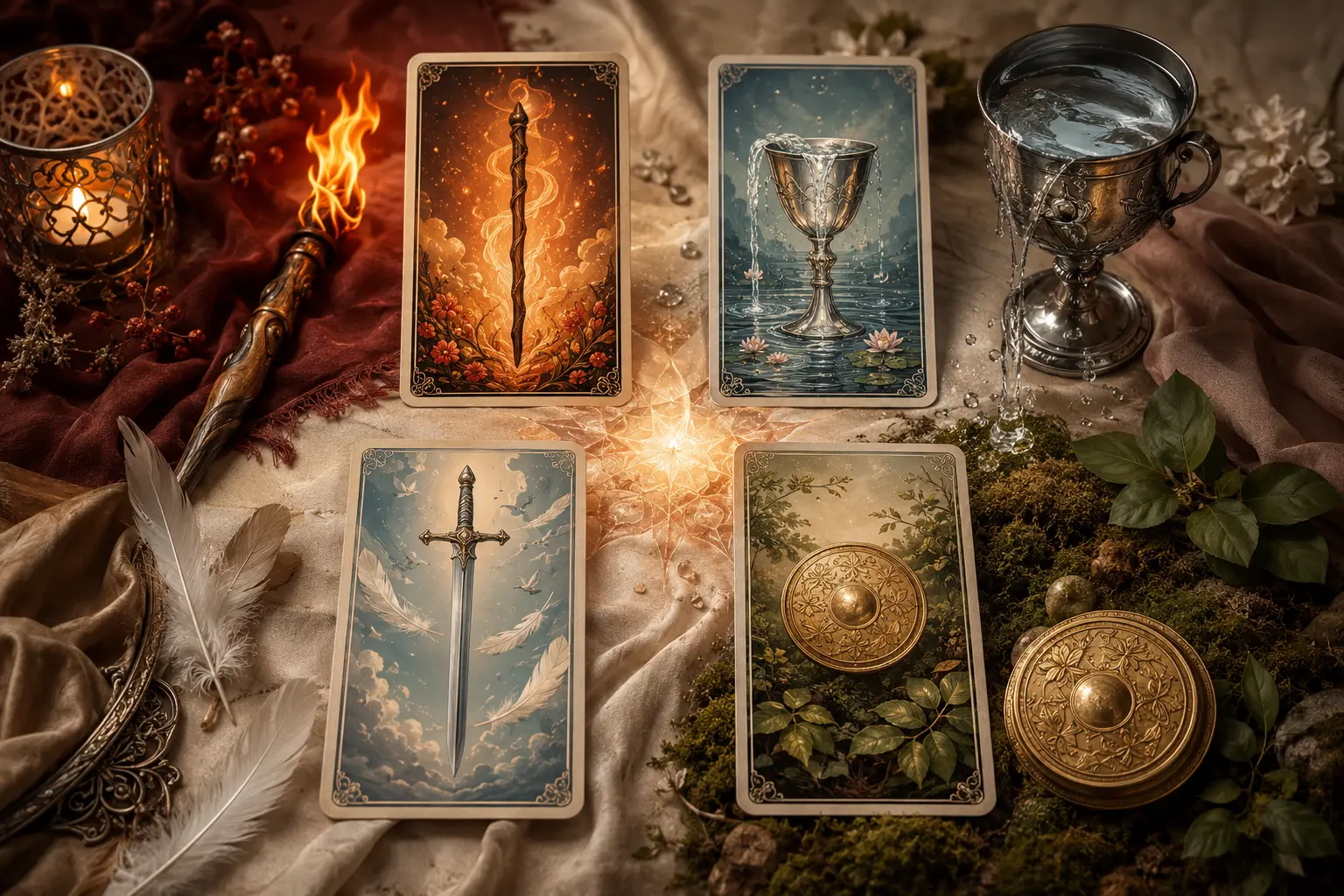
Seventy-eight tarot meanings can feel like the syllabus for an impossible exam. The good news is that the Minor Arcana does not ask you to hold 56 unrelated definitions in your mind.
It asks you to understand a pattern.
The four Minor Arcana suits describe four fields of human experience. Wands bring Fire and action. Cups carry Water and emotion. Swords move through Air and the mind. Pentacles belong to Earth and the material world. Once you recognize the field, the number, image and spread position tell you what is happening inside it.
So when a card appears, do not begin with, What sentence did the guidebook give this card? Begin with, Where in life is this energy moving?
The four tarot suits at a glance
| Suit | Element | Life area | Core question | When unbalanced |
|---|---|---|---|---|
| Wands | Fire | Action, purpose, ambition, creativity | What wants to move? | Burnout, conflict, scattered effort |
| Cups | Water | Emotion, love, bonds, intuition | What is being felt? | Idealization, dependency, emotional overflow |
| Swords | Air | Thought, truth, speech, decisions | What needs to be understood or said? | Worry, harsh words, endless analysis |
| Pentacles | Earth | Money, work, body, home, resources | What can be built or sustained? | Stagnation, scarcity, overattachment to security |
These correspondences are widely used in modern tarot, especially in traditions shaped by nineteenth and twentieth-century Western esotericism. They are not one unchanged code that every historic card player used. The four suits existed before tarot's elemental associations developed. You can follow that longer story in the history of the Minor Arcana.
Wands and Fire: action, desire and creative force
Fire does not wait for a finished map. It reaches, transforms and consumes. In a tarot reading, Wands show the force that gets you moving: motivation, desire, courage, competition, attraction, enterprise and the need to make something real through action.
This is why Wands often appear around a new business idea, a career leap, a creative project, travel, sport or a strong spark between two people. They do not guarantee success. They show that energy is available and wants direction.
In daily life, Wands may describe:
- starting a project before every detail is solved;
- feeling called toward a larger role;
- taking a risk, competing or leading;
- sexual energy and physical attraction;
- a fast schedule with many demands.
The shadow of Fire appears when movement loses purpose. Too many Wands can feel like ten ideas competing for one body. Enthusiasm becomes impatience. Leadership becomes domination. A powerful beginning burns through its fuel before a structure can hold it.
When Wands dominate, ask: What deserves my energy, and what is only creating heat?
Cups and Water: emotion, connection and intuition
Water receives the shape of the vessel that holds it. It joins, reflects, remembers and flows beneath the visible surface. Cups therefore speak the language of feelings, relationships, imagination, empathy, memory and intuitive response.
Cups are often called the love suit, but love is only one current within Water. A Cup card can hold friendship, family, grief, reconciliation, longing, fantasy, spiritual openness or the wish to withdraw. The suit tells you that emotional meaning matters. The number and scene show what that meaning is doing.
In daily life, Cups may describe:
- the bond forming between two people;
- a feeling that has not yet found words;
- nostalgia, memory or emotional return;
- creative imagination and symbolic dreams;
- compassion, forgiveness or the need to receive.
Water also distorts when it has no clear boundary. Feeling can become idealization. Empathy can turn into carrying another person's responsibility. Intuition can become wishful thinking when every impression is accepted without checking the facts.
When Cups dominate, ask: What am I truly feeling, and what story am I placing around the feeling?
Swords and Air: thought, truth and communication
Swords are the suit many beginners fear. Their scenes often contain separation, strain and conflict. Yet the element beneath the blade is Air: thought, language, perception, strategy and the ability to distinguish one thing from another.
A sword can cut, but it can also free. A direct conversation may end confusion. A clear boundary may stop a repeating pattern. A difficult decision may create the first honest path forward. Swords are not punishment. They show what happens when ideas, words and judgments carry the action.
In daily life, Swords may describe:
- an important conversation or disagreement;
- planning, research, writing and negotiation;
- a contract, rule, decision or ethical question;
- the difference between fact and assumption;
- worry, mental pressure or competing thoughts.
Too much Air can keep a person living from the neck up. Analysis replaces action. Words become weapons. Objectivity becomes distance from feeling. The answer is not to reject thought, but to give it a useful task.
When Swords dominate, ask: Which fact is clear, which belief is untested, and what needs to be said with precision?
Pentacles and Earth: matter, resources and results
Earth is what can be touched, measured, tended and built. Pentacles bring the reading into money, work, health, the body, home, time, skills and the resources that support everyday life.
This suit is sometimes reduced to cash, but Earth is wider than a bank balance. Your sleep, schedule, food, craft, living space and capacity to keep a promise all belong here. Pentacles ask what is sustainable. They care about the result that remains after inspiration and emotion have passed.
In daily life, Pentacles may describe:
- a job, payment, purchase or long-term investment;
- learning a skill through repetition;
- the condition of the body and daily habits;
- home, property and practical security;
- the slow growth created by consistent work.
Earth becomes heavy when security is treated as the only value. Careful planning can harden into fear of change. Patience can become passivity. Possessions, status or routine can begin to define worth.
When Pentacles dominate, ask: What is the practical reality, and what can I do repeatedly enough to change it?
How the elements replace mechanical memorization
A suit gives you the field. A number gives you the stage or movement. The picture shows the human expression. The spread position gives the card its job.
Suit + number or rank + image + position = a meaning that belongs to this reading.
Take the Five of each suit. Five often introduces friction, instability or a test:
- Five of Wands: Fire meets friction, so energy competes, clashes or learns through challenge.
- Five of Cups: Water meets loss, so attention gathers around disappointment and what remains emotionally unfinished.
- Five of Swords: Air meets conflict, so words, motives or victory itself must be questioned.
- Five of Pentacles: Earth meets lack, so resources, belonging or material support feel uncertain.
You have not memorized four disconnected paragraphs. You have watched one number move through four elements.
The numbers give each element a stage
Numbers create another layer of structure. They do not have to mean exactly the same thing in every deck or tradition, but they offer a reliable path through the numbered cards:
| Number | Basic movement | Question to ask |
|---|---|---|
| Ace | Seed, opening, raw potential | What is beginning? |
| Two | Pair, choice, polarity | What is meeting or dividing? |
| Three | Growth, expression, first result | What is taking form? |
| Four | Structure, stability, boundary | What is being held? |
| Five | Disruption, friction, test | What challenges the structure? |
| Six | Adjustment, exchange, movement onward | What restores flow? |
| Seven | Assessment, strategy, inner test | What must be examined? |
| Eight | Power, movement, repetition, skill | Where is energy concentrating? |
| Nine | Maturity, intensity, near completion | What has reached fullness? |
| Ten | Completion, consequence, transition | What has reached its limit? |
Now place the number inside the suit. The Two of Cups brings two into Water, so relationship, mutual recognition or an emotional choice becomes possible. The Two of Swords brings two into Air, so the same number may become opposing thoughts, a pause between decisions or information held in balance.
The court cards follow a different pattern. A Page meets the element as a student or messenger. A Knight pursues it. A Queen holds and understands it from within. A King directs it in the outer world. Deck traditions vary, so treat this as a starting framework rather than a rigid personality test.
What a dominant or missing element means
In a multi-card spread, repeated suits create atmosphere. Four Wands in a five-card reading make action and desire hard to ignore. Several Cups bring emotional truth to the center. Many Swords show that thought, communication or tension is carrying the story. Pentacles pull attention toward practical conditions and what can last.
A missing suit is softer information. No Pentacles in a career spread does not prove that money is absent or that the offer will fail. It may show that the current focus is ambition, emotion or negotiation rather than material terms. Check the real-world evidence before turning an absence into a prediction.
Balance matters more than judging one element as good. Fire begins, Water connects, Air clarifies and Earth sustains. A project needs all four at different moments.
A four-element spread for everyday clarity
Use this spread when a situation feels active in several directions at once. Draw one card for each position:
- Fire: What action or desire is asking for expression?
- Water: What feeling or relationship needs to be acknowledged?
- Air: What truth, decision or conversation brings clarity?
- Earth: What practical step can support the situation now?
The card in each position does not need to match the named element. A Cup in the Earth position might show that emotional support is the practical resource. A Sword in the Water position might reveal that a feeling needs language before it can move. The contrast is part of the reading.
Once the four cards are clear on their own, connect them into one account. The guide to reading tarot card combinations as a story will help you follow direction, repeated suits and the relationship between cards.
Your first question is simpler than you think
The Minor Arcana becomes manageable when you stop treating every card as an isolated password. First locate the element. Then ask what the number, figure and image are doing inside that field.
Wands move. Cups feel. Swords name. Pentacles build. Each can create, protect, overwhelm or become stuck. Their meaning comes alive in the way the element meets the question in front of you.
To see all four suits used as one professional toolkit, continue with The Magician's formula for grounded confidence and career action.
You do not need perfect recall to read well. You need a strong foundation, attention to the card and enough trust to form one clear sentence before reaching for another definition.
See which element is shaping your question
A personal tarot reading can show where energy is gathering, what is missing and how emotion, thought, action and practical reality are interacting in your situation.
Explore personal readingsFour elements in tarot: quick answers
What are the four elements in tarot?
The four elements are Fire, Water, Air and Earth. In the most widely used modern correspondence system, Wands connect with Fire, Cups with Water, Swords with Air and Pentacles with Earth.
Which tarot suit represents love and emotions?
Cups, connected with Water, most directly represent emotion, relationships, receptivity, memory and intuition. A Cup card can describe joy, closeness, grief, fantasy or emotional withdrawal depending on its number, image and position.
Which tarot suit represents money and work?
Pentacles, connected with Earth, most often describe money, work, resources, health, the body, home and results built over time. Wands may also appear for ambition, enterprise and career momentum.
What does it mean when one tarot suit dominates a spread?
A dominant suit shows the language carrying most of the spread. Many Wands emphasize action, many Cups emotion, many Swords thought or communication, and many Pentacles practical conditions. Dominance adds emphasis, but does not determine the answer by itself.
Do I need to memorize all 56 Minor Arcana cards?
No. Begin with the suit or element, add the number or court rank, then read the image, spread position and question. This structure gives you a working interpretation that can become more detailed with practice.
Tarot can support reflection and personal insight. It does not prove facts, guarantee events or replace medical, legal or financial advice.