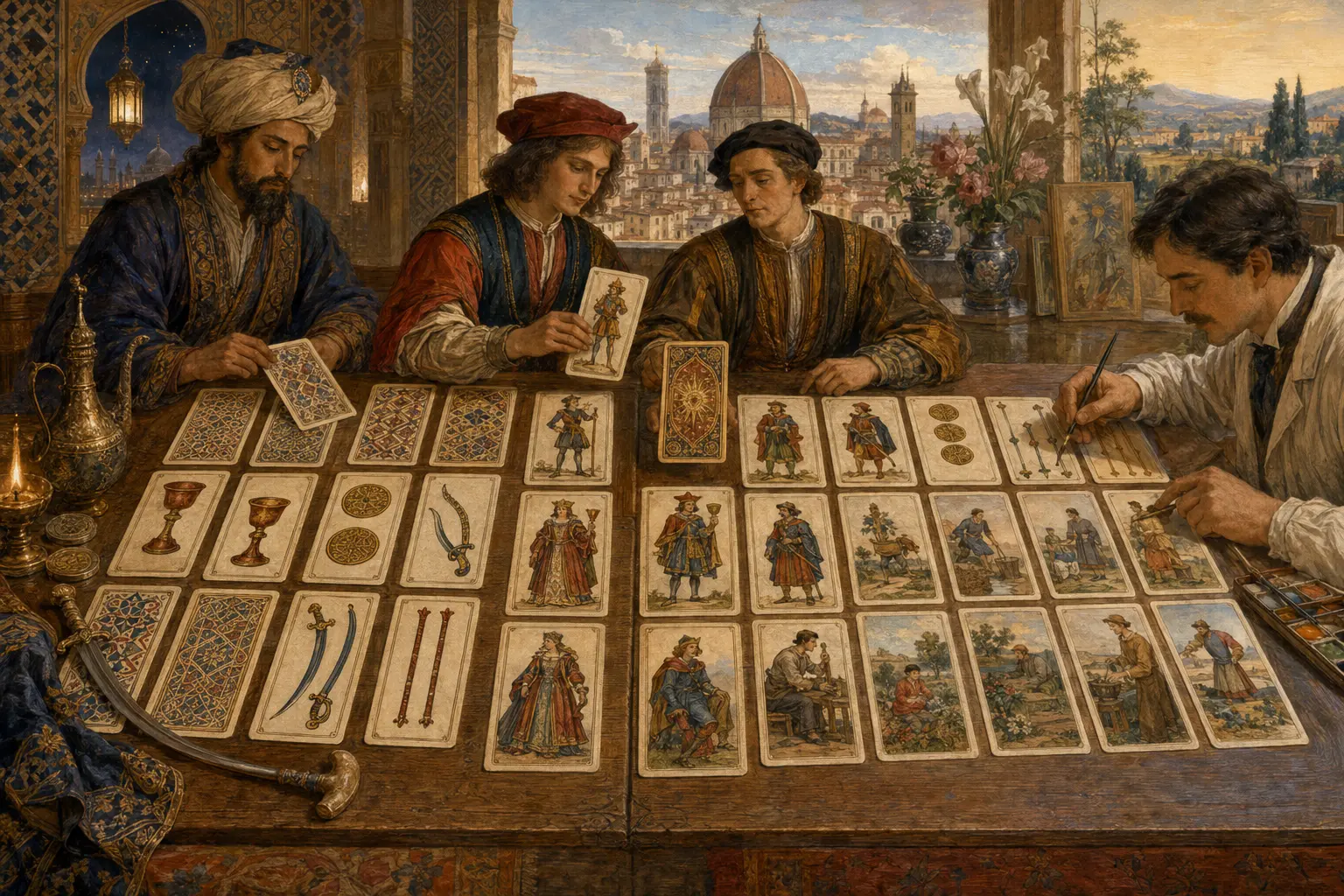
The Major Arcana receives most of the attention. The Fool steps toward a cliff. Death rides through a fallen kingdom. The Tower splits under a flash of light. Beside those images, a card with six cups or eight coins can seem modest.
Yet the Minor Arcana carries the older structure. Its four suits belong to the long history of playing cards, a history that crosses the Islamic world, Mediterranean trade routes, Italian courts, French print shops and the London studio where Pamela Colman Smith gave each numbered card a human scene.
The short answer: the Minor Arcana grew from four-suit playing cards that reached Europe before tarot existed. Italian tarot added trumps to that known structure in the fifteenth century. For hundreds of years, many numbered cards showed suit objects alone. In 1909, Smith's narrative scenes made the 56 cards far easier to read as a visual language of work, love, thought, conflict, choice and material life.
What is the Minor Arcana?
A standard tarot pack has 78 cards. Twenty-two are the trumps and The Fool, now called the Major Arcana. The other 56 form the Minor Arcana.
Each of its four suits contains 14 cards:
- Ten numbered cards, from Ace to Ten
- Four court cards, most often Page, Knight, Queen and King
The word minor can create the wrong impression. These cards are not weaker. They work at a different scale. The Major Arcana tends to frame a larger theme or turning point. The Minor Arcana shows how that theme enters a conversation, a budget, a desire, a decision or a day at work.
Before tarot: the Islamic card connection
The full origin of playing cards remains hard to pin to one place. Card games existed in Asia before they reached the Mediterranean, and many objects were lost because paper does not survive with ease. What the evidence does show is a strong link between Islamic packs and the suit system adopted in southern Europe.
The best-known surviving example is the Mamluk pack held at Topkapı Palace Museum in Istanbul. It dates from around the fifteenth or start of the sixteenth century, though the card tradition behind it must be older. The pack was designed around four suits:
- Cups
- Coins
- Swords
- Polo sticks
Each suit had ten numeral cards and three rank cards: a king, a deputy and a second deputy. The cards did not show portrait figures. Rank was conveyed through inscriptions, suit emblems and dense geometric ornament. That design reflects an aniconic artistic choice, but it is too broad to say that all Islamic art banned the human figure. Figurative art existed in many nonreligious settings across the Islamic world.
The resemblance to the later Latin suits is hard to miss. Cups, coins and swords pass across with little change. Polo was not part of life in most of Europe, so the polo sticks became batons, clubs or wands. Historians still debate the exact routes and stages of transfer. The safest conclusion is not that one surviving pack gave birth to every European deck. It is that the Topkapı cards preserve a close relative of the card culture from which key European suit forms emerged.
Cards arrive in Europe before tarot
Written records place playing cards in Europe in the late fourteenth century. They appear in Italy, Spain, France and other regions within a short span. Trade, travel and contact across the Mediterranean gave games many routes into new cities.
Europe did not receive one fixed pack and keep it unchanged. Card makers adapted rank names, emblems, costume and style for their own markets. Human figures appeared on court cards. In the Latin suit tradition, the four emblems became cups, coins, swords and batons. Regional packs did not always use the same number of court cards or the same ranks.
The four suits came before tarot. Tarot began when card makers placed a new group of picture trumps beside them.
This point matters because it reverses a common claim. Standard playing cards are not a tarot deck with 26 cards removed. The four-suit pack was already present. Tarot and later French-suited packs grew as branches from the wider family of European card games.
The Italian addition that created tarot
In northern Italy during the fifteenth century, makers added a run of painted triumphs to the four suits. These extra cards acted as trumps in a game first known as trionfi. A Fool stood apart from the numbered trumps. With time, this family of games became known as tarocchi or tarot.
The suit section now contained 56 cards because Italian tarot used four court ranks: King, Queen, Knight and Knave or Page. The triumphs did not replace the older suits. They sat above them in play. A deck that had once described rank and number now held emperors, virtues, fortune, death, stars and other images drawn from Renaissance culture.
These costly hand-painted packs belonged at first to elite patrons. Print then allowed card games to reach a wider public. For centuries, tarot remained above all a game. The names Major Arcana and Minor Arcana came from later occult thought, not from the first Italian players. For the larger timeline, read the full history of tarot.
How the familiar 52-card deck fits the story
As card making spread, Europe produced several suit systems. France adopted hearts, diamonds, clubs and spades around the late fifteenth century. Their flat, distinct shapes were well suited to stencil work and print production. Court ranks were often reduced to King, Queen and Jack, which gave four suits of 13 cards and a total of 52.
That is the direct structure behind many modern packs used for poker, bridge and other games. It stands beside tarot, not inside it. Both preserve four suits and numbered ranks, but tarot kept the Italian suit line in much of its imagery and added a fourth court rank plus the trumps and Fool.
The suit correspondences are not exact translations. Hearts resemble Cups, but a modern tarot reader should not assume that every historic game assigned emotion to hearts or thought to swords. The elemental system belongs to later esoteric tarot traditions.
For centuries, the pip cards were not little stories
Look at a traditional Tarot de Marseille Six of Cups and you will see six cups arranged in a formal pattern. A Ten of Swords shows ten swords. These are called pip cards because the suit emblems carry the number, much as ten diamonds mark a modern playing card.
This did not make the cards empty or dull. Pattern, color, number and suit could all carry meaning. Readers who used tarot for divination in the eighteenth and nineteenth centuries developed lists, number systems and suit associations. A reader could know that a Three of Cups meant one thing and a Seven of Swords another without needing a scene on the card.
Still, pip decks ask more from memory. The image does not stage the interpretation for you. You meet six cups and must bring number, element, tradition, question and card position into one thought.
1909: Pamela Colman Smith gives the pips a human world
The turning point came with the deck created by artist Pamela Colman Smith and writer A. E. Waite, first published in 1909. It is now called the Rider-Waite-Smith deck, a name that restores Smith's role to the title.
Smith illustrated the numbered suit cards with full scenes. The Six of Cups became an exchange between figures in a flower-filled space. The Eight of Pentacles became a craftsperson at a bench. The Three of Cups became a shared celebration. Instead of asking the reader to recall an entry from a list, each card opened a small human event.
Smith did not invent every meaning from nothing. She worked within an esoteric system shaped by Waite, the Hermetic Order of the Golden Dawn, earlier cartomancy and her own visual mind. Her achievement was translation. Number, suit and occult meaning became gesture, posture, landscape, weather, distance and relationship.
That choice changed how tarot could be learned. The reader could notice who turns away, who reaches out, what is guarded and what remains unfinished. Modern deck artists still return to this visual grammar, even when they change the setting, identity, culture or mood.
What the four suits mean in modern tarot
Many readers now connect each suit with an element and a field of experience. These links are useful, but they are interpretive traditions rather than one unchanged code from the Mamluk world.
- Wands and fire: drive, desire, work, courage, movement and creative force
- Cups and water: emotion, love, bonds, imagination, memory and intuition
- Swords and air: thought, speech, truth, tension, judgment and decision
- Pentacles and earth: money, labor, the body, home, skill, resources and security
A suit is not one keyword. Cups can show grief as well as love. Pentacles can show lack as well as wealth. Wands can burn out or lose direction. Swords can cut, but they can also name a fact that sets a person free. The practical guide to the four elements in tarot shows how to use these correspondences without memorizing 56 separate meanings.
How history can make you a stronger reader
Knowing this history removes the pressure to treat every image as a fixed sacred code. The cards have always changed as they crossed borders, workshops and belief systems. Their power comes in part from that long act of adaptation.
- Start with the suit. Name the field of life before you search for a detailed message.
- Read the number or rank. An Ace begins. A Ten reaches a limit or completion. A court card brings role, stance or social energy.
- Study the scene. In an illustrated deck, notice action, gaze, distance and setting.
- Check the spread position. The same card changes when it names a desire, obstacle, resource or next step.
- Connect the cards. Use repeated suits and movement across the spread to build one account. The guide to reading card combinations gives a full method.
You can also study one pip card beside a Marseille version. First read the suit and number without a scene. Then place the Rider-Waite-Smith image beside it. Notice what Smith adds and what the older card leaves open. That gap is where your own reading skill grows.
The everyday cards were never small
The Minor Arcana began long before anyone used that name. Its bones belong to play: four suits, number, rank, chance and strategy. Tarot added another layer. Occult readers added correspondences. Pamela Colman Smith added a stage on which ordinary human life could move.
That history explains why the 56 cards feel both familiar and deep. They share ancestry with the pack in a kitchen drawer, yet they can hold a whole week of choices. The grand archetype may name the chapter. The Minor Arcana tells us what happens on Tuesday morning, what is said at the table and what choice waits when the door closes.
Bring the four suits into your own story
A personal reading can show which suit dominates your present question, where energy is missing and how the cards connect across real events and choices.
Explore personal readingsMinor Arcana history: quick answers
Where did the Minor Arcana come from?
Their four-suit structure belongs to the wider history of playing cards. Mamluk packs from the Islamic world offer a close parallel to the Latin suits that appeared in Europe before tarot trumps were added in fifteenth-century Italy.
Did ordinary playing cards come from tarot?
No. Four-suit playing cards existed in Europe before tarot. Tarot added a set of trumps and one Fool to a suit structure that players already knew. French-suited packs and tarot then developed along related but separate paths.
What did Pamela Colman Smith change in the Minor Arcana?
She gave the numbered suit cards full narrative scenes in the Rider-Waite-Smith deck. The scenes turned abstract numbers and suit objects into human moments that readers could connect and remember.
What are the four Minor Arcana suits?
The four suits are Wands, Cups, Swords and Pentacles. In many modern systems they connect with fire and action, water and emotion, air and thought, and earth and material life.
Sources and further reading
- Victoria and Albert Museum: A history of tarot cards
- The Metropolitan Museum of Art: The World in Play
- The World of Playing Cards: Mamluk playing cards
- A. E. Waite: The Pictorial Key to the Tarot
Tarot can support reflection and personal insight. It does not prove facts, guarantee events or replace medical, legal or financial advice.