A tarot trick is useful only when it makes the reading clearer. It should help you see a relationship between cards, test an interpretation or notice a pattern that a list of keywords would miss.
The eleven techniques below work with almost any deck. They are small enough to try tonight and flexible enough to become part of your regular method.
Before trying a new technique
Read the spread once through its written positions. Then add one technique as a second layer. Counting suits, following visual direction and tracking numbers should refine the answer, not pull it away from the original question.
1. Use an anchor card to read what comes before and after
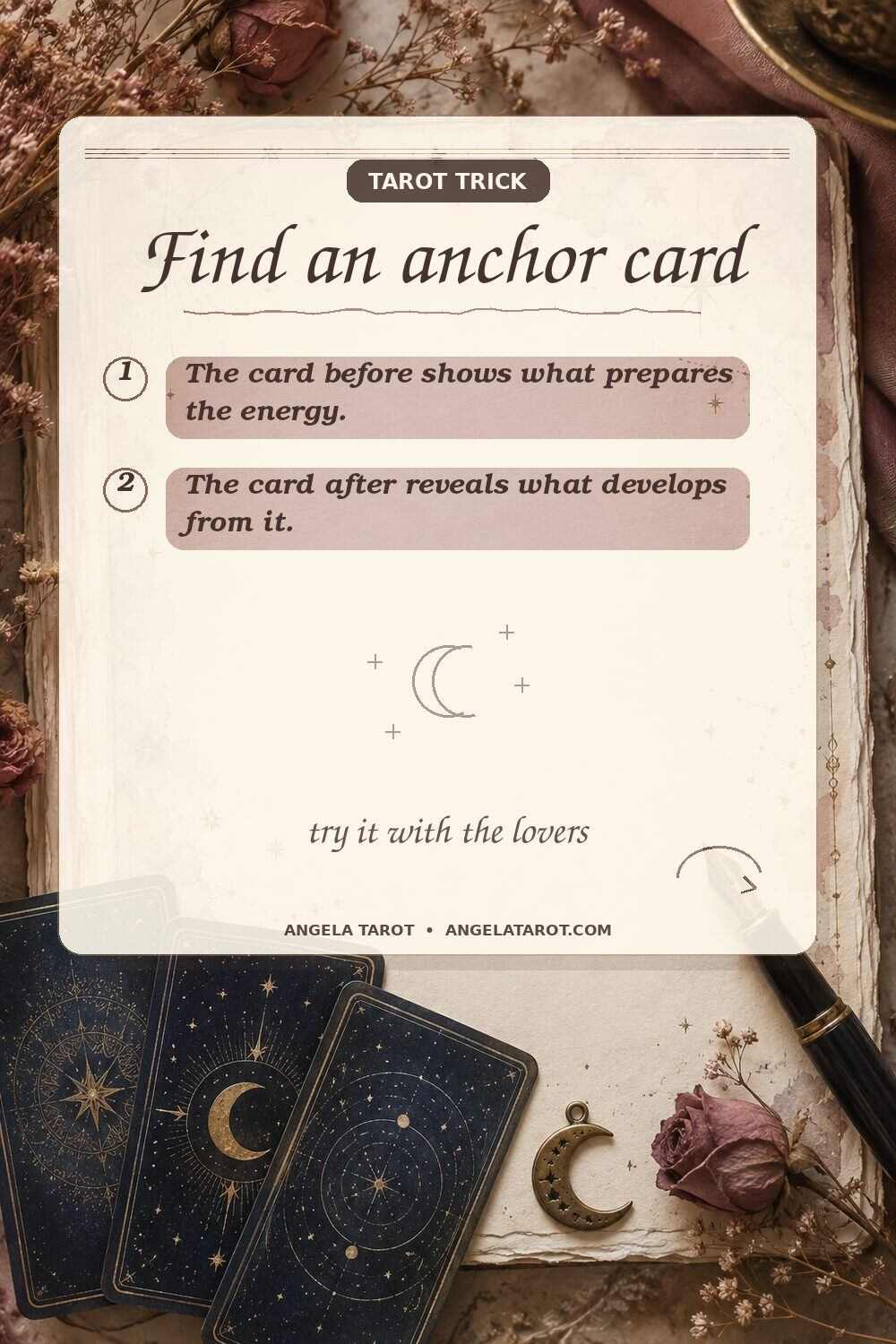
Choose one card connected with the question, find it inside a freshly shuffled deck and look at its neighbors. The card before can describe what prepares the energy. The card after can show what develops from it. This is a creative deck exercise, not a fixed historical rule, so test the result against the full situation.
Try it: Try it with The Lovers, Death or The Sun. Write the three cards as one sentence instead of three separate meanings.
2. Follow the direction the figures are facing
Figures often look toward, move toward or turn away from another card. A Queen facing a Page may show attention moving toward a message or younger energy. A Knight riding away from a Four of Cups may show movement away from emotional stagnation. Direction adds relationship between the images.
Try it: Lay three cards in a line. Note who looks left, right or straight ahead before opening a guidebook.
3. Read the first and last card as the frame
In a multi-card spread, the opening card introduces the condition and the final card reveals where the reading lands. Compare them before interpreting every detail. The middle cards then become the bridge between the beginning and the direction of travel.
Try it: Complete this sentence: The reading begins with ___, moves through ___ and ends with ___.
4. Count the dominant suit
Several cards from one suit can reveal the language of the reading. Cups emphasize feeling and relationship. Swords bring thought, conflict or communication. Wands bring desire and momentum. Pentacles bring time, resources, work and the material world. A dominant suit tells you where the question is actually living.
Try it: Count the suits after the first interpretation. Use the result to refine the story, not replace it.
5. Notice the suit that is missing
Absence can be as useful as repetition. A love spread with no Cups may be organized around communication, attraction or practical conditions rather than emotional exchange. A career spread with no Pentacles may contain ambition without enough structure. Missing suits are clues, not automatic problems.
Try it: Ask what quality would make the spread more complete, then look for a real-world way to bring it in.
6. Track repeating numbers
Repeated numbers create a rhythm across different suits. Twos may emphasize choice, polarity or relationship. Fives can show instability and adjustment. Eights often bring movement, skill or restriction depending on the suit. Repetition matters because the same stage of development is appearing in several areas.
Try it: Circle repeated numbers in your journal and write one shared theme beside them.
7. Turn the cards into a sentence
Give every card a role. The first card can be the subject, the second the action and the third the direction or result. This prevents a reading from becoming a list of disconnected definitions. Grammar is only a prompt, but it teaches the mind to connect images.
Try it: For three cards, write: Because of Card One, Card Two is happening, which leads toward Card Three.
8. Compare the action level of the cards
Some cards wait, some observe and some move. The Hermit withdraws. The Chariot advances. Four of Swords rests. Eight of Wands accelerates. When the action levels conflict, the spread may be describing a change of pace or tension between readiness and movement.
Try it: Rank the cards from stillest to most active. Ask where the reading changes speed.
9. Use one clarifier with one exact job
A clarifier should answer a precise question about one unclear card. It should not restart the entire reading. If Justice appears as advice, you might ask which part of Justice matters here. Pulling several cards because the first answer feels uncomfortable usually makes the message harder to evaluate.
Try it: Write the clarifying question before touching the deck again.
10. Read a Court card as person, energy or situation
A Court card may describe someone, a way of behaving or the role the situation requires. Page of Swords can be a curious person, the energy of investigation or a conversation based on incomplete facts. Context decides which level is most useful.
Try it: Ask whether a literal person is already visible. If not, read the Court as a role or approach first.
11. Return to the reading after real life has moved
An interpretation made immediately after drawing is only the first layer. Revisit the spread after a day, a week or the event itself. You will see which cards were literal, which described your response and which carried a wider theme than you first noticed.
Try it: Date every reading and add a short follow-up note instead of rewriting the original interpretation.
Use one trick at a time
Choose the technique that matches the spread. Visual direction works well with figures. Suit dominance works in larger layouts. The first-and-last frame works when the reading has a clear sequence. You do not need to apply all eleven to every question.
Continue with 15 tarot tips for beginners, then use the card-combination method to turn separate meanings into a coherent story.
Go deeper with repeating tarot cards and patterns, missing suits and the bottom card technique.
Tarot can support reflection and symbolic exploration. It cannot verify private facts, guarantee outcomes or replace medical, legal, financial or mental health guidance.
Pinterest tip library
Save 6 different tips
Each image contains a separate technique or checklist and saves this article as its source.
Find an anchor card
Save this Pin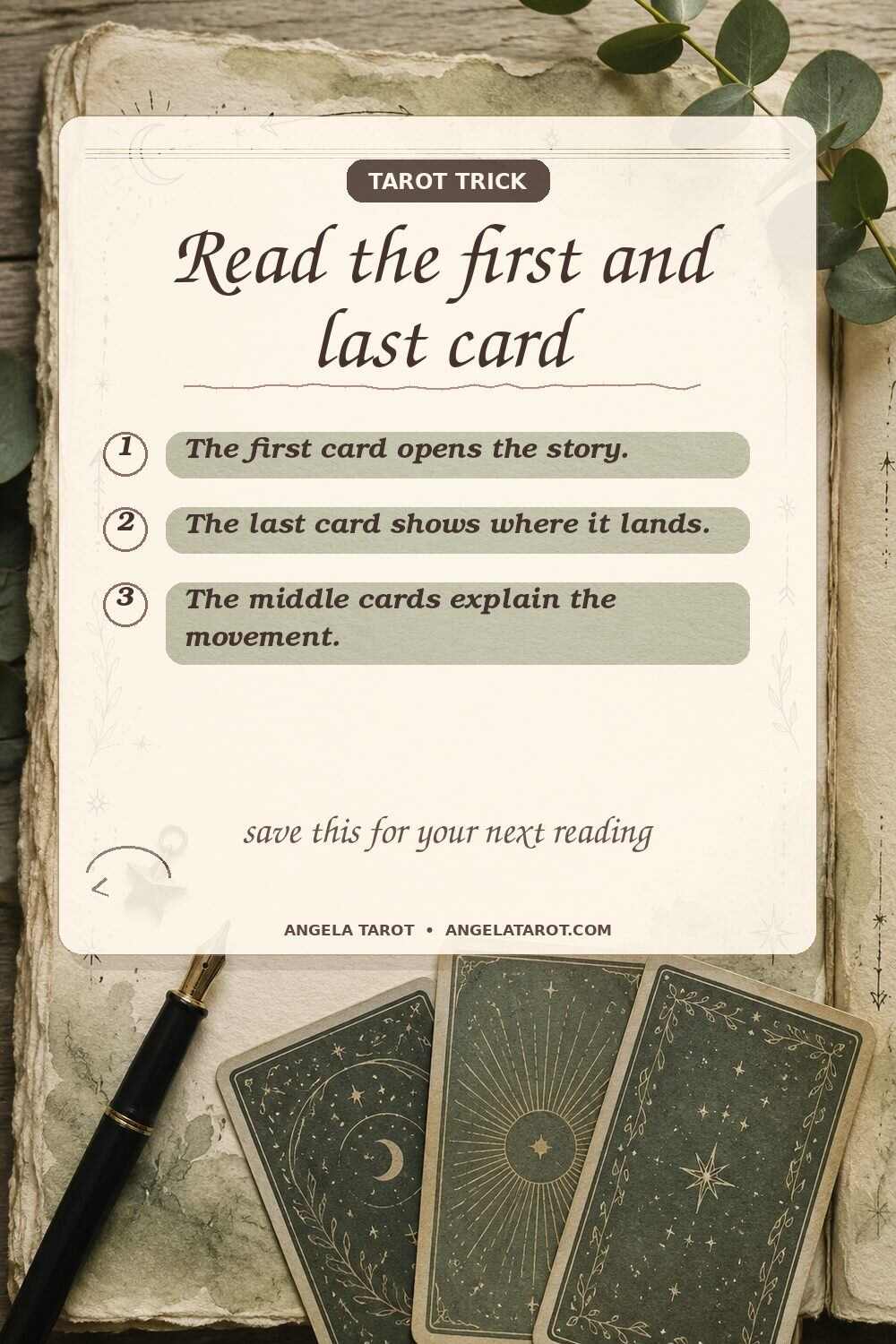
Read the first and last card
Save this Pin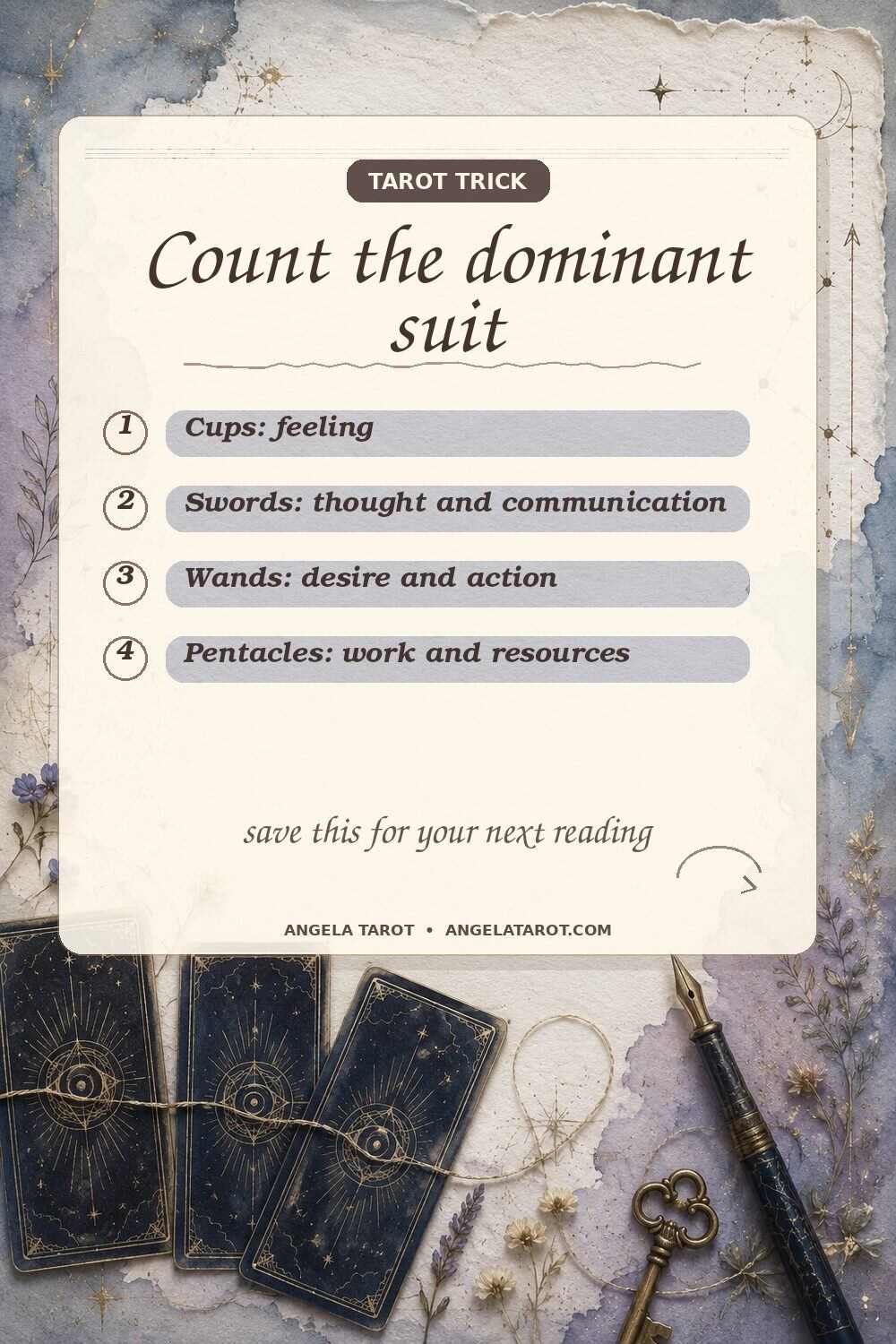
Count the dominant suit
Save this Pin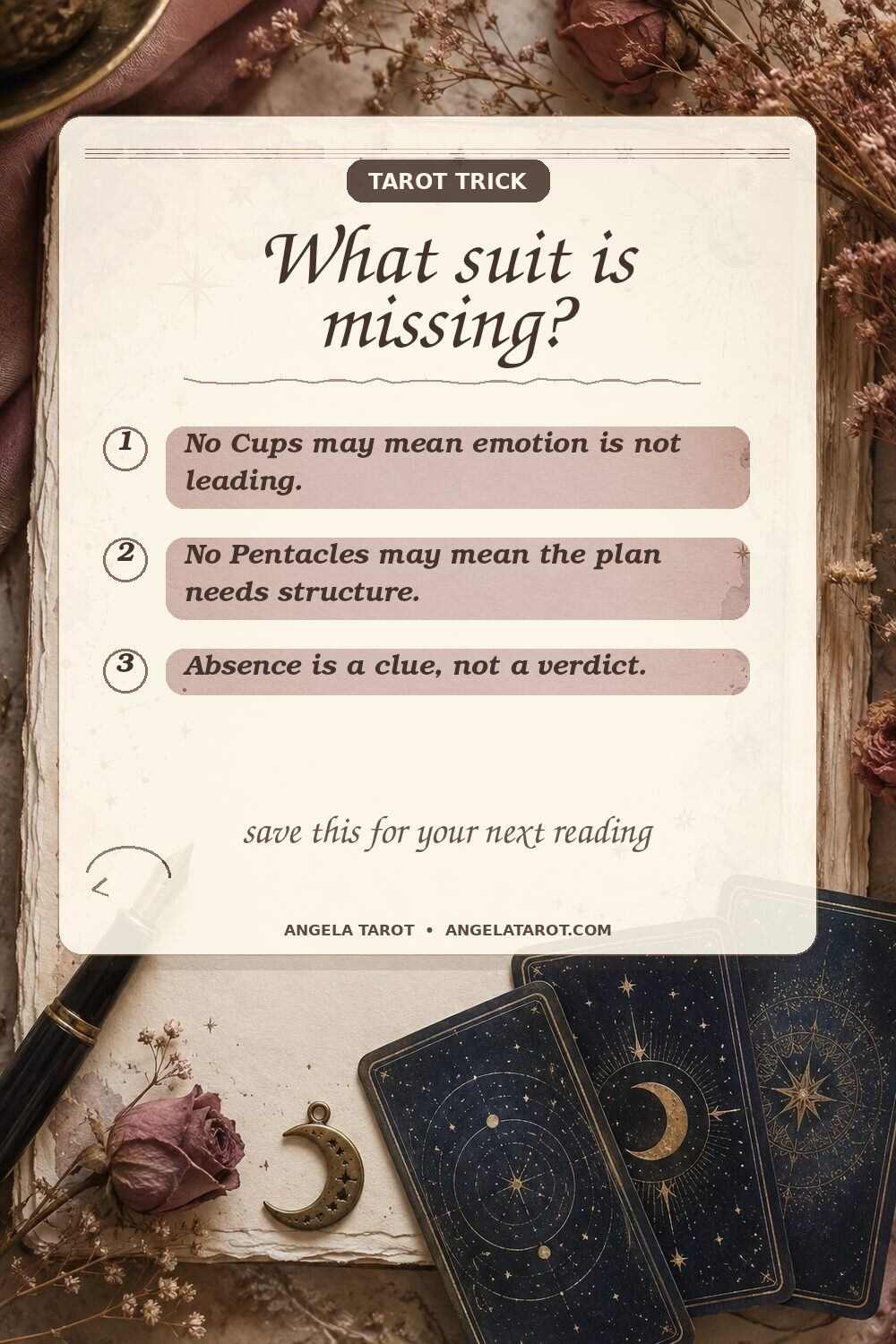
What suit is missing?
Save this Pin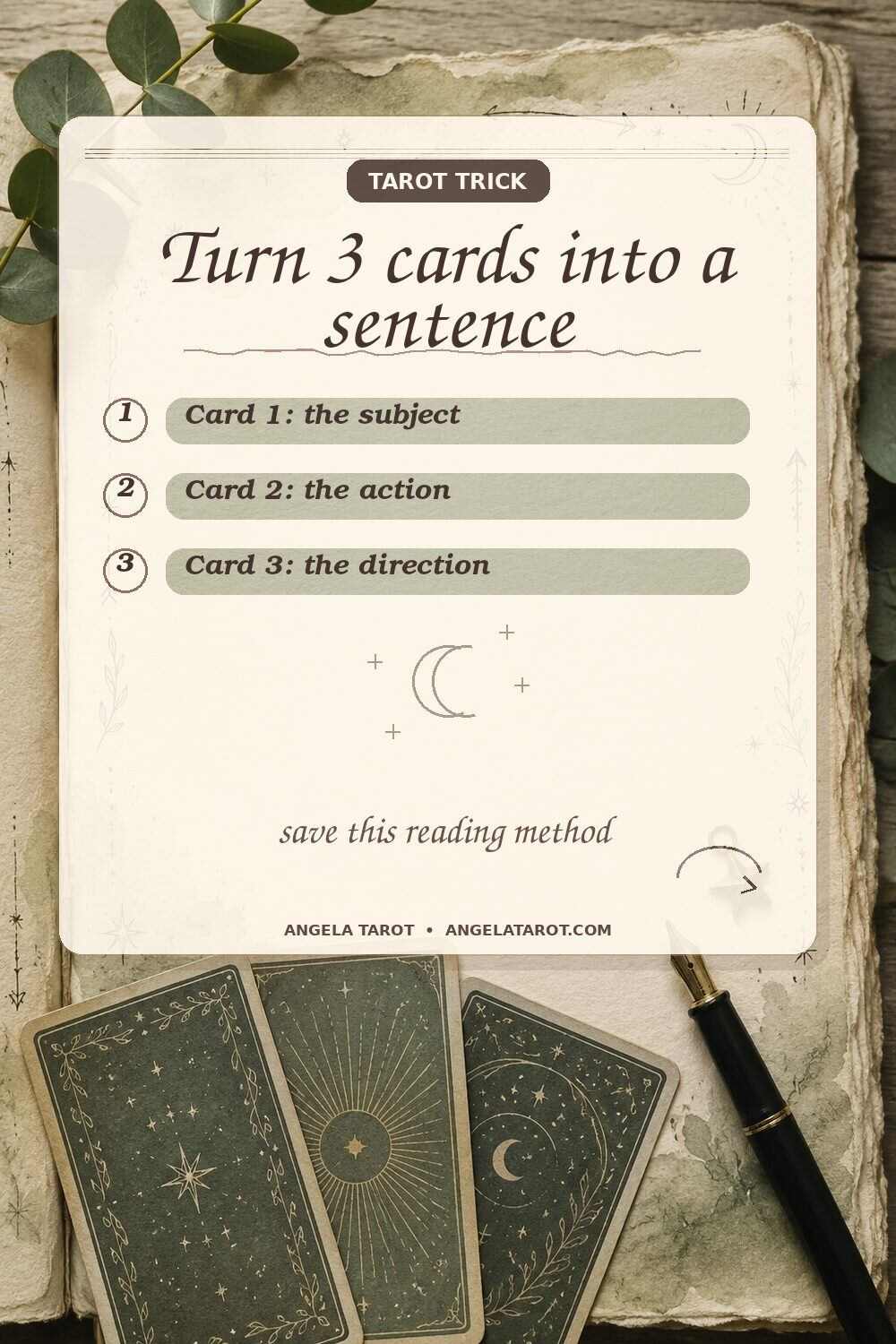
Turn 3 cards into a sentence
Save this Pin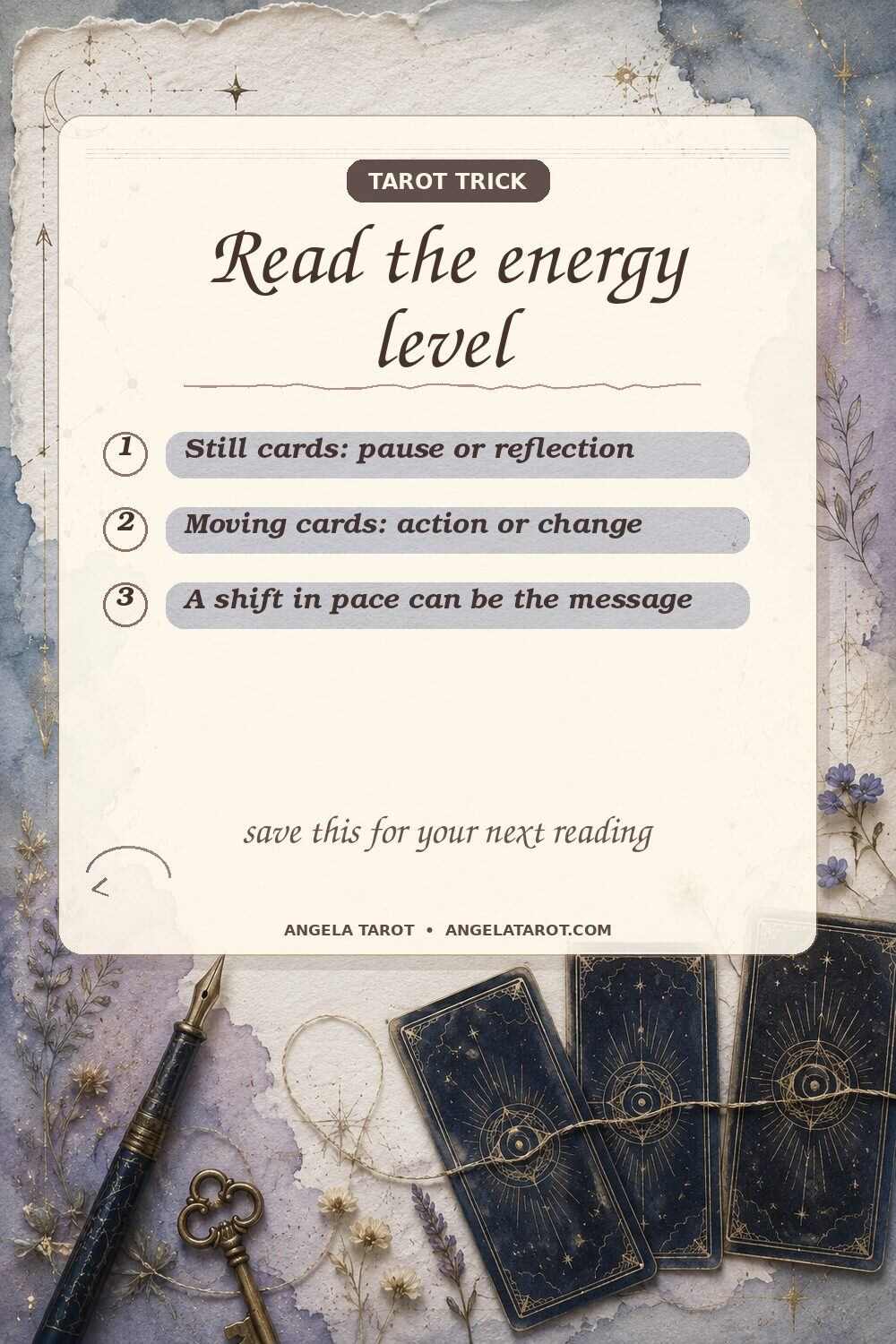
Read the energy level
Save this PinBring the method into your own reading
A personal reading can connect the cards with the relationship, decision or direction that matters most to you.
Explore personal readingsQuick answers
What is the best tarot trick for clearer readings?
Turn the cards into one sentence. It forces you to connect the images instead of listing separate definitions.
Does the card before and after method always work?
It is a creative deck exercise, not a fixed rule. Use it to explore a pattern, then test the interpretation against the question and real situation.
How do I know which suit dominates a reading?
Count Cups, Swords, Wands and Pentacles after the first interpretation. The most frequent suit often shows where the question is concentrated.
Should I read a missing suit?
You can treat it as a clue about an underrepresented quality, but absence is not automatically a warning.
How many clarifier cards should I pull?
One is usually enough when you can state exactly what needs clarification.