A tarot spread is not a row of separate dictionary entries. The answer lives in the movement between the cards.
Reading cards together means keeping the spread positions clear, then noticing how the images, suits, numbers and actions support or challenge each other. The method below can be used with three cards or a larger layout.
The seven-step combination method
- Say the question and positions.
- Describe each image without interpretation.
- Notice visual direction and action.
- Compare suits and elements.
- Track numbers, ranks and repetition.
- Use the middle or connecting card as a bridge.
- Write one sentence that contains the whole spread.
1. Start with the positions
Before combining symbolism, say what each position asks. A card in “what I know” and a card in “what is missing” already have a relationship.
Try it: Read position plus card aloud.
2. Find the visual conversation
Notice whether figures face each other, turn away, move toward the future side of the spread or remain still. Images create action between definitions.
Try it: Describe the scene as if it were one picture.
3. Compare suits and elements
Cups and Pentacles can ground feeling into something tangible. Wands and Swords may create fast, heated movement. Elemental harmony or friction is a second layer, not a fixed verdict.
Try it: Name what each suit brings to the exchange.
4. Track number progression
Two, Three and Four can show development. Ten followed by Ace can show completion opening into a new cycle. Reversed numerical movement may show review or return.
Try it: Look for sequence before interpreting isolated numbers.
5. Use the middle card as a bridge
In three-card readings, Card Two often explains how the beginning becomes the direction. It may be the action, obstacle or turning point.
Try it: Ask what changes because of the middle card.
6. Read the first and last card as a pair
The outer cards frame the whole reading. Compare their element, action, openness and emotional tone. The middle shows what connects them.
Try it: Summarize the movement from first to last.
7. Notice repetition
Repeated suits, numbers, colors, symbols or Court ranks tell you which theme insists on being seen. Repetition creates emphasis across different positions.
Try it: Circle the pattern in your notes.
8. Name the contrast
A still card beside a fast card, or a guarded card beside an open one, may show tension, timing or a change in approach. Contrast is part of the message.
Try it: Complete: One card wants ___, while the other wants ___.
9. Build one sentence
Use the cards as subject, action and direction. The sentence can be imperfect. Its purpose is to make the relationship visible.
Try it: Because of Card One, Card Two develops, leading toward Card Three.
10. Check the sentence against reality
A beautiful symbolic interpretation still needs to fit the question and the facts you have. If it requires unsupported assumptions, simplify it.
Try it: Separate what you know from what the cards are helping you explore.
A three-card example
Imagine Eight of Cups, The Hermit and The Star in past, present and future positions. Eight of Cups shows emotional departure. The Hermit slows the movement and turns it into reflection. The Star opens a future of renewal and a wider horizon.
Read separately, the cards mean departure, solitude and hope. Read together, the sentence becomes: leaving an emotionally incomplete situation creates a period of honest reflection that makes renewal possible.
Four useful combination patterns
| Pattern | What to notice | Example |
|---|---|---|
| Continuation | The second card develops the first | Ace of Pentacles + Eight of Pentacles |
| Contrast | The cards want different speeds or responses | Chariot + Four of Swords |
| Cause and effect | One condition creates another | Seven of Cups + Two of Swords |
| Completion and restart | A cycle closes and another opens | Ten of Wands + Ace of Wands |
Pair examples in context
Ace of Cups + Two of Cups: an emotional opening develops through mutual exchange. In an advice position, the pair may ask you to meet openness with reciprocity rather than projection.
The Tower + Ace of Pentacles: an unstable structure breaks, creating room for a more practical beginning. The Ace does not erase the disruption. It shows what can be built after reality becomes visible.
Death + Six of Swords: an ending is followed by transition away from the old condition. The pair emphasizes movement after completion, not a return to the previous form.
The Hermit + The Star: solitude, study or distance opens into renewal and a wider sense of direction. The hope of The Star grows from honest reflection rather than avoiding the present.
When cards contradict each other
Contradiction can be the message. The Chariot beside Four of Swords may show the tension between movement and rest. Queen of Cups beside Queen of Swords may ask you to combine emotional awareness with direct language. Name both needs before choosing which one the position emphasizes.
Practice with the 15 easy three-card layouts and add one technique from 11 tarot tricks.
Tarot combinations support interpretation and reflection. They cannot establish private facts, guarantee outcomes or replace professional guidance.
Pinterest tip library
Save 6 different tips
Each image contains a separate technique or checklist and saves this article as its source.
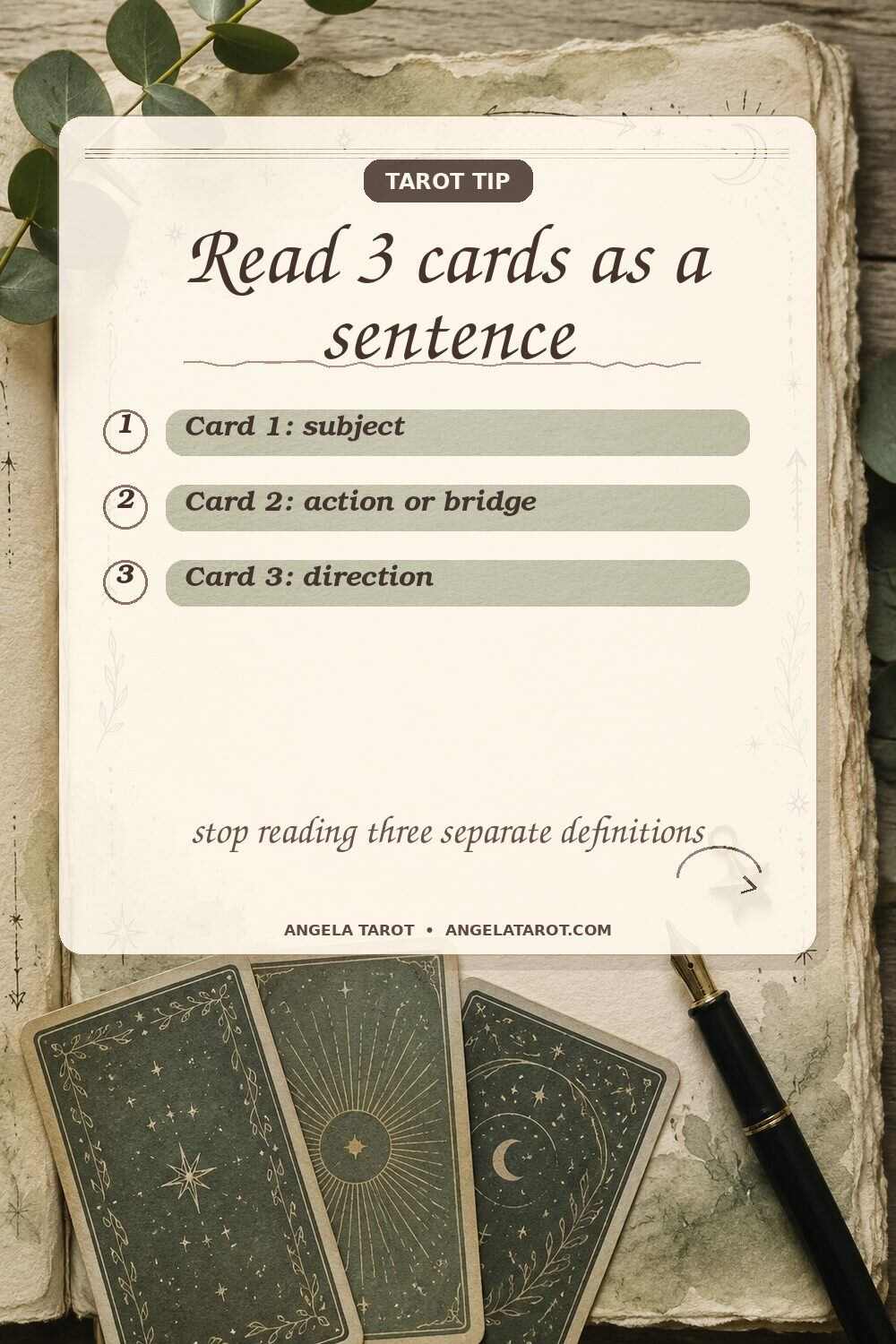
Read 3 cards as a sentence
Save this Pin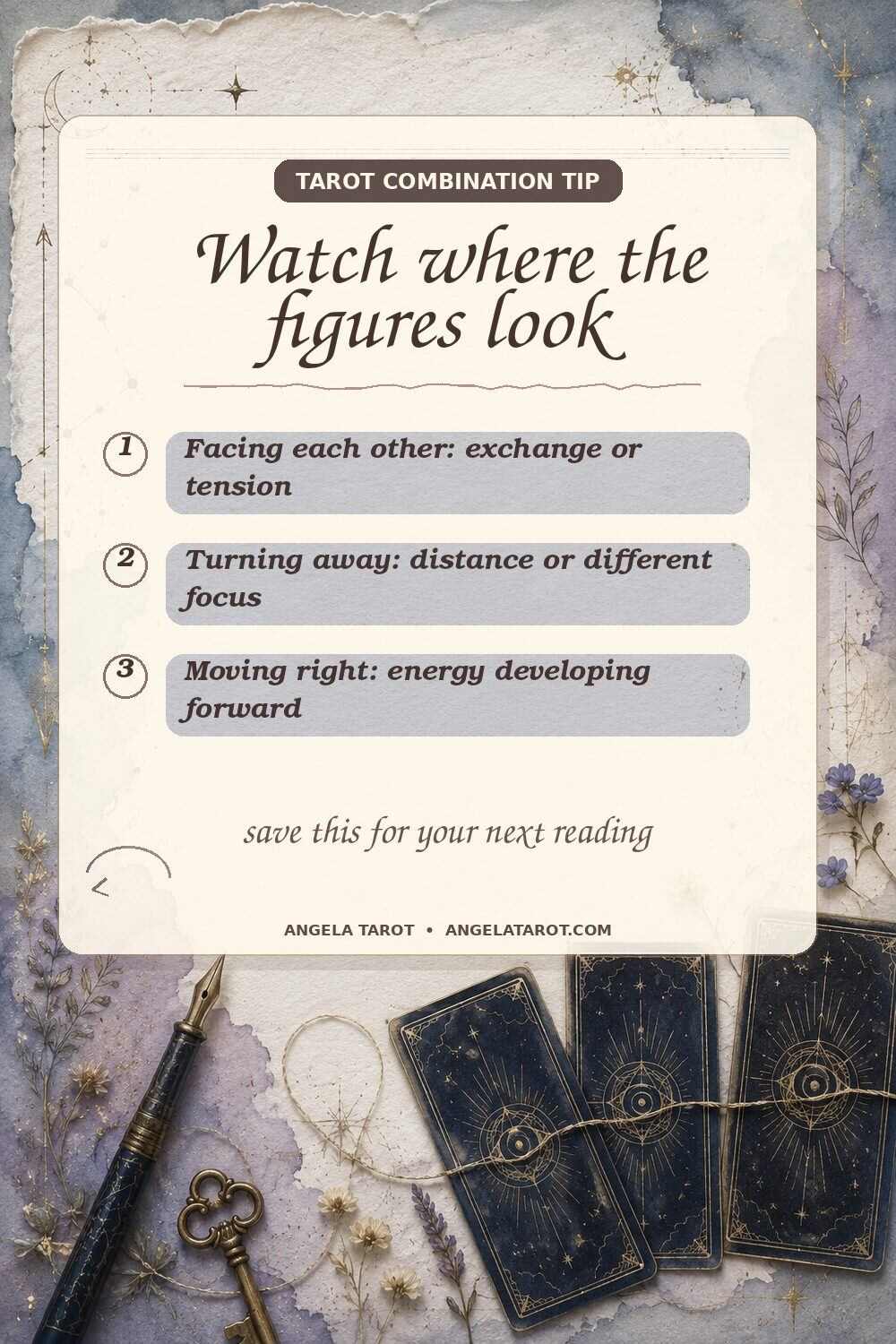
Watch where the figures look
Save this Pin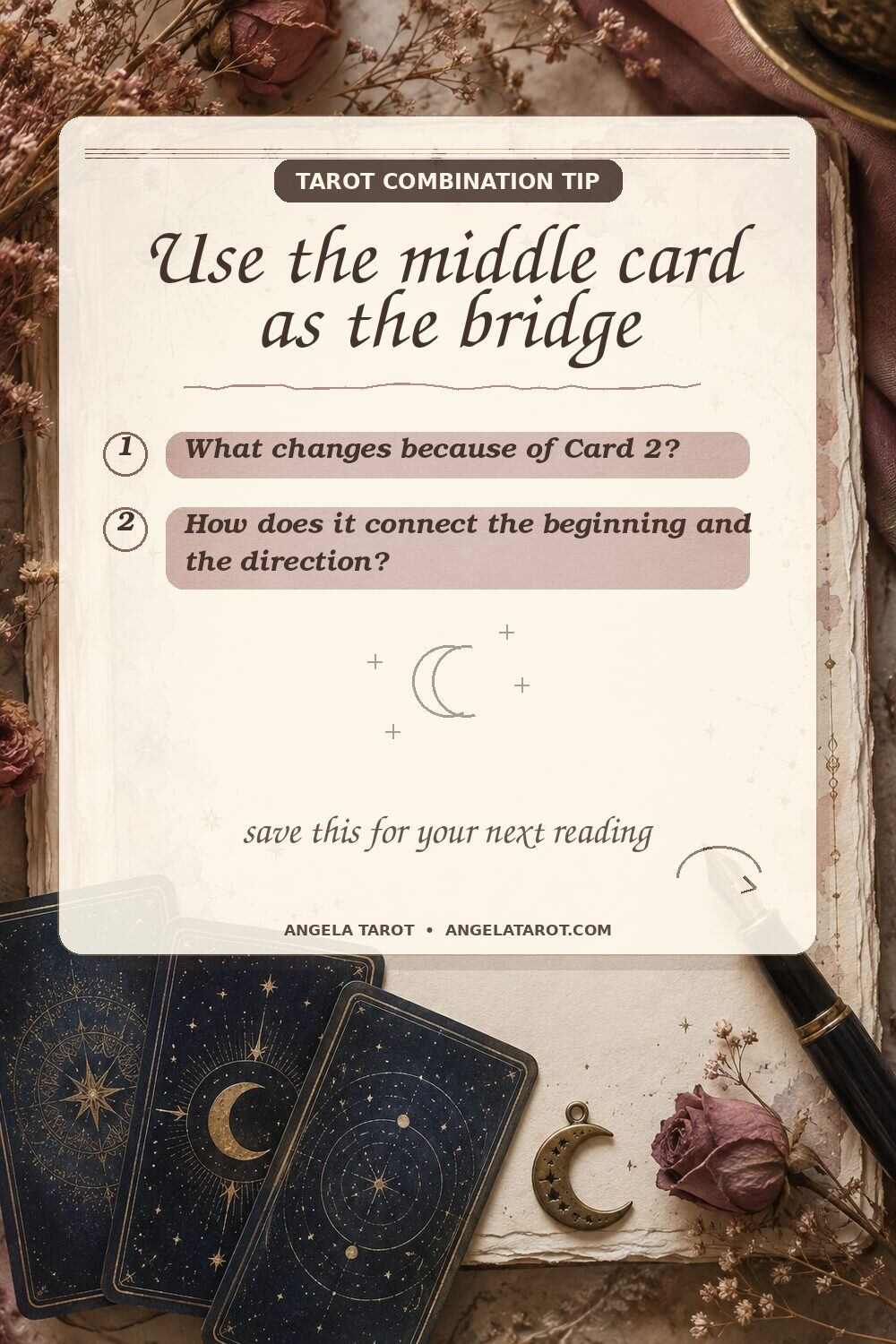
Use the middle card as the bridge
Save this Pin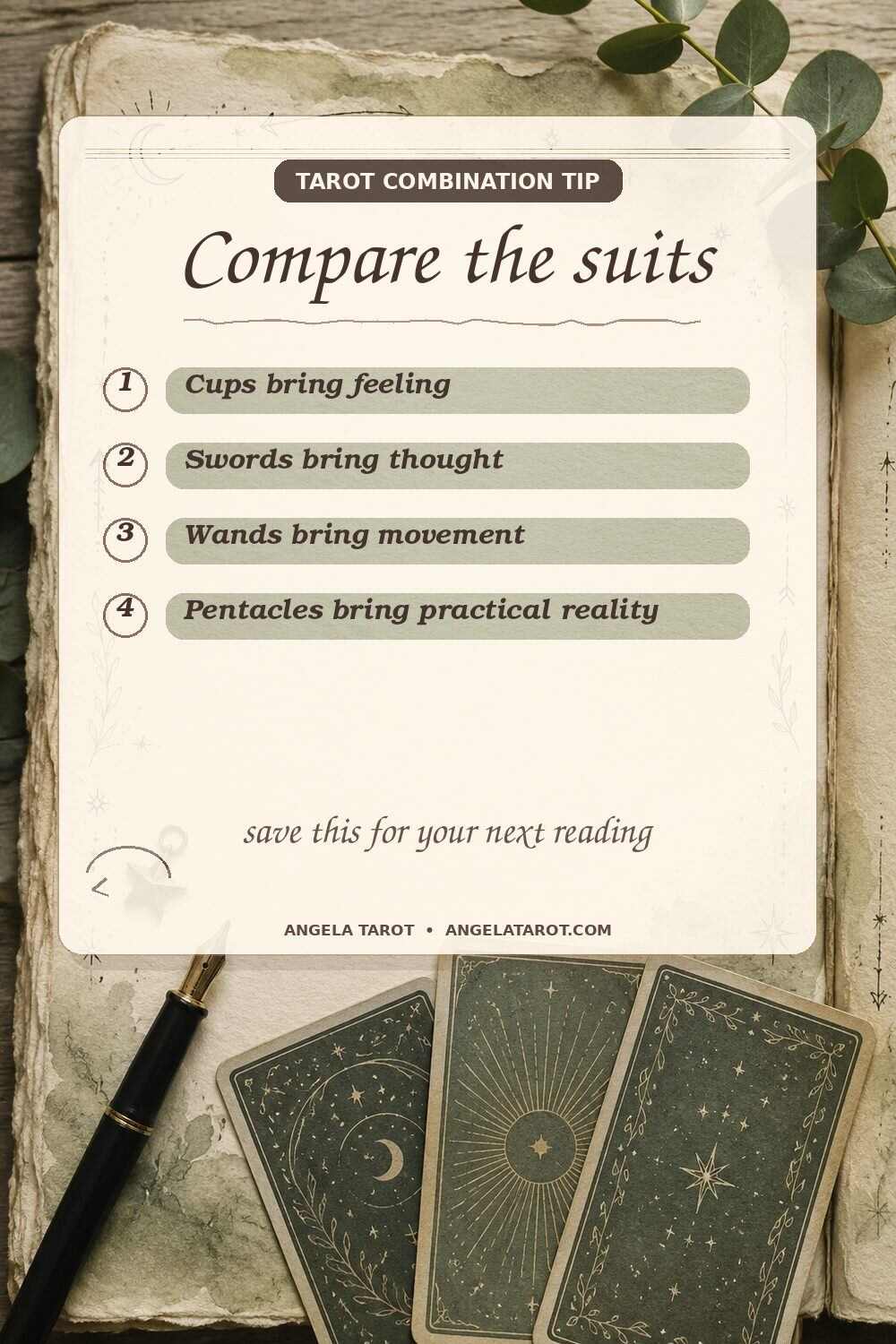
Compare the suits
Save this Pin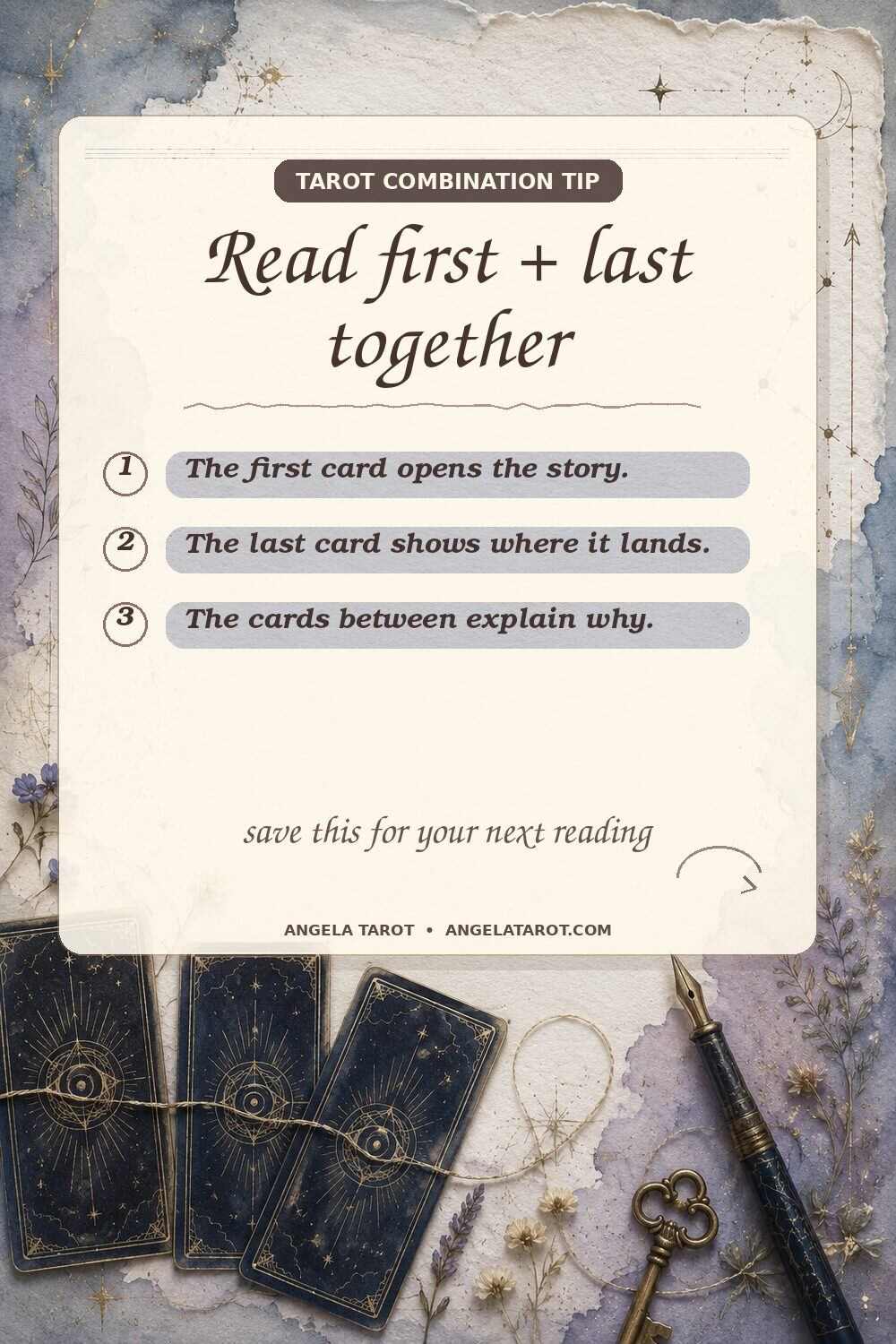
Read first + last together
Save this Pin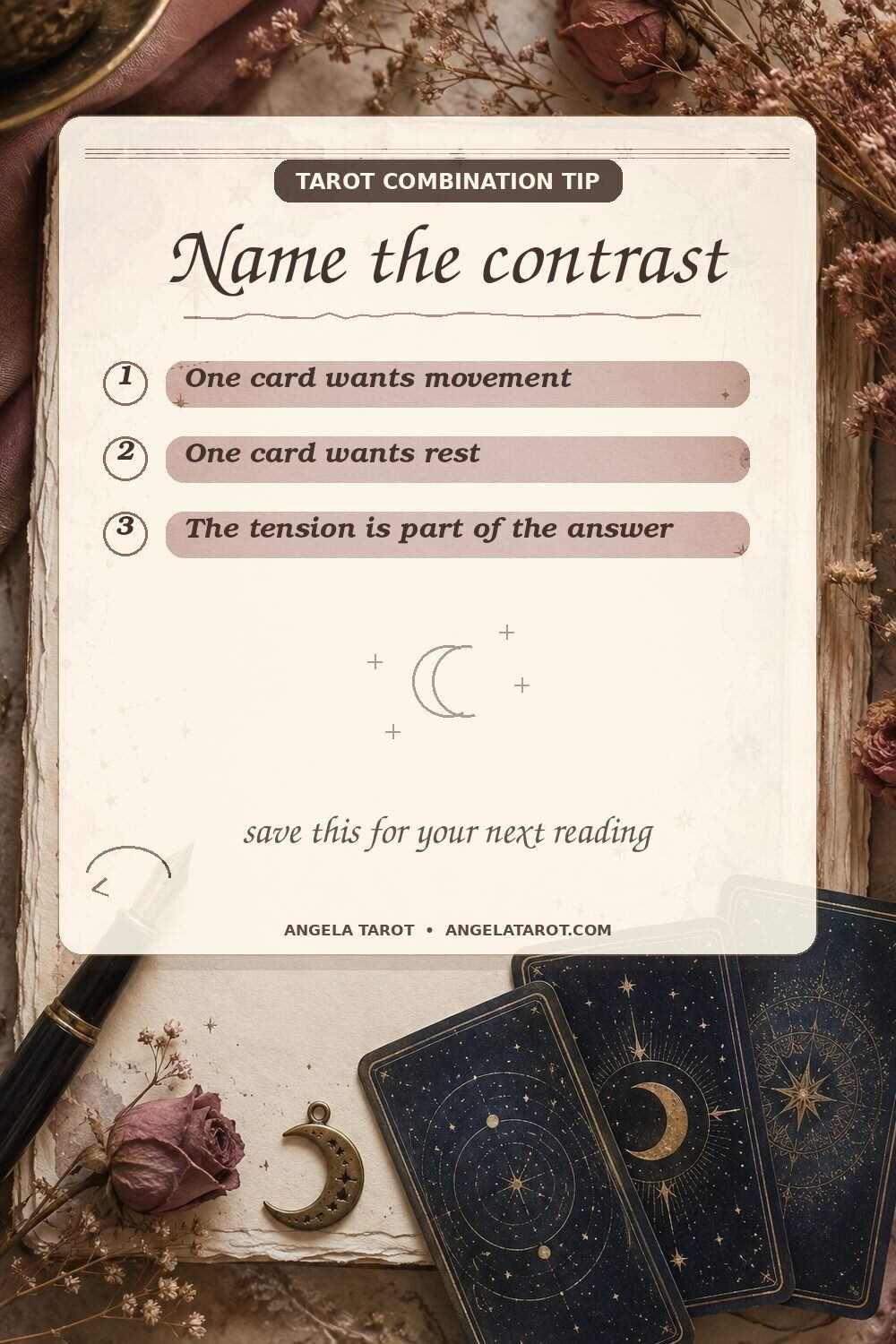
Name the contrast
Save this PinBring the method into your own reading
A personal reading can connect the cards with the relationship, decision or direction that matters most to you.
Explore personal readingsQuick answers
How do I connect tarot cards in a reading?
Start with the positions, notice the visual relationship and turn the cards into one sentence.
Which card is most important in a three-card spread?
The position decides. Often the middle card acts as the bridge between the beginning and direction.
Do tarot card combinations have fixed meanings?
Some pairings develop common themes, but the question and positions still determine the reading.
How do suits work together?
Suits show how emotion, thought, action and material conditions support or challenge each other.
What if the cards seem to contradict each other?
Name the contrast. It may describe tension, changing pace or two competing needs.