In this article
Seventy-eight cards can make a relaxing new interest feel like an exam. Add reversals, court cards, symbols, and four suits, and it is tempting to wait until you “know enough” to try a reading. You can begin earlier. A simple method and regular reflection teach you more than memorizing a list without context.
Learn the deck's basic map
A tarot deck has 22 Major Arcana cards and 56 Minor Arcana cards. The Major Arcana often speak to larger themes and transitions. The Minor Arcana show how themes appear in everyday situations.
The four suits offer useful starting points:
| Suit | Often points toward |
|---|---|
| Wands | Action, ambition, creativity, energy |
| Cups | Feelings, relationships, connection |
| Swords | Thoughts, communication, conflict, decisions |
| Pentacles | Work, money, resources, the physical world |
This is a map, not a rule that every card must follow in every reading. See the four elements in tarot when you want a deeper explanation.
Look at the image first
Before opening a guidebook, spend thirty seconds with the card. What is happening? Where is your eye drawn? Does the image suggest movement, waiting, exchange, or distance? Describe what you see in plain language. Then read a traditional meaning and ask how it relates to the question.
For example, The Hermit may prompt thoughts about solitude. In a question about a crowded schedule, you might read it as a need for quiet time. In a relationship question, it could describe space for reflection. The picture, question, and context work together.
Begin with one card and one good question
Try “What should I pay attention to today?” or “What could help me approach this conversation?” Pull one card. Write a sentence about what you notice and one possible action. You have completed a reading.
When one card feels comfortable, try three positions: situation, challenge, next step. Give each card a role before turning it over. The roles help you build a story instead of collecting three unrelated definitions. The site's guide to reading tarot cards as one story takes this further.
Use patterns to remember the Minor Arcana
Aces often suggest potential or a beginning. Twos can involve a choice, balance, or partnership. Threes may show development. Fours can reflect structure. Fives frequently bring friction or change. Tens often show a cycle reaching a turning point. Combine a number with its suit, then check the specific card image.
Court cards become easier when you think of Pages as learners, Knights as movers, Queens as expressions of mature qualities, and Kings as ways of directing or managing energy. These are prompts to investigate, not fixed labels for a person.
Leave reversals for later if you want
You can read an upright deck while learning the foundations. Reversed cards are an optional layer, not an entrance requirement. When you are ready, read how to interpret reversed tarot cards.
A seven-day beginner practice
- Day 1: Learn the Major and Minor Arcana and the four suits.
- Day 2: Pull one card and describe only what you see.
- Day 3: Ask an open question and compare your response with a guidebook.
- Day 4: Pull a card in the morning and revisit it at night.
- Day 5: Try a two-card reading: situation and helpful response.
- Day 6: Try a three-card reading: situation, challenge, next step.
- Day 7: Review your notes. Which symbols and questions taught you the most?
Do not redraw the same question repeatedly until you get a preferred card. If a reading is confusing, pause, check the wording of your question, and give yourself time.
Keep your own record
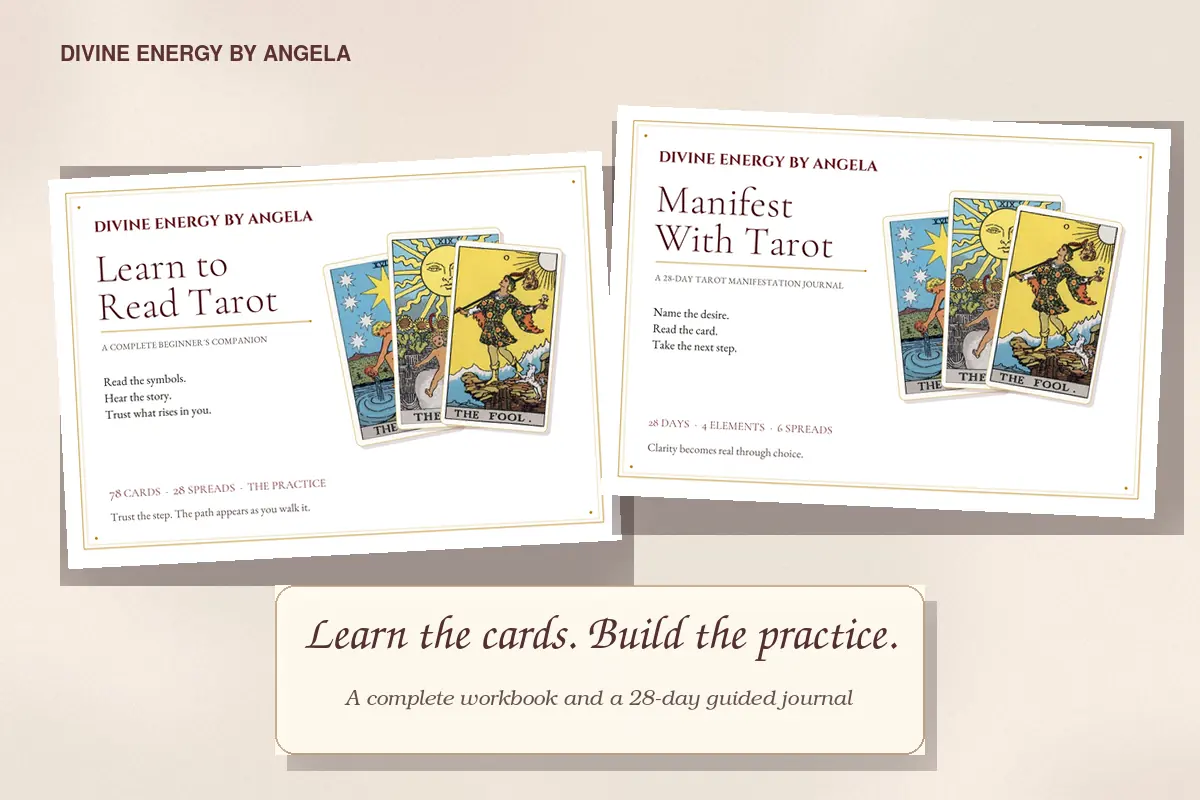
Write the date, question, cards, first impression, and a short follow-up. This makes your practice personal and helps you see how an interpretation holds up later. Continue with tarot journaling, or explore the Learn to Read Tarot Workbook and 28-Day Journal if you want a longer guided path.
You do not need to pass a test before you read. Learn the structure, stay curious about the image, and let experience deepen the meanings.
Explore the cards
Learn with Angela
Give your practice a little structure
Explore Learn to Read Tarot and the Manifest With Tarot journal for guided study, card practice and written reflection.
Explore the workbook and journal