In this article
A guidebook can give you a card's traditional meanings. A journal can show you how that card has appeared in your readings. Over time, you begin noticing repeated questions, symbols that catch your eye, interpretations that held up, and ones you would now change.
You need only a notebook or a document you can return to. A short, honest entry is more useful than a beautiful template you never fill in.
What to record
Start with the date, the exact question, and the cards in their positions. Write your first impression before checking a meaning. What do you see in each image? Which detail seems connected to your question? Then add any traditional meanings you want to consider and a short interpretation in context.
Finish with a possible next step and a date to revisit the reading. The follow-up matters because it separates a compelling first impression from what you later learned.
Copy this simple entry template
Date:
Question:
Cards and positions:
First impression:
Symbols I notice:
Traditional meanings to consider:
What feels relevant in context:
One possible action:
Follow-up date and notes:
You can use only the fields that help. For a first reading, two or three sentences are enough.
Try one daily card
In the morning, ask “What should I notice today?” Pull a card and write a short response. In the evening, return to the entry. Did you see the card's theme in a conversation, a decision, or your own reaction? Some days you may see no useful connection. Write that down too, rather than forcing a story after the fact.
If mornings are busy, the five-minute morning tarot routine gives this practice a simple structure.
Track repeating cards without jumping to conclusions
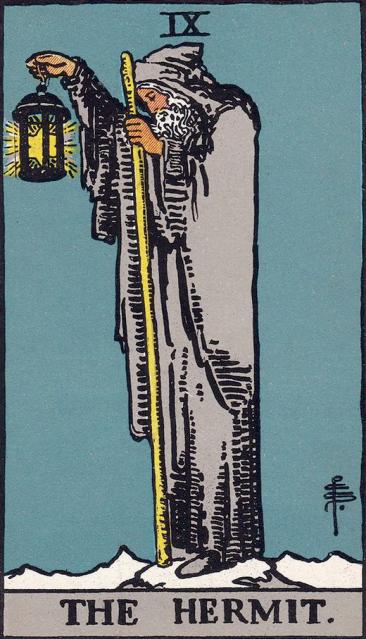
If The Hermit repeatedly appears, note the questions you asked and what was happening at the time. A repeated card might help you recognize a theme. It can also reflect repeatedly asking about the same concern. Observe the pattern before deciding what it means.
Consider keeping a page for each card. Add its traditional meanings, visual symbols, personal associations, and examples from your readings. This becomes your own reference over time.
Ask questions you can work with
“What will happen?” may leave you waiting for a verdict. “What am I overlooking?” or “What would help me make a clearer decision?” gives you something to explore. Tarot can support reflection while practical information remains part of the decision.
When a spread makes no sense, you can review the question and the role of each position before drawing more cards. See why a tarot spread can feel confusing.
Revisit important readings
A week or a month later, ask: What did I notice accurately? What did I assume? What information was missing? What meaning seems more useful now? You are allowed to revise an interpretation. That is how practice becomes learning.
At the end of a month, scan your entries for recurring cards, questions, and decisions. Notice changes in how you describe a card. Set one focus for the next month, such as asking clearer questions or practicing three-card readings.
Use a card as a writing prompt
You do not need a formal spread. Pull one card and ask what it reminds you of, what you resist in the image, and what embodying its most useful quality would look like today. For more questions, explore 100 spiritual journal prompts.
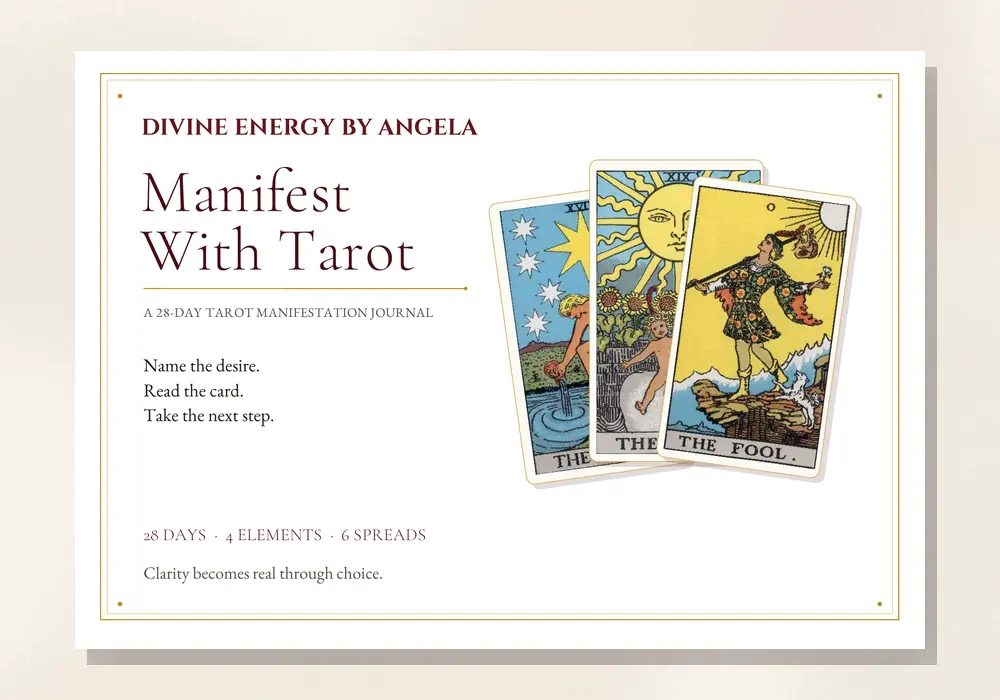
If you want a guided learning path alongside your personal notes, the Learn to Read Tarot Workbook and 28-Day Journal brings study and practice together.
Tarot journaling works because you can return to what you actually wrote. Separate readings become experience. Experience helps you notice patterns. And patterns give you a more grounded sense of what the cards mean to you.
Explore the cards


Learn with Angela
Give your practice a little structure
Explore Learn to Read Tarot and the Manifest With Tarot journal for guided study, card practice and written reflection.
Explore the workbook and journal