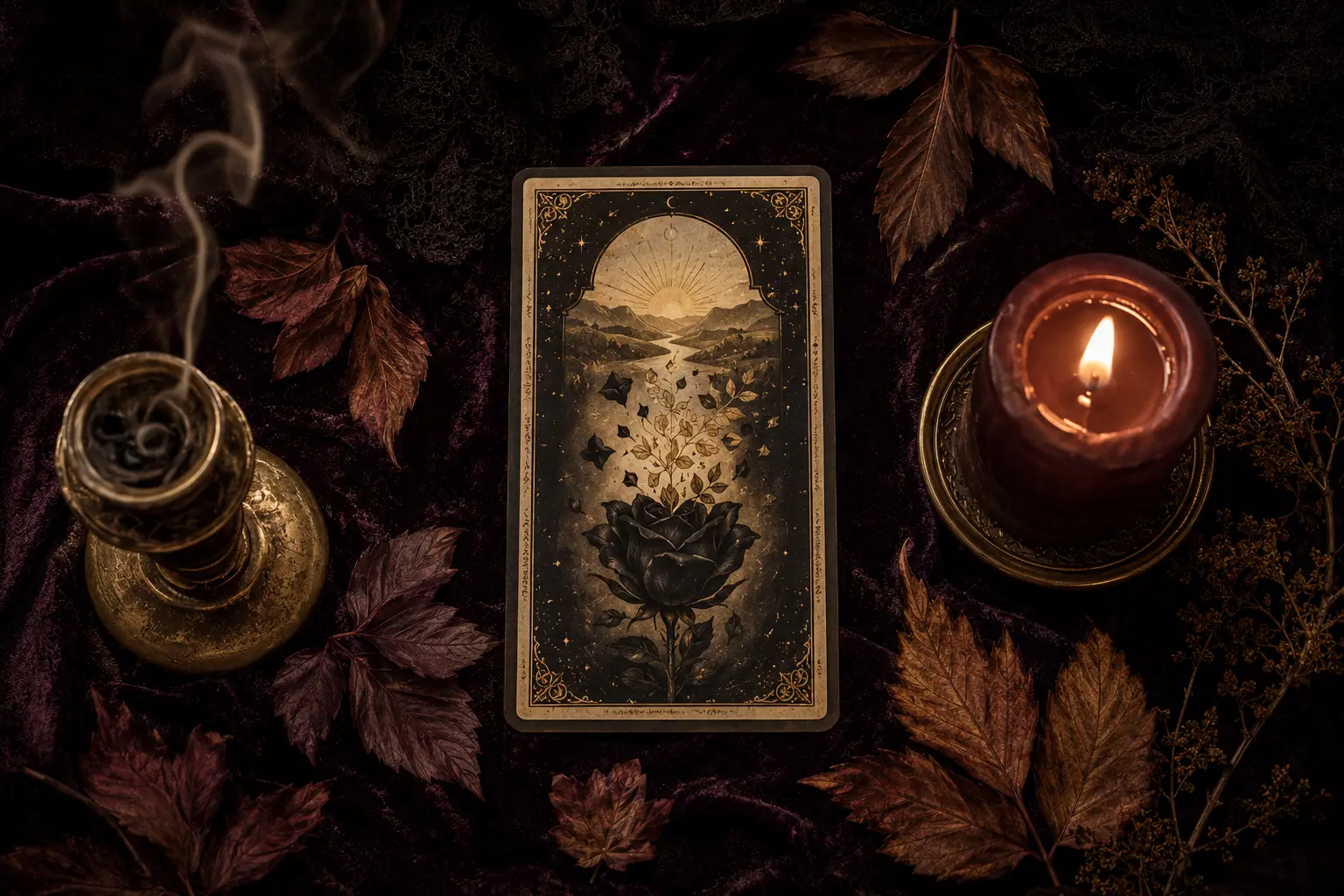
Few tarot cards create a faster reaction than Death. The name is direct, the imagery is severe and the mind can move from symbol to worst-case prediction before the rest of the spread has been read.
In most readings, the Death card does not predict physical death. It describes an ending, transition or change that makes a return to the old form unlikely. The experience may be chosen or unavoidable, welcome or difficult. What matters is that something has reached the edge of what it can remain.
The ten meanings below show how the card changes according to the question and spread position. For the traditional upright and reversed reference, you can also visit the dedicated Death tarot card meaning.
1. A chapter reaches completion
Death may show that a cycle has given what it can. A project closes, a season of life ends or a role no longer has a future in its current form. This is not always sudden. Sometimes the card confirms what has been ending for months.
2. An identity no longer fits
You may still be living through a label that once protected or defined you: the responsible one, the overlooked one, the person who always waits. Death can show that the identity has become too narrow for who you are becoming.
3. Release becomes necessary
In an advice position, Death asks what you are trying to keep alive through habit, hope or fear. Release does not mean pretending the past did not matter. It means ending the effort to make it return in exactly the same form.
4. A relationship changes form
In love readings, Death can show separation, but it can also mark the end of a relationship pattern. A casual bond may become committed. A connection built on uncertainty may require a final choice. The card says the present form cannot simply continue unchanged.
Read the surrounding cards. Death with Two of Cups can show a bond transformed through an honest ending and renewal. Death with Eight of Cups can emphasize departure. Death with Judgement may bring a return only after both people face what made the old relationship unsustainable.
5. A career path is ready to turn
Death may appear when a role, industry or professional identity has reached its limit. It does not promise an effortless new job. It shows that continuing only because the path is familiar may cost more than acknowledging the transition.
6. A habit loses its hold
In personal readings, Death can describe the end of a repeated behavior, coping strategy or attachment. The card is strongest when paired with a concrete choice. What will replace the old routine? What support makes the change sustainable?
7. Grief needs a place in the story
Not every ending becomes wisdom immediately. Death can ask for recognition before meaning. The card may validate the fact that something mattered and that its absence changes the shape of daily life.
8. The transition is already underway
Sometimes the card does not announce a future event. It names the present. The old structure has already weakened, the emotional departure has already begun or the decision has already been made internally.
9. Timing depends on completion
In a timing position, Death rarely gives a neat date. It points to a condition: after the closure, after the release, after the old agreement ends. The event may arrive when there is finally space for it.
10. Renewal follows an honest ending
Death contains the possibility of renewal, but it should not be reduced to a cheerful promise. The dawn in many versions of the card matters because it appears beyond the ending, not instead of it.
How position changes the meaning
- Past: an ending that still shapes the present.
- Present: a transition already taking place.
- Future: a coming closure or change of form.
- Challenge: resistance to necessary change.
- Advice: stop feeding what has completed.
- Outcome: the situation will not remain as it is now.
What reversed Death can reveal
Reversed Death often shows resistance, delay or incomplete release. You may know the chapter is over while continuing to organize your choices around it. In some contexts, the reversal can show that a difficult transition is easing. The question is not whether reversed automatically means better or worse. Ask where the movement has become blocked.
Read the card with honesty, not fear
Death is a serious card, but serious does not mean literal disaster. Start with the question, position and observable situation. Then ask what is ending, what is resisting and what becomes possible when the transition is acknowledged.
The guide to Death, The Tower and The Devil offers a calm five-step method for feared cards. If Death appears during a seasonal reading, the ten-card Samhain spread gives the ending a wider context of memory, inheritance and continuation.
Tarot must not be used to predict a death, diagnose illness or replace medical, legal, financial or mental health guidance.
Place the card back into its full story
A personal reading can explore what is truly ending, what remains and the choice that opens after the transition.
Explore tarot readingsQuick answers
Does the Death card predict physical death?
No. It is not responsible or reliable to use a tarot card to predict physical death. In most readings, Death describes endings, transition, release or a change of identity.
Is Death always a negative card?
No. The change may be difficult, relieving or both. Death often appears when something cannot continue in its previous form.
What does Death mean in a love reading?
It may show an ending, a major change in relationship form, the release of an old pattern or the end of one stage before another can begin.
What does reversed Death mean?
Reversed Death often points to resistance, delay, unfinished release or an attempt to preserve a form that has already become too small.
Does Death mean a new beginning?
It can, but the new beginning follows the ending. The card first asks what must be completed or released before renewal becomes real.