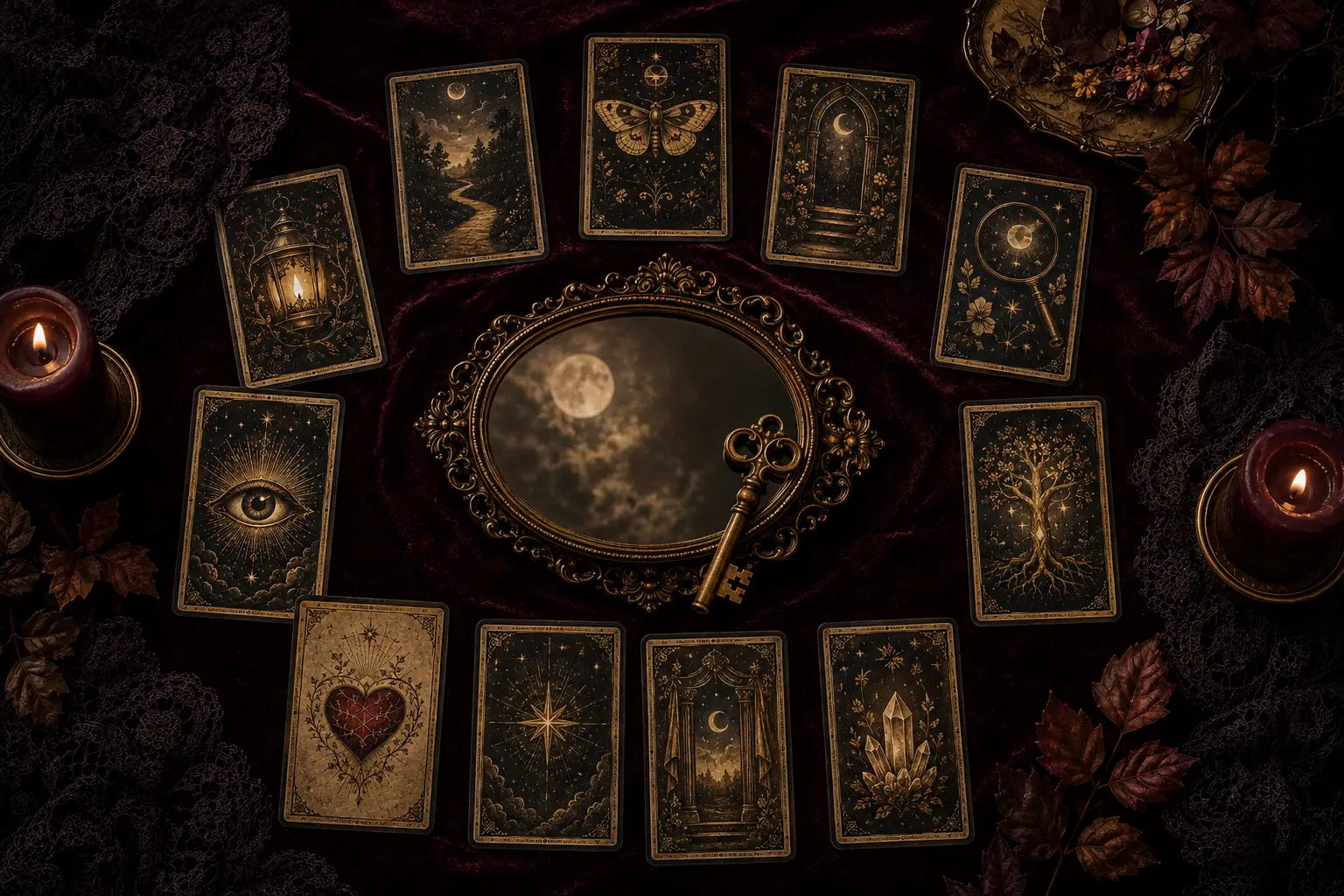
A hidden-truth reading can begin with a real instinct that something does not add up. It can also begin with fear filling the space where information is missing. Tarot is most useful when it helps you tell the difference.
No card proves a lie, betrayal or secret relationship. Cards can describe uncertainty, withheld information, intuition, avoidance and the moment a truth becomes visible. The interpretation still needs context and observable reality.
1. The High Priestess: what is known but not spoken
The High Priestess often appears when information is private, intuition is active or the full answer is not ready to be disclosed. She may represent a secret, but she can also represent your own need to stop forcing an answer before you have enough evidence.
2. The Moon: uncertainty, projection and partial visibility
The Moon shows a landscape where shapes are real but difficult to judge. It can point to hidden feelings, unclear motives or fear distorting perception. The card asks you to move carefully, not to assume that the worst interpretation is the truest one.
3. Seven of Swords: secrecy, strategy or avoidance
Seven of Swords is one of the clearest cards for information being withheld. Yet secrecy has several forms. Someone may be avoiding responsibility, protecting privacy, planning independently or acting dishonestly. The surrounding cards show which reading has support.
4. Two of Swords: a truth kept outside the decision
This card often describes suspended judgement. The information may be available, but accepting it would require a choice. In a hidden-truth spread, Two of Swords can point to deliberate avoidance rather than an external secret.
5. Eight of Swords: the belief that hides the exit
Eight of Swords reveals a mental frame that makes options difficult to see. The hidden truth may be that you have more agency than the current story allows, even if the first step remains uncomfortable.
6. Four of Pentacles: what is being protected
Four of Pentacles can show guarded resources, controlled emotion or fear of loss. Ask what the person or situation is trying to preserve. The card may describe secrecy around money, time, affection or security.
7. The Devil: the attachment beneath the explanation
The Devil can reveal the bind that no one wants to name: desire, shame, control, temptation or dependency. It does not diagnose another person. It shows where choice has become entangled with a powerful reward or fear.
8. The Hermit: truth found away from outside noise
The Hermit is less about someone hiding information from you and more about the truth that appears through distance and reflection. A temporary withdrawal may be necessary before you can hear your own judgement.
9. Page of Swords: questions, observation and incomplete facts
Page of Swords notices details and asks difficult questions. At its best, it shows curiosity and investigation. At its most unsettled, it can show monitoring, assumptions or collecting fragments without understanding the whole story.
10. Ace of Swords: the moment of clear recognition
Ace of Swords cuts through confusion. It may bring a direct conversation, decisive insight or fact that reorganizes the reading. The truth can feel liberating even when it changes what you hoped would happen.
11. Justice: evidence, accountability and consequences
Justice asks what can be supported, not only what can be imagined. In a hidden-truth reading, it may point to documentation, a fair assessment or the consequence of actions becoming visible.
12. Judgement: the past returns to be understood
Judgement reveals what can no longer remain buried. A past choice, unfinished conversation or ignored calling rises into awareness and asks for a response.
13. The Tower: revelation that changes the structure
The Tower can show a truth arriving through disruption. It does not always mean betrayal or disaster. It means an assumption, arrangement or explanation can no longer hold in the same way.
Three categories of hidden truth
- Information withheld by another person: High Priestess, Seven of Swords, Four of Pentacles.
- A blind spot within the reader: Moon, Two of Swords, Eight of Swords, Devil.
- A truth becoming visible: Ace of Swords, Justice, Judgement, Tower.
The categories can overlap. A relationship may contain both missing information and a fear that magnifies every gap.
A three-card spread for what is hidden
- What do I know? The facts and patterns already visible.
- What am I not seeing clearly? The unknown, blind spot or assumption.
- What would bring honest clarity? The question, boundary or action that reveals more.
Keep the third position practical. A card such as Page of Swords may ask for better questions. Justice may require evidence. The Hermit may ask you to step back before responding.
Do not use tarot to build an accusation
If a reading raises concern about deception, separate symbol from fact. What behavior have you actually observed? What question can be asked directly? What boundary would still matter even if your feared explanation is wrong?
Use the guide to reading tarot combinations before treating one card as a complete verdict. For a seasonal layout, The Veil hidden-truth spread keeps the reading focused on what is visible, what is unknown and what supports clarity.
Tarot can support reflection on trust, uncertainty and patterns. It cannot prove deception, establish another person's private thoughts or replace direct communication and evidence.
Look beneath the visible story
A personal reading can explore what is known, what remains uncertain and the question that brings you back to your own authority.
Explore personal readingsQuick answers
Which tarot card most strongly represents secrets?
The High Priestess and The Moon are often connected with what is not yet visible. Seven of Swords can point more directly to secrecy or information being withheld.
Does Seven of Swords always mean lying?
No. It can describe secrecy, strategy, avoidance, privacy or acting alone. The question and surrounding cards determine whether deception is a reasonable interpretation.
Can tarot prove that someone is cheating?
No. Tarot cannot establish a factual accusation. It may raise questions about trust, distance or hidden behavior, but observable evidence and direct communication still matter.
What card shows a truth coming out?
Ace of Swords, Judgement, Justice and The Tower can all show revelation, depending on whether the truth arrives through clarity, accountability, evidence or disruption.
How many cards should I draw for a hidden-truth reading?
Three to five cards are usually enough. More cards can make suspicion easier to project into the spread.