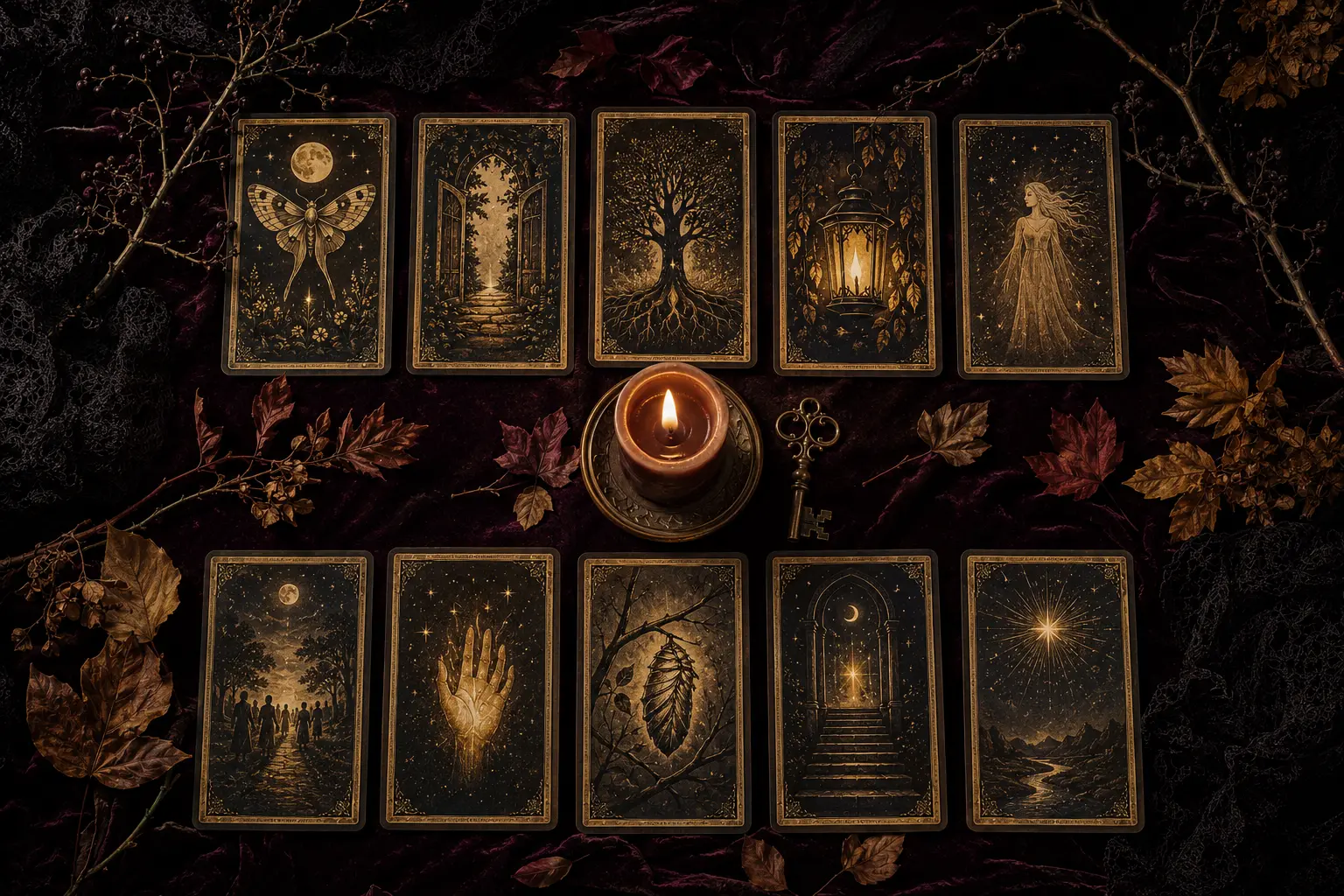
Samhain invites a particular kind of honesty. It asks what has reached its natural ending, what still follows us from the past and what we are willing to carry across the threshold into a new season.
People approach Samhain through different spiritual, cultural and personal traditions. This tarot spread does not assume that everyone understands the season in the same way. You can use it as an ancestral practice, a seasonal reflection or simply a structured moment to consider endings, memory and renewal.
The ten positions move from release into inheritance, then toward boundaries and future direction. Read them slowly. This is not a spread that needs ten immediate predictions.
Before you draw the cards
Choose one area of life that feels connected with transition. It might be a relationship, identity, habit, family role or plan that no longer fits. Write one sentence about why you are opening the reading.
You may place a candle or meaningful object beside the deck, but no object is required. What matters is the boundary around the session. Decide when it begins, when it ends and what you will do afterward to return to ordinary life.
- Shuffle with one clear intention.
- Lay the cards in two rows of five.
- Read the first row as the past and the threshold.
- Read the second row as choice and continuation.
- Write one practical action after the interpretation.
The ten-card Samhain tarot spread
- What has reached its ending? The cycle, identity or expectation that has given what it can.
- What am I still carrying? The feeling, obligation or story that remains attached to the ending.
- What deserves to be grieved or acknowledged? The part of the experience that needs honest recognition before release becomes possible.
- What strength did I inherit? A gift, capacity or form of wisdom carried through family, culture or lived experience.
- What pattern did I inherit? A belief or behavior that once served a purpose but may limit the life you are building now.
- What deserves to be remembered? A lesson, person, value or story worth keeping close.
- What can end with me? A cycle you are ready to meet differently instead of passing forward.
- What boundary protects the next chapter? The limit, standard or act of discernment that creates room for change.
- What seed am I carrying forward? The quality or intention that wants patient attention through the next season.
- What message belongs at the threshold? The central wisdom that gathers the whole reading into one direction.
How to read the two rows
The first five cards reveal the emotional and inherited material surrounding the transition. Look for repetition. Several Cups may show that memory and attachment matter more than the visible event. Pentacles can bring attention to security, family roles, property or the habits through which a pattern is maintained.
The second row moves from memory into choice. Card Seven is especially important. It does not accuse your family or ask you to reject where you came from. It identifies the place where awareness allows a different response.
If Card Eight shows Queen of Swords, the new boundary may involve direct language and fewer explanations. If it shows Four of Pentacles, protection may be necessary, but you should also ask whether fear is closing more than it needs to.
Reading ancestral cards without making unsupported claims
An ancestor position can be approached spiritually, psychologically or symbolically. A card cannot prove that a specific deceased person is present, nor should it be used to invent facts about family history.
Ask instead: What value does this image represent? Where has this pattern appeared in my family story? What evidence do I have, and what remains interpretation?
If you know little about your lineage, the spread can still work. Inheritance includes what was modeled by caregivers, community and culture. The lesson may be visible in your own habits even when its earliest source is unknown.
When Death, Judgement or Six of Cups appears
Death often fits the threshold naturally. It usually marks completion, shedding or a change that cannot be reversed into its previous form. It does not predict physical death.
Judgement may bring a call to answer the past differently. It can show accountability, awakening or a moment when an old story is finally understood from a wider view.
Six of Cups can point toward childhood, nostalgia, family memory or the version of the past you keep returning to. Ask whether the memory is a source of strength, a selective story or both.
For a wider seasonal practice, the guide to seven Halloween tarot spreads includes layouts for shadow work, love, protection and future direction.
Close with one act of continuation
Do not end the session with ten interpretations floating in your mind. Choose one sentence from the reading and turn it into a grounded act. You might write a letter you do not send, preserve a family recipe, end a repeated conversation, place a boundary around your time or begin a small practice that represents the future seed.
The purpose of the spread is not to remain at the threshold forever. It is to recognize what you carry, then cross with greater awareness.
Tarot can support spiritual reflection and journaling. It cannot verify spirit contact, establish facts about family history or replace medical, legal, financial or mental health advice.
Meet the threshold with a personal reading
A seasonal reading can explore what is closing, what is asking to begin and the direction that now belongs to you.
Explore a renewal readingQuick answers
How many cards are in this Samhain tarot spread?
This spread uses ten cards. You can divide it into two five-card sessions if you want more time with each position.
Do I have to communicate with ancestors to use it?
No. The spread can be read as reflection on family history, inherited beliefs, learned patterns and the values you want to carry forward.
Can I use the spread outside Samhain?
Yes. It works at any personal threshold, including a move, ending, birthday, anniversary or major change.
What if I know little about my family history?
Read the cards through what you learned from the people, culture and environment that raised you. Ancestral reflection does not require a complete family record.
Should I use reversals?
Only if reversals are already part of your reading practice. The positions provide enough contrast without requiring reversed cards.