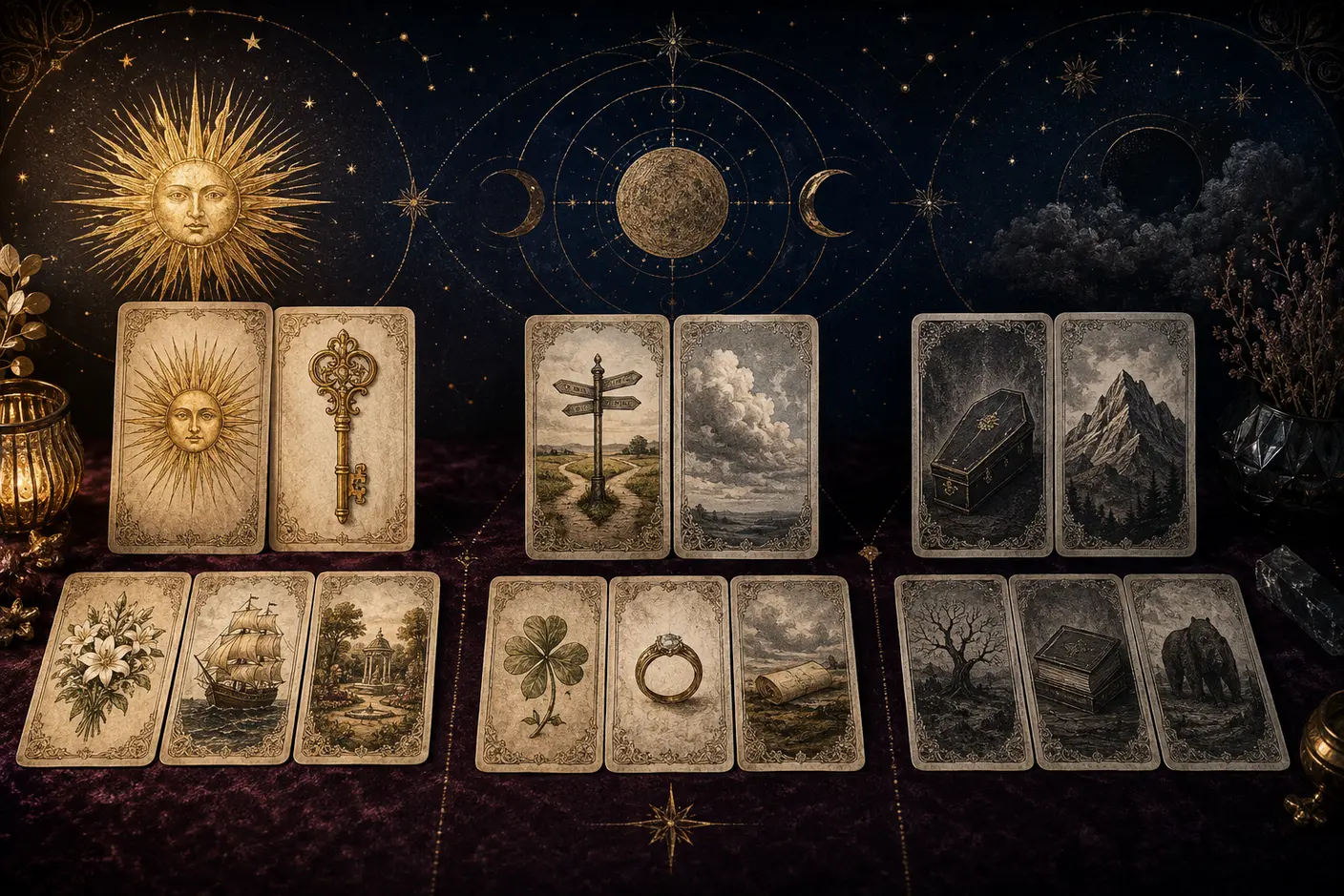
Lenormand can answer a yes or no question, but it rarely stops at one word. The card shows the leaning and the condition inside it.
Sun may say yes through clarity and success. Mountain may say no because the path is blocked. Crossroads may say the answer depends on a choice that has not been made. This context is what makes the method useful.
How to use the reference
- Ask one specific question that can be answered yes, no or not yet.
- Include a time frame when the question concerns a future event.
- Draw one card for the basic leaning.
- Read the condition before declaring the answer.
- For more detail, draw two additional cards for what helps and what develops.
Complete 36-card yes or no table
| No. | Card | Leaning | Condition |
|---|---|---|---|
| 1 | Rider | Yes | Movement, news or an arrival begins the answer. |
| 2 | Clover | Yes | The opportunity is real but may be brief. |
| 3 | Ship | Yes, with distance | Travel, expansion or time to cross the gap is required. |
| 4 | House | Yes, stable | The answer favors what is established, safe or familiar. |
| 5 | Tree | Yes, gradually | Growth is possible through time, roots and consistency. |
| 6 | Clouds | Unclear | Information is incomplete or changing. |
| 7 | Snake | No, or complicated | The path contains a detour, mixed motive or extra layer. |
| 8 | Coffin | No | The matter is closed, inactive or must end first. |
| 9 | Bouquet | Yes | An invitation, welcome response or appreciation supports it. |
| 10 | Scythe | No, suddenly | A sharp decision, cut or risk changes the direction. |
| 11 | Whip | No, unless resolved | Conflict or repetition keeps the issue active. |
| 12 | Birds | Maybe | Conversation is possible, but worry and changing words affect it. |
| 13 | Child | Yes, at the beginning | The result is new, small or not fully developed. |
| 14 | Fox | Maybe | Check work, motive, details and self-interest. |
| 15 | Bear | Yes, with power | Authority, resources or a strong person controls the result. |
| 16 | Stars | Yes | The path is clear, guided or connected through a network. |
| 17 | Stork | Yes, with change | The present situation must move into another form. |
| 18 | Dog | Yes | Loyalty, friendship or reliable support helps. |
| 19 | Tower | No, or distant | Separation, independence or formal boundaries remain. |
| 20 | Garden | Yes | Public contact, community or a wider network opens it. |
| 21 | Mountain | No | A substantial obstacle or delay blocks the current path. |
| 22 | Crossroads | Maybe | The answer changes with a decision or competing option. |
| 23 | Mice | No | Stress, loss or gradual erosion weakens the result. |
| 24 | Heart | Yes | Affection, desire or emotional sincerity supports it. |
| 25 | Ring | Yes | An agreement, commitment or repeating cycle confirms it. |
| 26 | Book | Unknown | Important information is still private or unopened. |
| 27 | Letter | Yes | The answer comes through a message, document or record. |
| 28 | Man | Depends on the person | The chosen significator, his choices or role decides it. |
| 29 | Woman | Depends on the person | The chosen significator, her choices or role decides it. |
| 30 | Lily | Yes, gradually | Maturity, peace, family or ethical action supports it. |
| 31 | Sun | Strong yes | Success, visibility and confidence strengthen the result. |
| 32 | Moon | Yes, emotionally | Recognition, intuition or a cycle shapes the answer. |
| 33 | Key | Strong yes | The matter is important, certain or ready to open. |
| 34 | Fish | Yes | Money, business, independence or free movement supports it. |
| 35 | Anchor | Yes, lasting | The result is stable, persistent or fixed in place. |
| 36 | Cross | No, or difficult | A burden, duty or unavoidable test weighs on the result. |
Positive, negative and conditional cards
Strong positive cards include Sun, Key, Clover, Bouquet and Stars. Strong challenging cards include Coffin, Mountain, Mice and Cross. Clouds, Crossroads, Book and the person cards usually need more information.
Most of the deck is conditional. Ship can be yes for travel and no for staying close. Tower can be yes for independence or an institution, but no for emotional closeness. Ring is yes for commitment and may be no when the question asks whether a cycle will finally end.
Question context changes the leaning
- “Will we commit?” Ring: yes, the card matches the subject.
- “Will this pattern stop?” Ring: likely no, the cycle repeats.
- “Will I move?” Stork: yes, change and relocation are supported.
- “Will things remain the same?” Stork: no, the current form changes.
- “Will I receive a reply?” Letter: yes, written communication is central.
- “Do I know the whole story?” Book: no, something remains undisclosed.
A better three-card yes or no spread
- The leaning: the basic yes, no or unknown.
- The condition: what supports, delays or complicates it.
- The development: where the current direction leads within the time frame.
Example: Rider + Mountain + Key. Movement is trying to begin, but a real obstacle stands in the middle. Key at the end says a solution exists and the matter can open after the block is addressed. Calling the line an immediate yes would miss its condition.
Should you count the cards?
For three cards, a simple balance can help: two positive cards against one challenging card lean yes, while two challenging cards lean no. But order remains important. Sun + Mountain + Key differs from Sun + Key + Mountain because the final Mountain leaves the obstacle unresolved.
Questions that need more than yes or no
Questions about health, legal outcomes, financial risk or another person’s private behavior should not be reduced to a binary card pull. Ask what information is missing, what choice remains yours and what practical source can confirm the facts.
Use the complete Lenormand meanings guide for wider context. When the question concerns communication, continue with Lenormand cards for contact and messages.
A yes or no Lenormand reading reflects the current question, conditions and symbolic direction. It cannot guarantee an outcome or replace evidence and professional advice.
Ask the question beneath the yes or no
A personal reading can show the answer, the condition shaping it and what could change the present direction.
Explore personal readingsQuick answers
Can Lenormand answer yes or no questions?
Yes, but the card usually gives both a leaning and a condition. A positive card can still show delay, and a challenging card can show what must change before the answer opens.
Which Lenormand cards are the strongest yes?
Sun, Key, Clover, Bouquet and Stars are among the clearest positive cards. Heart and Ring are strong when the question concerns love or commitment.
Which Lenormand cards are the strongest no?
Coffin, Mountain, Mice and Cross often lean strongly negative. Clouds and Crossroads are more uncertain than final.
How many cards should I draw for yes or no Lenormand?
One card gives a simple leaning. Three cards give a better answer through the result, condition and likely development.
Should I count positive and negative cards?
You can use a simple balance as a first layer, but the final card order and combinations matter more than a mechanical score.