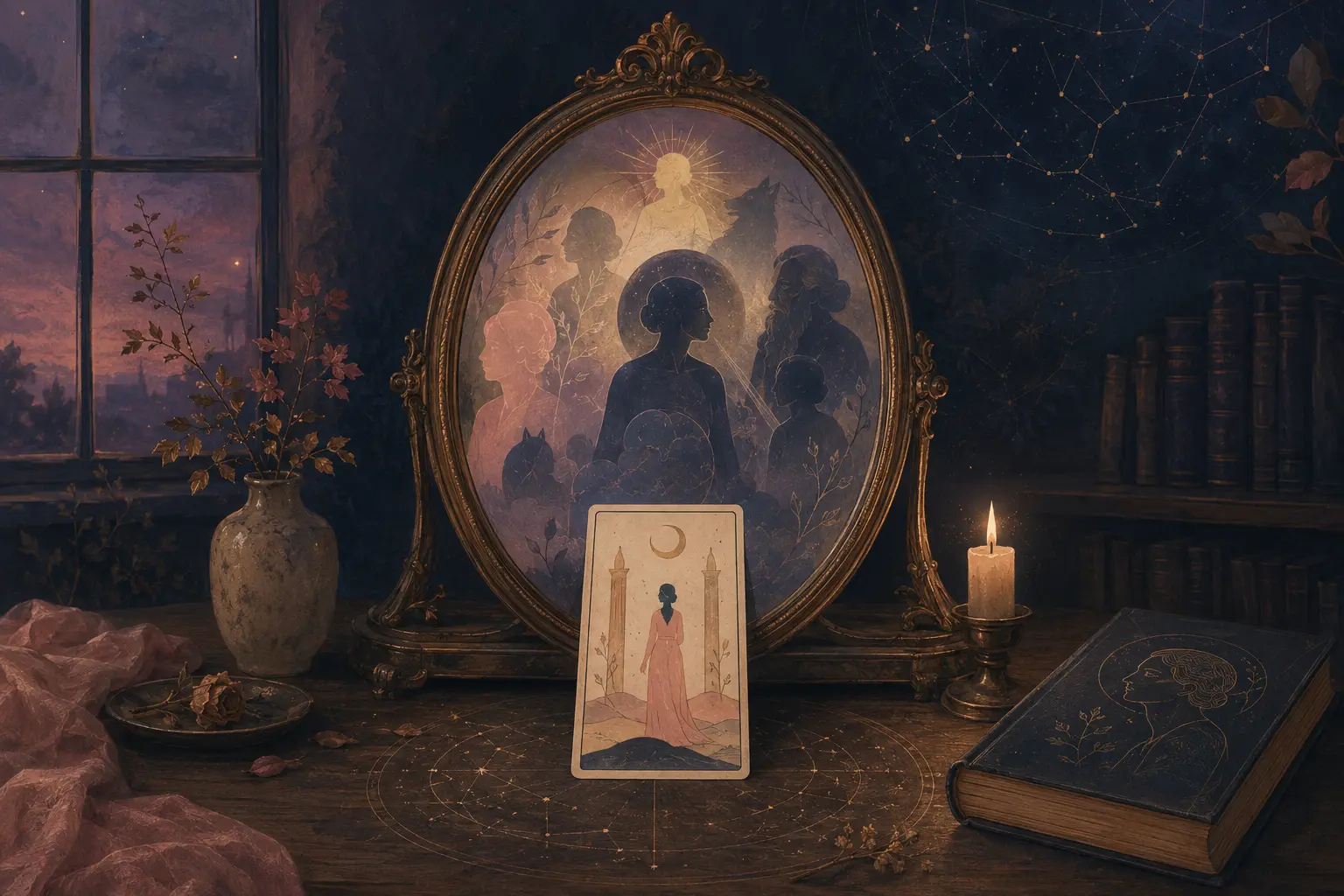
Have you ever told someone that you read tarot and seen that look? The half-smile. The pause. Then the question: “Do you believe cards can predict the future?”
It can put you on the spot, even when you know the cards hold far more depth than a promise about what happens next. The good news is simple: tarot does not need a fixed future to have value.
It can work as a rich symbolic language. It can give form to a conflict you have not named, expose a pattern you keep circling and place a hard choice where you can see it. A Jungian approach helps us understand why.
First, what did Carl Jung say about tarot?
Carl Gustav Jung was a Swiss psychiatrist who developed analytical psychology. His work explored dreams, symbols, archetypes, the shadow and the collective unconscious. If you want to explore that last idea through the cards, begin with these three practical shadow work tarot methods.
Jung did discuss tarot. In a 1933 seminar, he described the cards as psychological images and connected the Major Arcana with archetypal ideas. In a 1960 letter, he wrote that the C. G. Jung Institute had begun experiments with tarot, astrology, geomancy and the I Ching, but the work stopped due to a lack of staff and funds.
There is no sound evidence that Jung built a formal tarot method for therapy or used tarot with patients. What we now call Jungian tarot comes from applying his ideas about symbols and the unconscious to the cards. That distinction matters. It makes the argument more honest, not less powerful.
Tarot as a psychological mirror
A tarot card does not have one flat meaning. The Moon may bring up fear for one person, desire for another and a sense of creative mystery for someone else. The image stays the same. The response changes.
This is where projection enters the reading. In psychology, projection describes a process in which inner material shapes what we see in the world before us. When an image is open to more than one reading, our memories, hopes and conflicts help decide what stands out.
Tarot can resemble a projective exercise because its scenes invite a response. It is not a clinical test, and a tarot reader is not making a diagnosis. The card gives the mind a surface. What catches your eye may reveal what has been asking for your attention.
The card does not have to contain your future. It can reveal the story through which you are meeting the present.
Archetypes make the cards feel personal
Jung used the word archetype for deep patterns that appear across myth, dream, religion and human life. The mother, ruler, seeker, trickster, lover and shadow take new forms in each culture, yet the core tensions feel known.
The Major Arcana gives these patterns a visual stage:
- The Emperor can call attention to structure, authority, control and the limits that hold life together.
- The Tower can expose a structure that can no longer carry the truth, from a belief to a bond or a version of the self.
- The Hermit can mark a turn away from outside noise and toward a truth that needs time, honesty and space.
These cards do not have to announce a set event. They can show which human pattern has taken hold of the present. Once you can name that pattern, you can ask what it wants, what it costs and what choice may change it.
If you want to explore this symbolic layer further, read Tarot Archetypes and Zodiac Signs.
Synchronicity and the meaningful card
Then comes the harder question: if the shuffle is random, why does the card fit?
Jung used the term synchronicity for a meaningful coincidence in which an inner state and an outside event meet without a clear chain of cause. He explored this idea through the I Ching and astrology, and he placed tarot among the intuitive systems that could be studied through this lens.
Synchronicity is not scientific proof that a deck can see tomorrow. It is a way to speak about the strange force of a moment that feels charged with meaning.
There is also a grounded account. The human mind searches for pattern. Tarot images contain conflict, loss, desire, duty, hope, change and return. When you bring a real question to a card, your mind connects the symbol with the part of life that feels most urgent.
Chance and meaning do not cancel each other. A card may arrive through chance, while the insight it opens can still matter. For a wider look at this question, see Why Do the Right Tarot Cards Appear?
From fortune-telling to active reflection
A psychological approach changes the question. It moves you from waiting for fate to examining your part in the story.
| Passive fortune question | Active reflection question |
|---|---|
| Will I get a new job? | What fear or pattern blocks my next step at work? |
| Will my ex come back? | What keeps me tied to this bond, and what do I need to see? |
| What will happen tomorrow? | Which part of my life asks for attention today? |
| Is this person my destiny? | What does this bond awaken in me, and is it good for the life I want? |
This shift does not strip tarot of wonder. It gives the reading a place to land. The answer becomes a door into action, not a sentence you must wait to receive.
The limits of reading for yourself
Self-reading can be a wise practice. It can also become hard when the question touches a breakup, money, work, loved ones or a choice you fear making.
When the stakes feel personal, three problems tend to appear:
- Confirmation bias. You notice the meanings that support what you want and pass over the ones that challenge it.
- Emotional noise. A hard card can feel like a threat, while a hopeful card can become a promise. In both cases, the symbol gets pulled into the fear or wish.
- Too many cards. You pull again, ask the same question in a new form and keep going until the first message is buried under ten more.
This does not mean you lack intuition. It means you are inside the situation. We all have blind spots where hope, fear and habit protect the story we know.
Why an outside reader can change the reading
No reader is free from perspective. Yet a skilled reader is not attached to the outcome in the same way you are. That distance can make room for a question you have avoided, a pattern you have made normal or a choice hidden beneath the urge for reassurance.
A good reading does not replace your judgment. It does not hand your future to a stranger. It helps separate what you know from what you fear, what you hope from what you have been shown and what you can change from what you cannot control.
This is where a professional perspective earns its place. Not as a voice of fate, but as another set of eyes on the symbols, the story and the parts that may be hard to see from within.
Need a clear view of your situation?
If you feel caught in one question or your own cards have begun to echo the same fear, a personal reading can bring space and a fresh point of view. We can look at the pattern, the choices around it and the next step that belongs to you.
Explore personal readingsTarot does not lose its power when the future stays open
In fact, an open future may be what makes the cards useful. Tarot can show the forces at work now: the role you have taken, the shadow you avoid, the bond you repeat and the choice that waits beneath the noise.
An open future does not rule out forecasting. It changes what a forecast means. Read how tarot predictions follow present patterns, likely outcomes and turning points without treating one path as inevitable.
You do not need to prove that the deck controls events. You do not need to dismiss the sense of wonder when a card meets you at the right moment. You can hold both: respect for mystery and responsibility for your own life.
For more on the psychology behind this experience, read Why Tarot Feels So Accurate.
Source note: This article draws on Jung’s work on archetypes and synchronicity, reports of his 1933 seminar comments on tarot and his 1960 correspondence. A Jungian tarot reading is a modern application of those ideas, not a clinical method created by Jung.
Tarot can support reflection and personal insight. It is not therapy, diagnosis, legal advice, financial advice or proof of a fixed future.