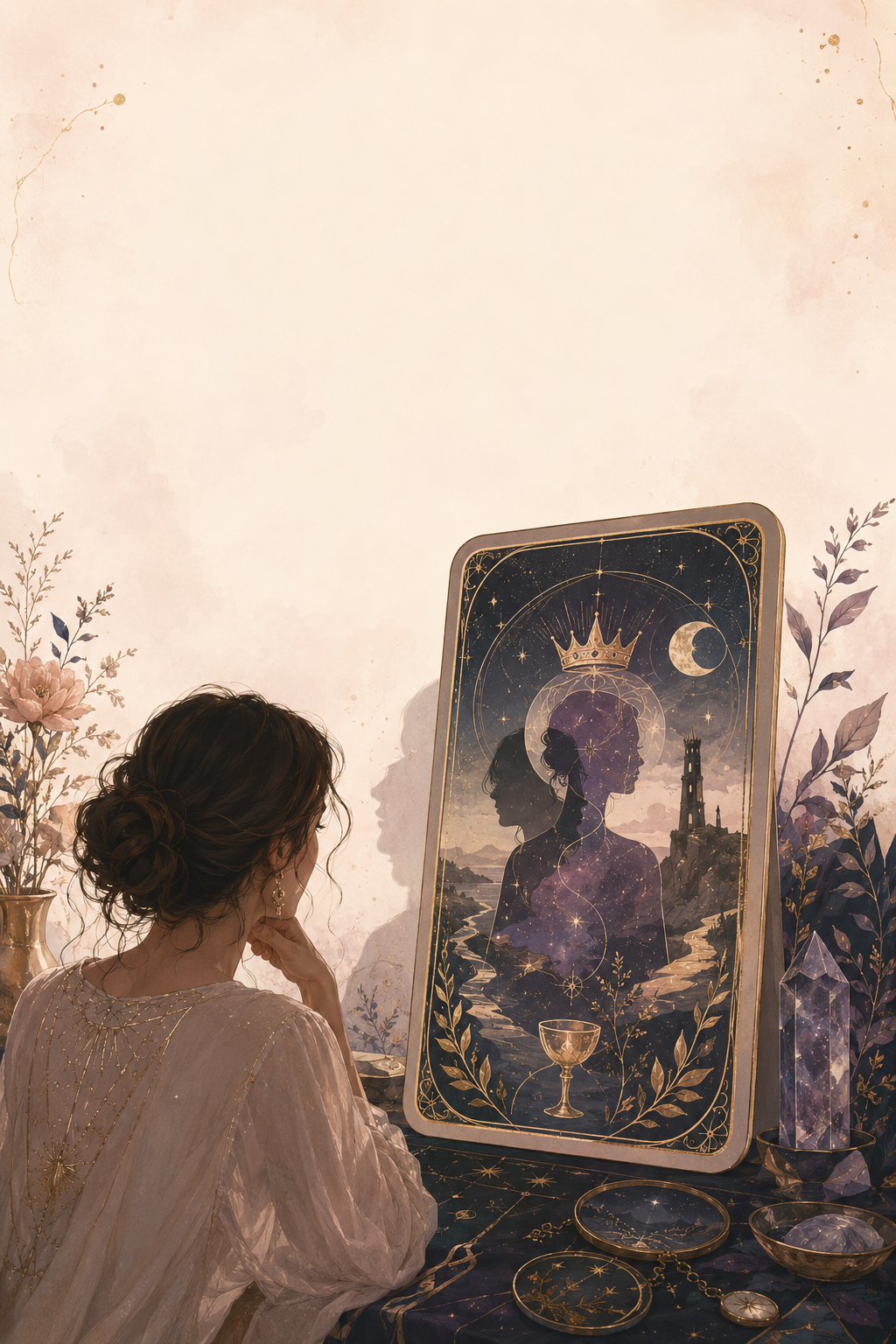
Tarot can feel uncannily personal. A card turns over and seems to name the exact tension, hope or choice that has been difficult to express.
There are different ways to understand that experience. Some readers see spiritual guidance or synchronicity. Others see a psychologically rich system of images that helps people recognise patterns already active in their lives. These explanations do not have to cancel one another out.
Archetypes give experience a shape
In Jungian psychology, archetypes describe recurring symbolic patterns: the caregiver, the ruler, the seeker, the shadow, the innocent and the transformer. The Major Arcana gives these patterns a visual sequence, from beginnings and choice to crisis, integration and renewal.
The Emperor and Empress can evoke structure and care. The Tower and Death speak to disruption and change. The Devil and Moon bring attention to attachment, projection, fear and what has not yet become clear.
Tarot as a psychological mirror
A symbolic image does not contain one single personal meaning. When you look at it, memories, expectations and emotions help decide what becomes important. The card becomes a mirror: not because it secretly contains every answer, but because it gives your attention a focused surface.
This is similar in spirit to how ambiguous images can be used in psychological exploration, although a tarot reading is not a clinical assessment or a diagnostic test. It is a reflective conversation with symbols.
The card may be random, but the meaning you recognise in it can still be significant.
Projection reveals what has your attention
Projection does not mean that a person is imagining everything or being irrational. It means that inner material can influence what we notice and how we interpret an image. The same Moon card may feel comforting to one person and frightening to another because the question, history and emotional context are different.
Why stories create insight
Human beings naturally connect events into narratives. When several cards appear together, the mind looks for a relationship between them: what begins, what is blocked, what changes and what follows. That process can encourage lateral thinking and help someone approach a familiar problem from a new angle.
The story is not proof that the future is fixed. It is a way to organise experience well enough to see choices that were difficult to see before.
The visual power of the Minor Arcana
The Rider-Waite-Smith deck became especially influential because Pamela Colman Smith illustrated scenes on the numbered cards. Instead of showing only six cups or eight swords, the cards show people living through emotion, conflict, effort and recovery. The viewer can enter the scene and ask where they are standing inside it.
Intuition, synchronicity or higher guidance?
A reader may notice the right detail through experience and intuition. A client may experience the timing as synchronicity. A spiritual reader may understand it as guidance from a higher force. These are different interpretations of the same meaningful moment, and none should be presented as an objective guarantee.
The most grounded position is to let the cards open a question rather than close one. If a reading brings recognition, ask what behaviour, boundary or decision that recognition invites.
What tarot can responsibly offer
Tarot can offer language for emotion, a pause from automatic thinking and a new arrangement of familiar facts. It can help someone reflect on a relationship, a decision or a repeating pattern. It cannot prove another person’s private thoughts, guarantee a date or remove the freedom of choice.
That may be why the cards remain useful after six centuries. Their power is not dependent on one origin story. It lives in the meeting between image, question, reader and the person looking for meaning.
This article discusses tarot as a symbolic and reflective practice. It is not a psychological diagnosis, therapy or proof of supernatural knowledge, and it does not replace qualified professional advice.