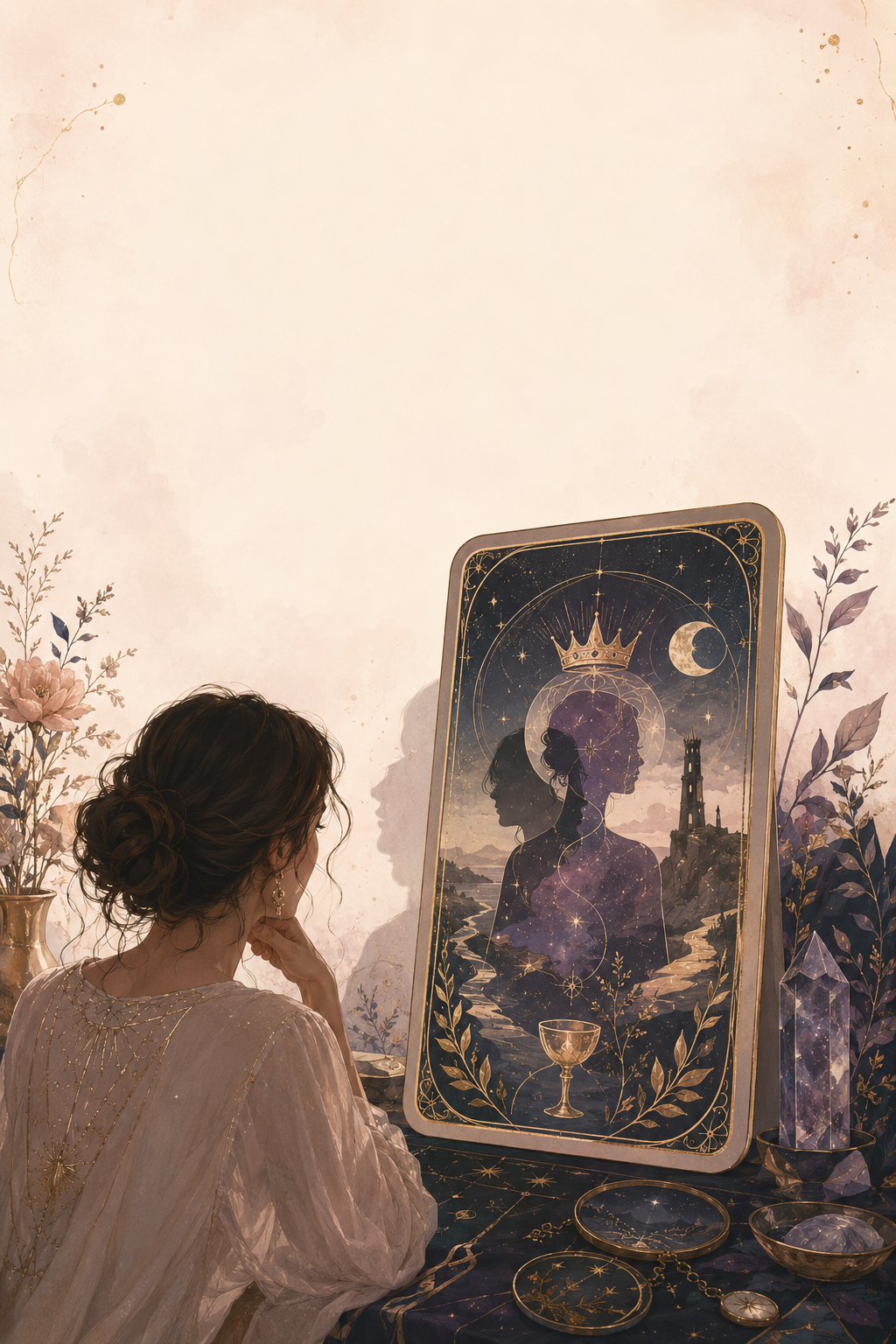
Most experienced readers know the moment: one card turns over and names the situation with such precision that simple chance feels like an incomplete explanation.
There is no single proven answer for why this happens. Psychology can explain how meaning forms, intuition influences what we notice, synchronicity describes meaningful coincidence, and spirituality offers the possibility of guidance. The experience can be explored without pretending that one interpretation has been conclusively established.
The mind is built to find patterns
Human beings constantly organise scattered information into stories. Psychologists use the term apophenia for our tendency to perceive meaningful connections in uncertain or random material. This ability can sometimes mislead us, but it is also essential to learning, creativity and recognising patterns.
The Barnum–Forer effect adds another caution: broad statements can feel uniquely personal because they describe experiences shared by many people. Tarot contains universal themes—loss, hope, conflict, waiting and renewal—so part of its familiarity comes from the breadth of human experience it represents.
One card contains many layers
The Hanged Man does not offer one flat sentence. It may evoke suspension, sacrifice, a changed perspective, surrender, procrastination or the need to release control. The question and surrounding cards help determine which layer matters.
This symbolic density does not make every interpretation equally valid. A responsible reader checks the image against the actual situation instead of forcing the client’s life to fit the card.
Perhaps the card is chosen by chance. The moment of recognition can still carry genuine meaning.
Intuition as rapid processing
Intuition can involve fast, largely unconscious processing of experience, emotional memory and subtle cues. A practiced reader may recognise a pattern before being able to explain every step that produced the impression.
Intuition is not infallible. Fear, hope and confirmation bias can imitate it. That is why strong readings stay curious, distinguish observation from assumption and return attention to behaviour and choice.
Synchronicity instead of simple fate
Carl Jung used the term synchronicity for coincidences that are not connected by an obvious cause but feel deeply related through meaning. He discussed the idea in connection with symbolic systems including the I Ching and astrology.
Synchronicity is a philosophical and psychological framework, not scientific proof that a card knows the future. It offers language for the experience of an inner state and an external event meeting at exactly the right moment.
Higher guidance as a spiritual interpretation
Some people understand the right card as guidance from God, spirit, the universe, ancestors or a higher self. This can be personally meaningful and can coexist with psychological explanations. It should be presented as belief and lived experience rather than objective fact.
A spiritual interpretation also does not require a fixed destiny. Guidance may reveal a possibility or invite a decision while leaving human freedom intact.
Can the explanations coexist?
The card may be selected randomly. Psychology helps explain why it becomes meaningful. Intuition shapes what the reader notices. Synchronicity describes the timing, while spirituality offers another understanding of why the encounter matters.
You do not have to settle the metaphysical question before receiving something useful from the reading. The practical test is what follows: does the insight create clarity, support a healthy boundary or reveal a choice that deserves attention?
The responsibility of the reader
The sense of accuracy should never be used to claim certainty about another person’s private mind or to frighten someone with an inevitable future. The most powerful reading makes space for recognition without taking away agency.
The right card may feel extraordinary. Its value becomes real when it helps you meet your life more honestly.
This article explores psychological, philosophical and spiritual interpretations of tarot. It does not establish supernatural causation, provide psychological diagnosis or replace qualified professional advice.