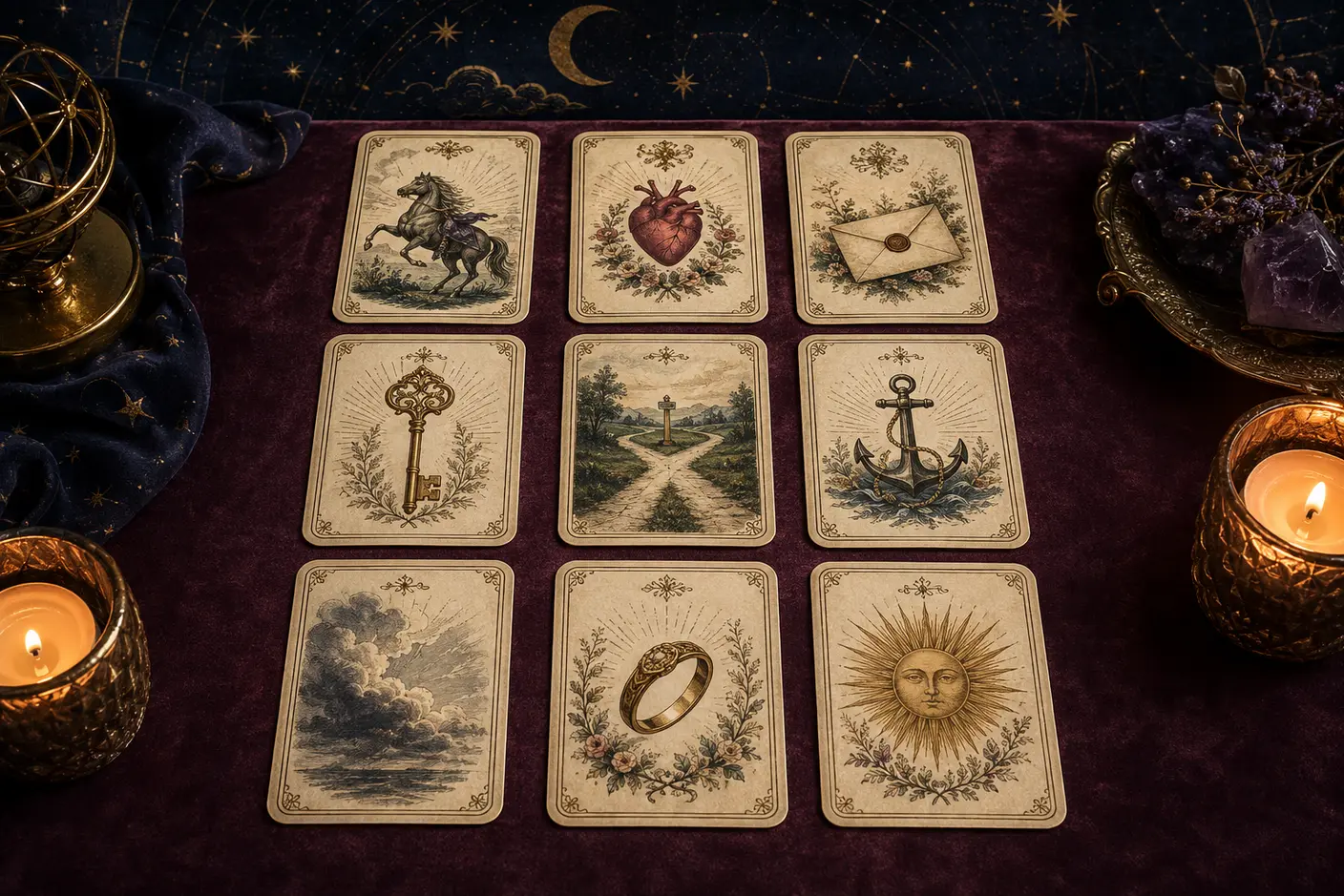
The nine-card portrait is where Lenormand begins to feel like a complete scene. It is larger than a three-card line, yet small enough to keep every relationship visible.
The spread uses a three-by-three grid. The center card names the heart of the matter. The rows show the story moving across the page. Columns reveal what supports, crosses or develops beneath the visible situation. Diagonals and corners add a final layer of connection.
Do not try to read every possible pair. The aim is one coherent answer, not a catalogue of twenty combinations.
The 3x3 Lenormand layout
| 1 | 2 | 3 |
|---|---|---|
| Background | What is above the matter | Early direction |
| 4 | 5: Center | 6 |
| Immediate influence | Heart of the question | Immediate development |
| 7 | 8 | 9 |
| Underlying factor | What becomes concrete | Later direction |
This positional language is a useful starting point, not an unchangeable law. Some readers treat the top row as past, the middle as present and the bottom as future. Others read all three rows as separate sentences. Choose the structure before drawing and keep it consistent.
Step 1: begin with one focused question
A nine-card spread needs a subject and a time frame. “What is developing around my job search over the next six weeks?” gives the cards a clear field. “Tell me everything about my future” creates too many possible meanings.
For relationship questions, ask about the bond, communication or likely development rather than trying to prove another person’s private thoughts.
Step 2: read the center card
Position Five is the anchor of the spread. If Ring is central, the reading concerns an agreement, partnership or repeated cycle. If Mountain is central, the obstacle cannot be treated as a minor detail. If Letter is central, communication, paperwork or recorded information carries the story.
Then read the cross around the center: Cards Two, Four, Six and Eight. These four cards describe what surrounds the central issue most closely.
Example: Heart in the center with Clouds above, Tower left, Rider right and Key below can describe affection surrounded by uncertainty and distance, with approaching movement and a decisive fact becoming visible.
Step 3: read the three horizontal rows
Read each row from left to right as a sentence.
- Top row, Cards 1-2-3: the context, what is influencing the matter from above or what is already in motion.
- Middle row, Cards 4-5-6: the immediate situation and its strongest movement.
- Bottom row, Cards 7-8-9: what becomes practical, underlying or more visible as the situation develops.
If the rows contradict each other, look for sequence. A difficult top row and supportive bottom row may show improvement. A positive opening followed by Mountain or Coffin below can show momentum becoming blocked or inactive.
Step 4: read the columns
The columns connect what is above with what is below.
- Left column, Cards 1-4-7: origin, existing pattern or what feeds the current situation.
- Center column, Cards 2-5-8: the central pressure and the condition that shapes the answer.
- Right column, Cards 3-6-9: development, outward direction or what is likely to become visible next.
In a future-focused question, the right column deserves special attention, but it should not be isolated from the rest of the portrait.
Step 5: read the diagonals
The two diagonals cross through the center:
- Cards 1-5-9: the main narrative moving through the heart of the spread.
- Cards 3-5-7: a second path, complication or influence meeting the central subject.
If both diagonals repeat the same theme, that theme is central. Ring at the center with Heart and Anchor on one diagonal reinforces a stable commitment. Ring with Clouds and Mice on the other shows that uncertainty and gradual strain are also active.
Step 6: use the four corners as the frame
Cards One, Three, Seven and Nine describe the outer boundary of the question. Read them as two pairs or as a short chain. They often reveal the situation’s larger frame before details are added.
Rider + Letter + Key + Sun creates a strong frame of arriving information, certainty and visibility. Tower + Mountain + Crossroads + Ship frames the matter through distance, obstruction and the need for another route.
A complete example: will communication reopen?
Imagine this portrait:
| Tower | Clouds | Birds |
| Mountain | Letter | Rider |
| Crossroads | Key | Sun |
Letter in the center makes communication the subject. Mountain + Letter + Rider shows a blocked message beginning to move. Clouds + Letter + Key shows uncertainty around communication becoming clearer. Birds + Rider + Sun supports active conversation and visible movement in the right column.
The answer is not simply “yes.” The portrait says communication has been limited by distance and uncertainty, but movement becomes more likely when a choice is made and clarity replaces the block.
How to read a person card
If a chosen person card appears, read the eight positions around it when available. A card directly beside the person is immediate. A card across the grid is more distant or less accessible. Direction in the artwork can add emphasis, but it should not override the layout and question.
What not to do with nine cards
- Do not assign a different unrelated question to every position after seeing the cards.
- Do not read every pair and give all combinations equal weight.
- Do not pull nine clarifiers for a spread that already contains nine cards.
- Do not turn one challenging card into the entire outcome.
- Do not repeat the portrait immediately because the first answer was not preferred.
A simple order for every reading
- Name the center card.
- Read the cross around the center.
- Read all three rows.
- Read the three columns.
- Check both diagonals.
- Use the corners as the frame.
- Write one final paragraph that answers the original question.
Practice first with the three-card Lenormand line, then use the combination method whenever a row feels disconnected.
Lenormand reflects symbolic patterns and likely developments. It cannot guarantee an outcome or establish another person’s private thoughts as fact.
Let nine cards become one clear picture
A personal reading can connect the central issue, hidden influence and likely development around one focused question.
Explore personal readingsQuick answers
What is a 9-card Lenormand portrait?
It is a three-by-three spread that shows one situation through a central card, three horizontal rows, three columns, two diagonals and four corner cards.
Which card is most important in a 9-card Lenormand spread?
The center card, Position Five, usually names the heart of the matter. The cards around it explain its cause, condition and development.
Do I read all nine cards left to right?
Begin with the three horizontal rows from left to right, then read the columns, diagonals and corners. These layers should support one main interpretation.
Can a 9-card portrait show timing?
Yes, when the question includes a time frame. The final column or bottom row can describe later development, while timing cards show pace and conditions.
Should I use significator cards in a 9-card portrait?
You can, but they are not required. If Man, Woman or another chosen significator appears, its surrounding cards describe the immediate environment around that person.