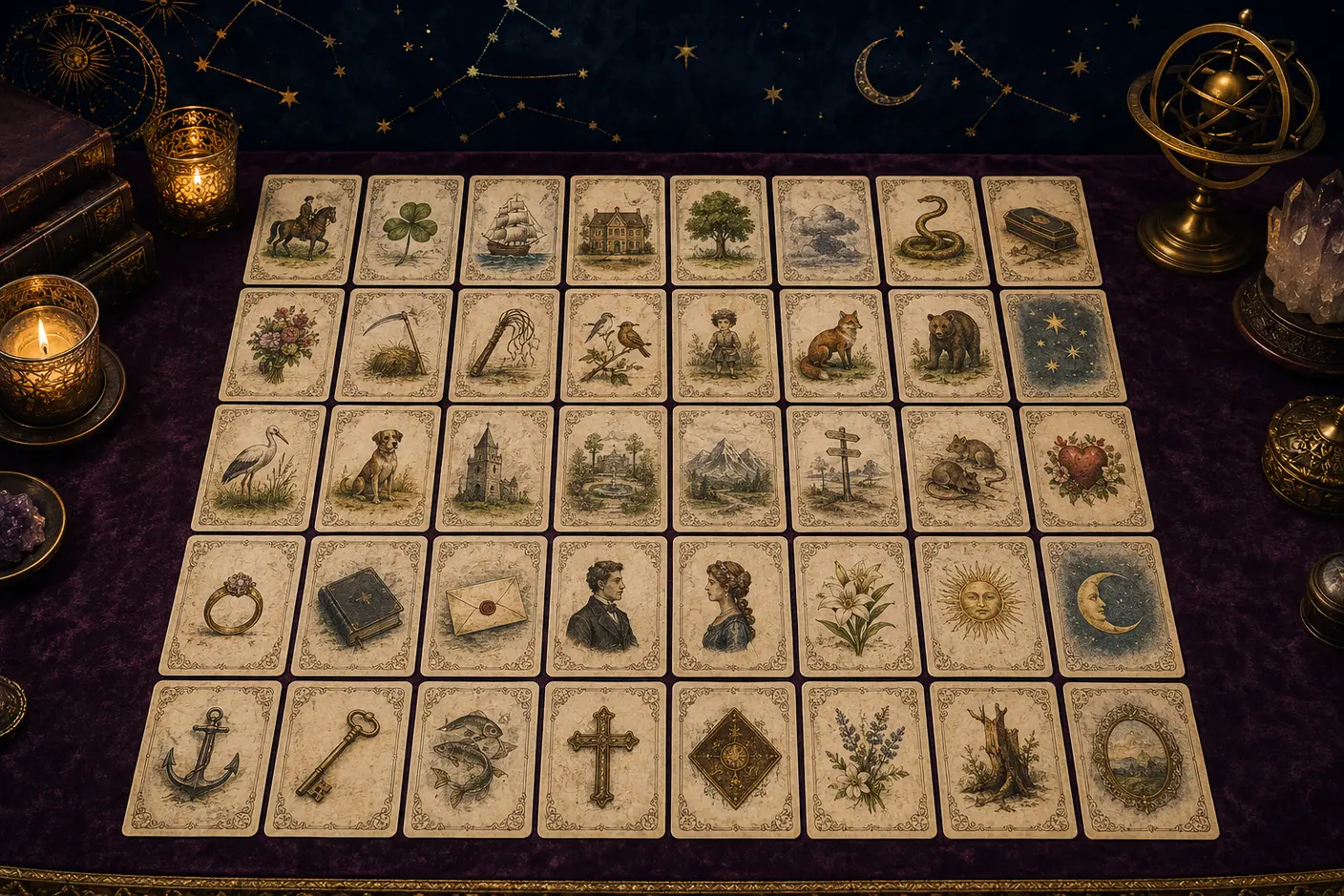
The Grand Tableau places every Lenormand card on the table. That sounds like more information, but the real skill is knowing what not to read.
A useful Grand Tableau has a clear time frame and a reading order. You locate the querent or subject, examine the nearest cards, identify the most important houses and follow only the lines that answer the question. Without that structure, thirty-six direct symbols quickly become noise.
The two common layouts
8x4 plus four
Lay four rows of eight cards. Place the final four cards as a short fifth row beneath the center. These last four are often called the fate, destiny or outcome cards, depending on the tradition. A grounded way to read them is as a concentrated summary of what becomes important later in the chosen time frame.
The irregular shape creates clear corners, edges and a special final group. It is useful when you want a broad landscape with a visible closing note.
9x4
Lay four rows of nine cards. The result is a balanced rectangle with no separate final row. This format is easy to scan horizontally, vertically and diagonally. It also places the center of the layout between cards rather than on one single position, so the significator and question cards carry more of the focus.
Neither format is more accurate. Choose the one whose structure you can read consistently.
Choose a time frame before shuffling
A Grand Tableau can describe many areas of life, so it needs a boundary. A month, three months or six months is clearer than an unlimited future. Long time frames do not automatically create better readings. They create more room for conditions to change.
You can ask for a general overview, but write two or three priority subjects before drawing, such as love, work and home. This keeps the reading from becoming a search for every imaginable event.
Step 1: locate the significator
Traditionally, Man and Woman are used as person cards. Modern decks may provide alternatives. Choose the card that represents the querent before shuffling.
Its position gives the first orientation:
- Near the left edge: much of the tableau lies ahead of the person.
- Near the right edge: more of the visible story may already be developed or closing.
- Near the top: the practical or underlying field extends below.
- Near the bottom: the person may be close to a result, limit or turning point within the spread.
These are reading conventions, not fixed predictions. The cards beside the significator matter more than the edge alone.
Step 2: read the nearest cards
Begin with the cards directly beside, above, below and diagonal to the significator. Close cards are immediate, influential or easy to access. Distant cards can describe background themes, later developments or matters requiring more effort.
If Heart, Ring and Rider cluster around the person card, relationship movement is immediate. If Mountain and Tower stand close while Heart is far away, distance and obstruction are more active than the desired emotional outcome.
Step 3: locate the question cards
Each subject has natural cards:
- Love: Heart, Ring and the relevant person cards.
- Communication: Rider, Birds and Letter.
- Work: Fox, Anchor, Bear and sometimes Tower.
- Money: Fish, Bear and Clover.
- Home: House, Stork and Tree.
- Travel or distance: Ship, Tower and Mountain.
Read the cards around the subject card, then examine its distance from the significator. A distant Ring does not mean commitment is impossible. It means commitment is not in the immediate field or requires other developments first.
Step 4: read the houses
Every position carries the symbolic house of the card with the same number. Position One is the House of Rider. Position Two is the House of Clover. Position Thirty-Six is the House of Cross.
The card that lands in a house shows what is happening within that theme. Letter in the House of Rider can show a message arriving. Mountain in the House of Ring can show a blocked agreement. The separate guide to Lenormand houses in the Grand Tableau explains the full method.
Step 5: use horizontal and vertical lines
Read the row containing the significator as its immediate narrative. Cards behind the figure may describe established context, while cards in the direction it faces may describe what receives attention. If your deck’s artwork faces differently, define the convention before reading.
The vertical line can show what is conscious or visible above and what is practical, underlying or developing below. Do not force past and future labels onto every row unless that is your chosen system.
Step 6: use diagonals and mirroring selectively
Diagonals reveal secondary paths crossing the subject. Mirroring pairs cards at equal distance across a row or column. Knighting borrows a chess-like move to connect cards that are not adjacent.
These techniques are valuable, but they belong after the main message is clear. A beginner can read an accurate Grand Tableau using significators, proximity, question cards, houses and direct lines. Extra techniques should confirm the story, not invent a new one.
How to read the final four cards in 8x4+4
Read the final four as two pairs and then one sentence. They may show the concentrated direction of the period, what becomes unavoidable or the practical result after the larger landscape unfolds.
Example: Crossroads + Letter + Key + Sun can show a decision leading to decisive information and a visible positive result. If those cards are unrelated to the stated question, treat them as a broader closing theme rather than forcing them into one subject.
A beginner reading order
- Set the time frame and priority subjects.
- Choose the significator before shuffling.
- Lay all thirty-six cards without moving them.
- Read the significator’s position and nearest cards.
- Locate the cards for each priority subject.
- Compare their distance and direction from the significator.
- Read the most important houses.
- Follow one horizontal, vertical or diagonal line that directly answers the question.
- Read the final four if using 8x4+4.
- Write a short summary for love, work, home and the overall direction.
Common Grand Tableau mistakes
- Trying to interpret all 630 possible card pairs.
- Changing the significator after seeing where it landed.
- Using an unlimited future with no timing boundary.
- Giving a distant card more weight than the immediate cluster.
- Adding mirroring and knighting before the basic story is understood.
- Repeating the tableau before the original time frame has meaningfully changed.
When to move up from nine cards
Read the Grand Tableau after pairs, three-card lines and the nine-card portrait feel natural. The large layout does not replace combination skill. It multiplies the places where that skill is needed.
The Grand Tableau reflects symbolic patterns and current direction. It cannot guarantee events, prove private facts or replace practical and professional guidance.
See the whole landscape around one question
A personal reading can separate the central story from background detail and show which development deserves your attention now.
Explore personal readingsQuick answers
How many cards are in a Lenormand Grand Tableau?
A Grand Tableau uses all 36 Petit Lenormand cards in one layout.
What is the difference between 8x4 and 9x4?
The 8x4 layout places four rows of eight cards with four final cards below. The 9x4 layout places four even rows of nine cards.
Which Grand Tableau layout is best for beginners?
The 9x4 layout is visually even and easy to scan. The 8x4+4 layout gives the final four cards special emphasis. Either works when the method remains consistent.
Do I need to read every card in a Grand Tableau?
Every card belongs to the tableau, but not every pair needs a separate interpretation. Begin with significators and question cards, then expand only where the structure supports it.
How often should I read a Grand Tableau?
Use it for a broad period or major overview rather than repeating it for the same question every few days. Many readers choose a month, quarter or another clear time frame.