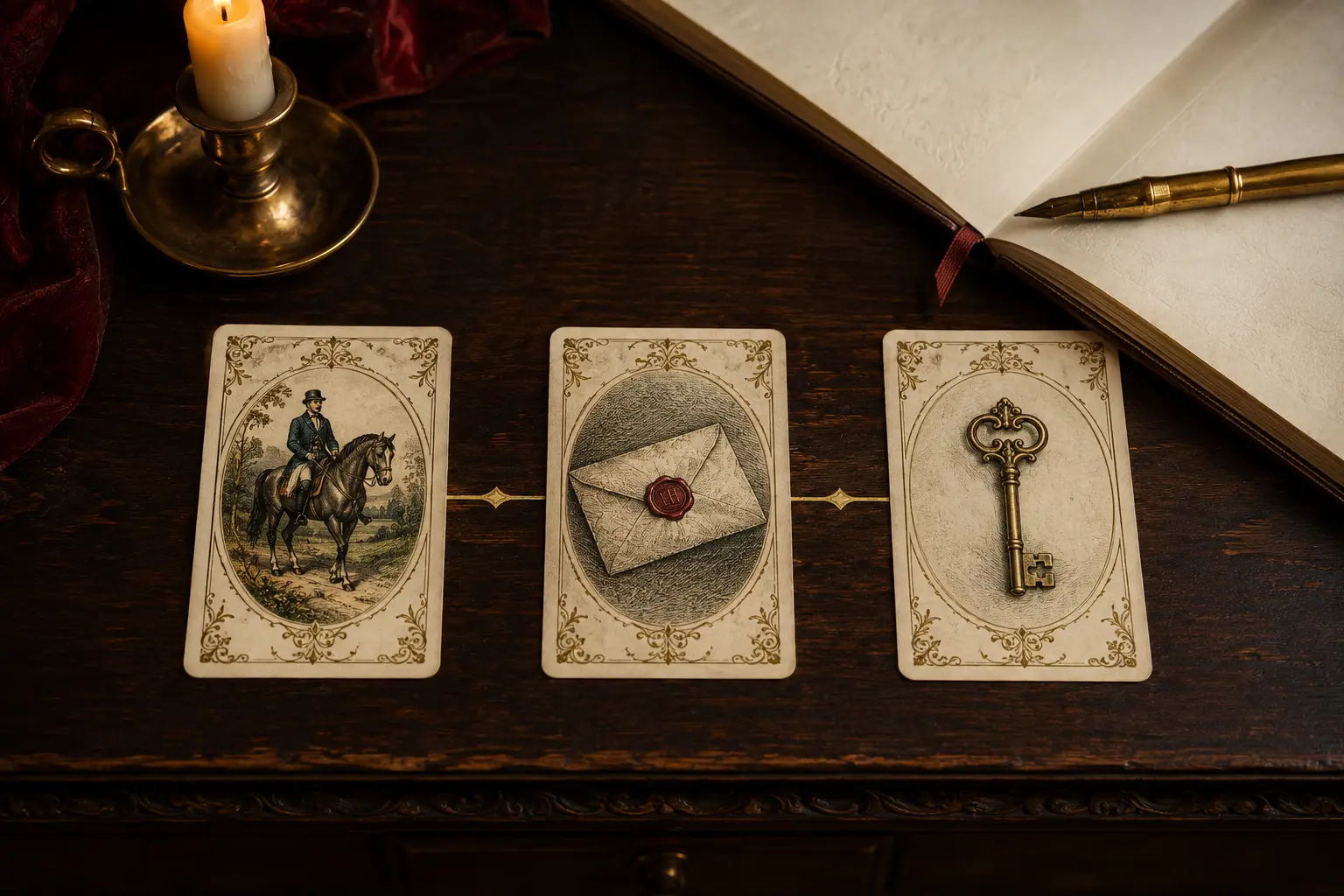
Three cards are enough to learn how Lenormand truly works. The line is short, but it requires you to connect symbols instead of giving each card a separate speech.
A good three-card reading produces one main sentence, followed by a small amount of context. If you finish with three unrelated definitions, return to the question and combine again.
Choose a question with a clear subject
Ask about one situation and, when useful, include a time frame. “What is developing around this job application over the next month?” is easier to read than “What will happen in my career?”
For relationship questions, focus on the bond or communication rather than claiming access to another person’s private mind.
Method 1: read the line as one sentence
Read from left to right. Card One introduces the subject. Card Two becomes the main action or condition. Card Three shows how it develops.
Rider + Letter + Key can read as: arriving written news brings a decisive answer. Heart + Mountain + Stork can read as: affection meets an obstacle, then the situation changes.
Method 2: make the center card the focus
The middle card often carries the central issue. The cards on either side modify it.
- Clouds + Ring + Sun: the commitment moves from uncertainty toward clarity and success.
- Fox + Letter + Key: a work document or cautious message is important and confirmed.
- Ship + Heart + Anchor: love connected with distance seeks stability or becomes established.
Method 3: use defined positions
Positions help when the question needs structure. Choose one system before drawing:
- Past, present, future.
- Situation, development, likely outcome.
- What is known, what complicates it, what helps.
- Current pace, timing condition, likely window.
Do not change the positions after seeing the cards. That makes the answer fit your preference instead of the original question.
Step-by-step reading process
- Write the question and time frame.
- Draw three cards and keep them in order.
- Give each card one direct keyword.
- Identify the central subject or action.
- Combine the first two cards, then the second and third.
- Read the full line as one natural sentence.
- Write one practical observation or next step.
Example 1: a message after no contact
Tower + Birds + Rider. Tower shows distance or separation. Birds bring conversation and active exchange. Rider brings incoming news or a person approaching.
A clear sentence is: communication approaches after a period of distance. This is not a guarantee that a specific person will contact you. It is a likely movement within the stated time frame.
Example 2: a work opportunity
Fox + Clover + Letter. Fox connects the line with work or careful self-interest. Clover brings a brief opportunity. Letter shows written communication or paperwork.
The line may describe a small work opportunity arriving through a message or document. Clover warns that the window may not remain open for long.
Example 3: relationship direction
Heart + Ring + Mice. Heart brings affection. Ring creates commitment or a repeating relationship cycle. Mice show gradual erosion, stress or reduction.
The relationship contains feeling and commitment, but worry or repeated strain is weakening the bond. The line does not need an invented third party to be meaningful.
Example 4: change of home
House + Crossroads + Stork. Home reaches a decision point and then changes. This can support moving, choosing between living arrangements or changing the household structure.
Read pairs inside the line
A three-card line contains two neighboring pairs: Cards One and Two, then Cards Two and Three. You can also read the outer pair as background.
In House + Crossroads + Stork, House + Crossroads is a choice about home. Crossroads + Stork is a decision leading to change. House + Stork confirms change connected with the home.
When the line contains contradiction
Contradiction often describes movement. Clouds + Key may show uncertainty resolving into certainty. Sun + Mountain may show a positive outcome blocked or delayed. Coffin + Rider may show movement returning after a stopped period.
Ask which card comes first and which comes last. Order tells you whether the line is closing, opening, improving or becoming more limited.
When to pull one clarifier
Use a clarifier only for a named ambiguity. If Fox could be work or caution, ask: “What area does Fox describe here?” Pull one card and attach it to Fox rather than rebuilding the whole line.
If every card receives another card, the original spread loses its structure.
Practice with one line per day
Ask a small observable question, record your sentence and return later. Daily practice teaches combination language faster than memorizing hundreds of fixed pairs.
Keep the complete thirty-six-card guide nearby, then use the full combination method when the sentence feels uncertain. When three-card lines feel natural, continue with the nine-card Lenormand portrait. The article on why a Lenormand answer feels unclear helps when repeated draws have added more symbols than direction.
Lenormand reflects symbolic patterns and likely developments. It cannot guarantee an outcome or replace factual information and professional advice.
Bring one focused question to the cards
A personal reading can connect the symbols around your situation and show the next development without adding unnecessary cards.
Explore personal readingsQuick answers
What do three Lenormand cards represent?
You can read them as one sentence, as past, present and future, or through defined positions such as situation, development and outcome.
Which card is most important in a three-card Lenormand spread?
The middle card often acts as the central subject. The first card sets the context and the third shows how the line develops.
Should I read three Lenormand cards left to right?
Yes. Left-to-right reading is a clear beginner method. You can also read the outer cards as modifiers of the center card.
Can I pull a clarifier for a three-card line?
Pull one only when you can name exactly what needs clarification. Repeated extra cards can weaken the clean structure of the line.
How often can I repeat the same Lenormand question?
Repeat when the situation or available information has changed. Immediate repetition often creates more combinations without adding clarity.