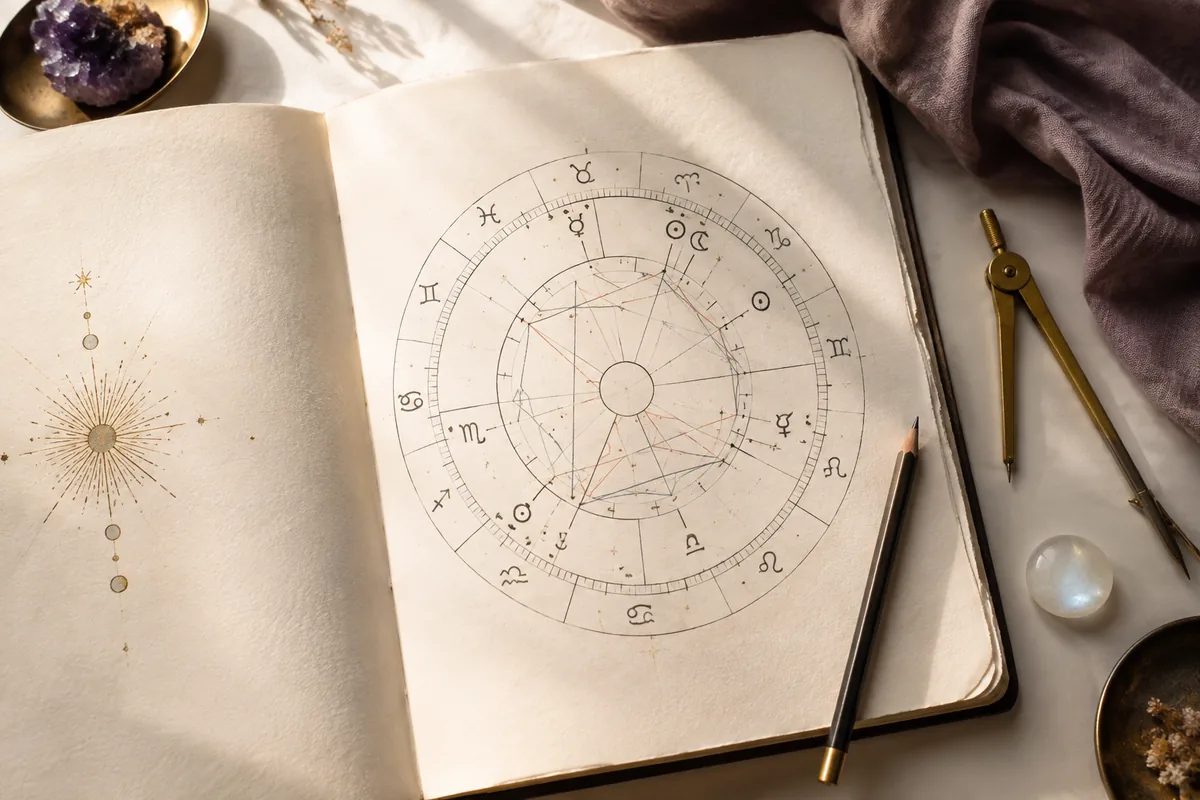
A natal chart can look like a page filled with symbols, lines and twelve separate compartments. The chart becomes readable when you stop treating every placement as an isolated fact and follow a consistent order.
This guide gives you that order. It begins with the chart’s structure, moves through the planets and houses, then brings the strongest themes together into one interpretation.
What you need before the analysis
Use the birth date, exact birth time and birthplace. The time determines the Ascendant, Midheaven and house cusps. A difference of several minutes can matter when an angle sits close to the next sign.
If the birth time is unknown, read the planets by sign and their aspects, but do not present the houses or Rising sign as certain. A noon chart is a working reference, not a substitute for verified time.
Step 1: Read the four angles
The Ascendant describes how a person enters experience and meets unfamiliar situations. The Descendant opens the relationship axis. The Midheaven points toward public direction, vocation and visibility. The Imum Coeli describes roots, home and the private foundation.
These four points create the skeleton of the chart. Notice their signs before reading the planets placed near them.
Step 2: Read the Sun, Moon and Rising sign
The Sun describes identity, purpose and the qualities a person grows into. The Moon describes emotional needs, instinctive responses and what creates inner steadiness. The Rising sign describes the approach to life and the style through which the rest of the chart is expressed.
Do not force the three to agree. A Capricorn Sun may want measured progress, while an Aries Moon reacts immediately. The contrast is not an error. It is part of the person’s real inner movement.
Step 3: Find the chart ruler
Identify the planet that rules the Rising sign. For example, Mercury rules Gemini and Virgo, Venus rules Taurus and Libra, and Mars rules Aries. Read the chart ruler by sign, house and major aspects.
A Virgo Rising with Mercury in the tenth house may organize life around skill, competence and public contribution. If Mercury squares Saturn, confidence in the voice may develop through discipline and experience rather than appearing fully formed at the beginning.
Step 4: Add the personal planets
Mercury describes thinking and communication. Venus describes attraction, values and the way connection is received and offered. Mars describes desire, assertion and action. Read each planet as a complete sentence: planet, sign, house, aspects.
Venus in Leo in the eleventh house, for example, may seek generous affection and loyalty through friendship, community or shared creative circles. A close opposition from Saturn would add selectivity, responsibility or caution around trust.
Step 5: Read the houses with planets
Houses show the life areas where planetary energy becomes visible. Begin with houses containing the Sun, Moon, chart ruler, Venus, Mars or several planets. A concentrated house often carries more weight than an empty one.
Then read the sign on each house cusp and locate its ruling planet. This links one part of life with another. If the ruler of the seventh house is in the tenth, relationships may connect strongly with public life, vocation or long-term direction.
Step 6: Read the major aspects
Aspects describe how planets exchange energy. Conjunctions merge. Oppositions create two poles that need awareness and balance. Squares create friction and movement. Trines show an established flow. Sextiles show an opportunity that grows through use.
Prioritize close aspects involving the Sun, Moon, angles, chart ruler and personal planets. A chart with many lines does not require every minor aspect to receive equal attention.
Step 7: Look for repetition
The most trustworthy interpretation usually appears more than once. A strong water emphasis, Moon near an angle and several planets in the fourth or eighth house may repeat themes of emotional sensitivity, privacy and deep bonding.
Repetition matters more than one placement taken out of context. It tells you which patterns organize the chart and which details are supporting notes.
A complete synthesis example
Imagine Taurus Rising, Venus in Gemini in the second house, Sun in Cancer in the third and Moon in Capricorn in the ninth. Taurus Rising seeks stability and a measured approach. Venus as chart ruler in Gemini connects security with ideas, language and adaptable skills. The Cancer Sun in the third adds memory, emotional intelligence and a need to communicate with care. The Capricorn Moon in the ninth finds steadiness through structure, study and a wider framework for life.
The synthesis is not four separate descriptions. It becomes: this person builds stability through useful ideas and thoughtful communication, while emotional maturity grows through study, perspective and long-term meaning.
What a responsible analysis does not claim
A birth chart does not prove a fixed fate, a guaranteed marriage, a medical condition or one unavoidable career. It gives symbolic language for patterns and potentials. The reading becomes more accurate when it is connected with age, culture, experience and real circumstances.
Continue with the Big Three guide, explore the twelve houses and read what a professional birth chart reading can reveal.
Continue with the chart ruler method, stelliums and empty houses.
Astrology supports reflection and symbolic interpretation. It does not replace medical, legal, financial or mental health guidance.
Pinterest birth chart library
Save 6 different guides
Each image contains a separate chart-reading method or cheat sheet worth returning to.
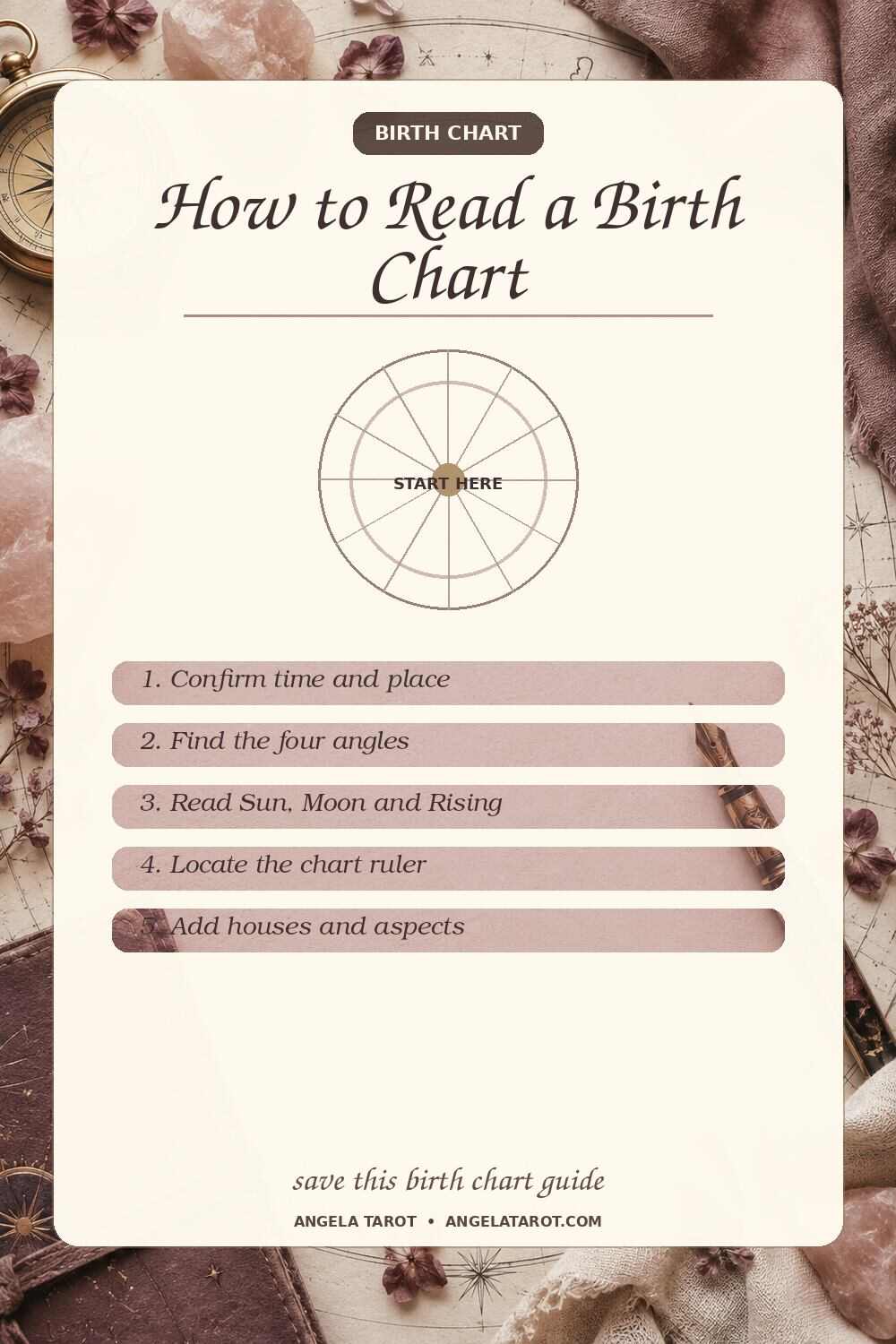
How to Read a Birth Chart
Save this guide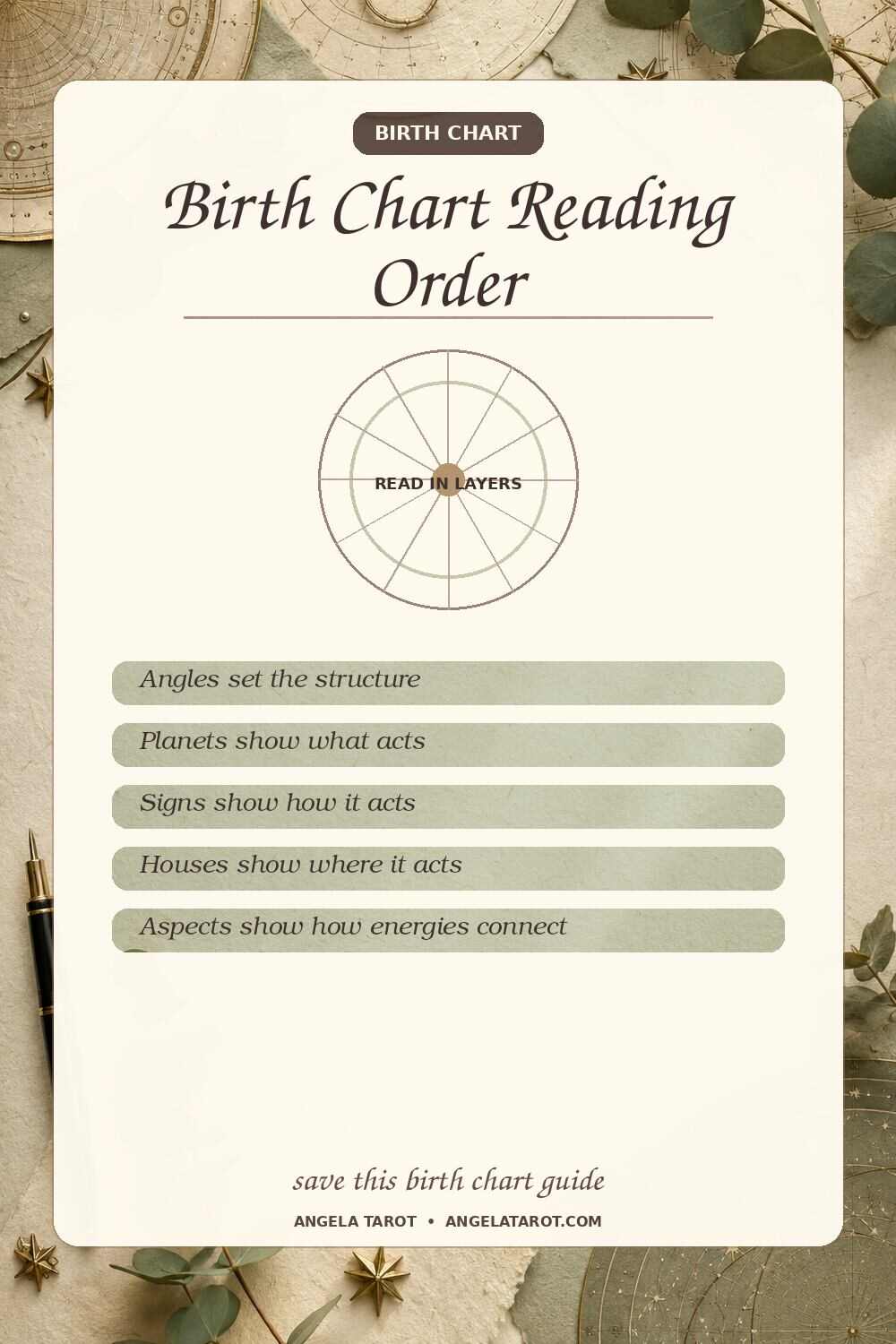
Birth Chart Reading Order
Save this guide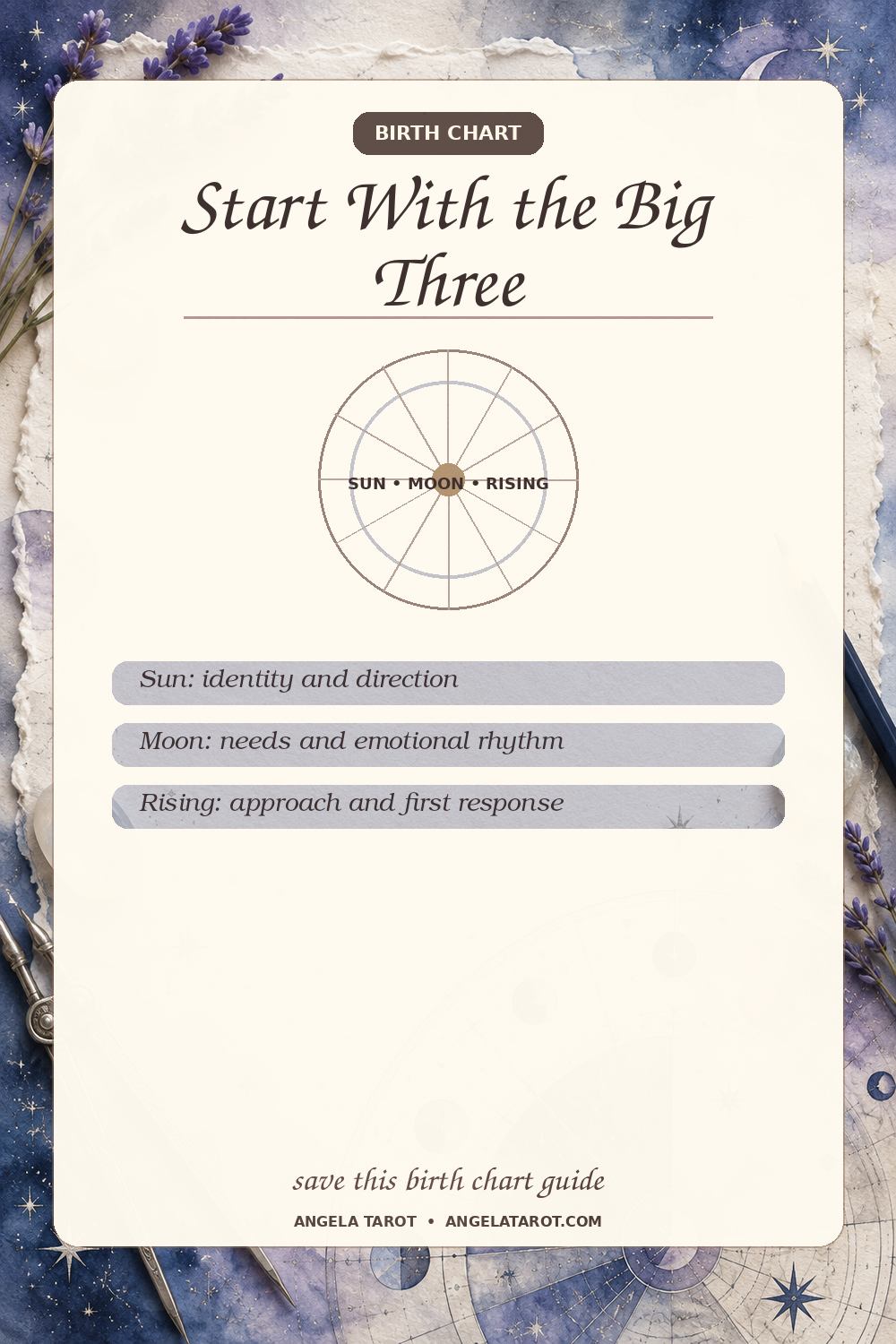
Start With the Big Three
Save this guide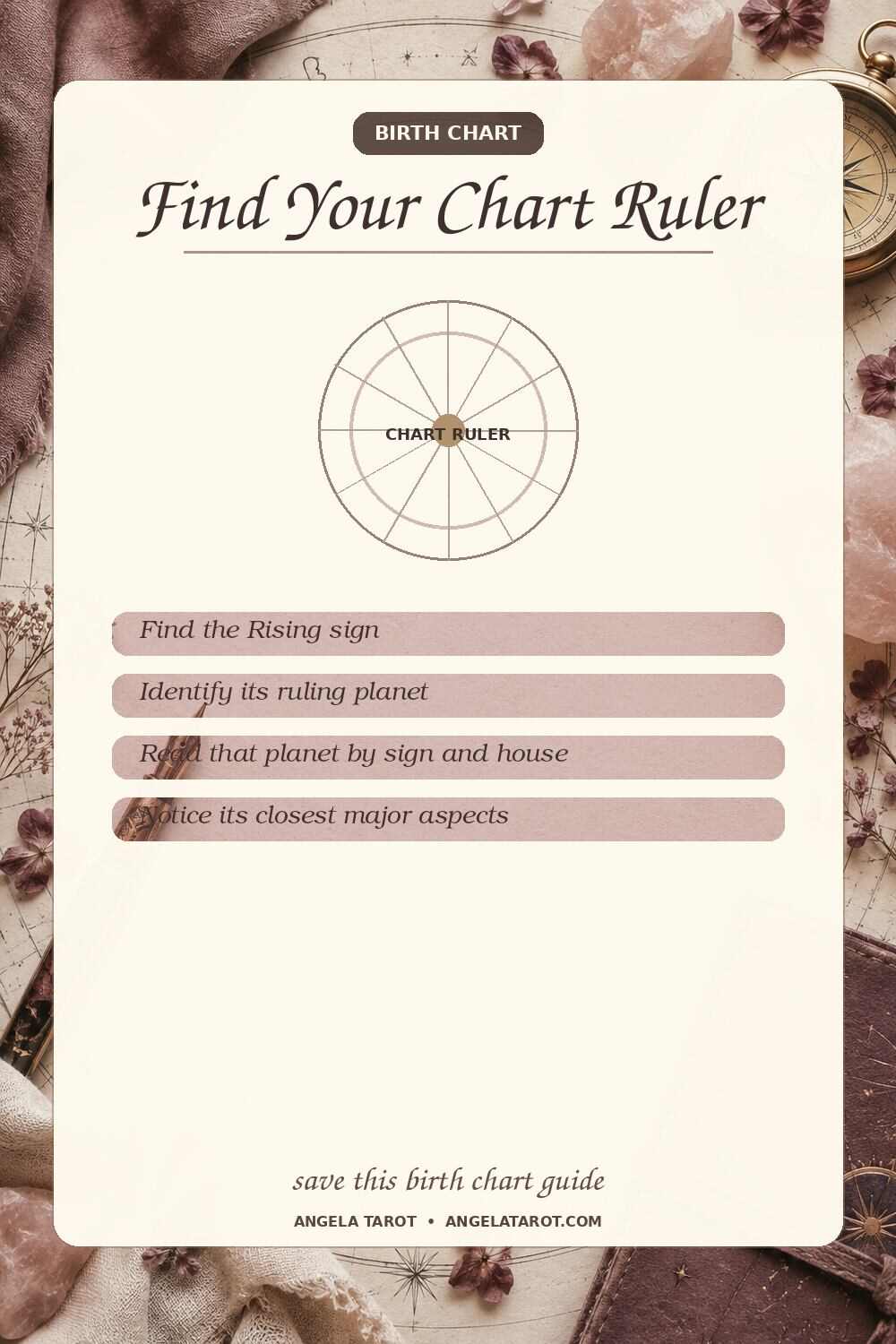
Find Your Chart Ruler
Save this guide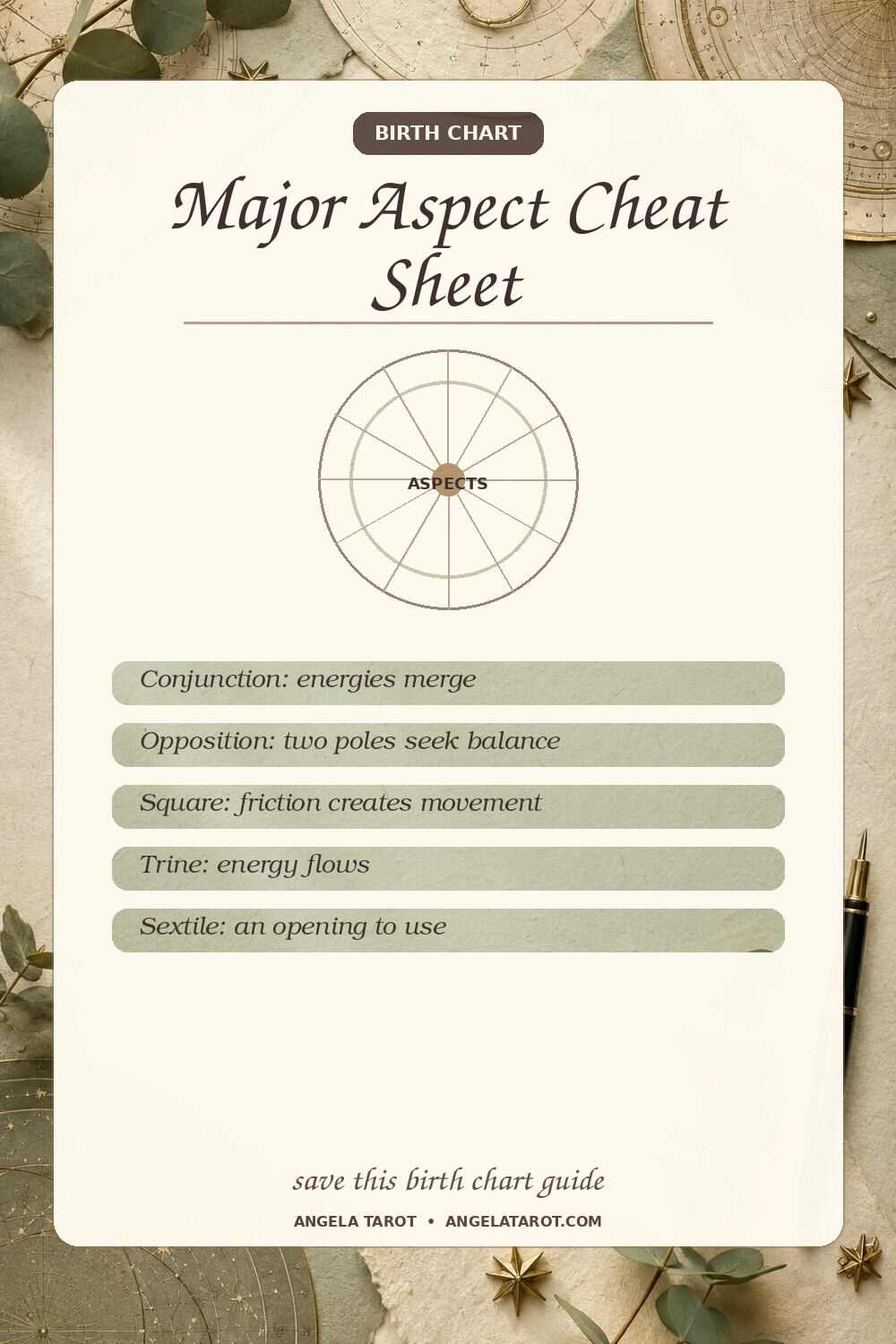
Major Aspect Cheat Sheet
Save this guide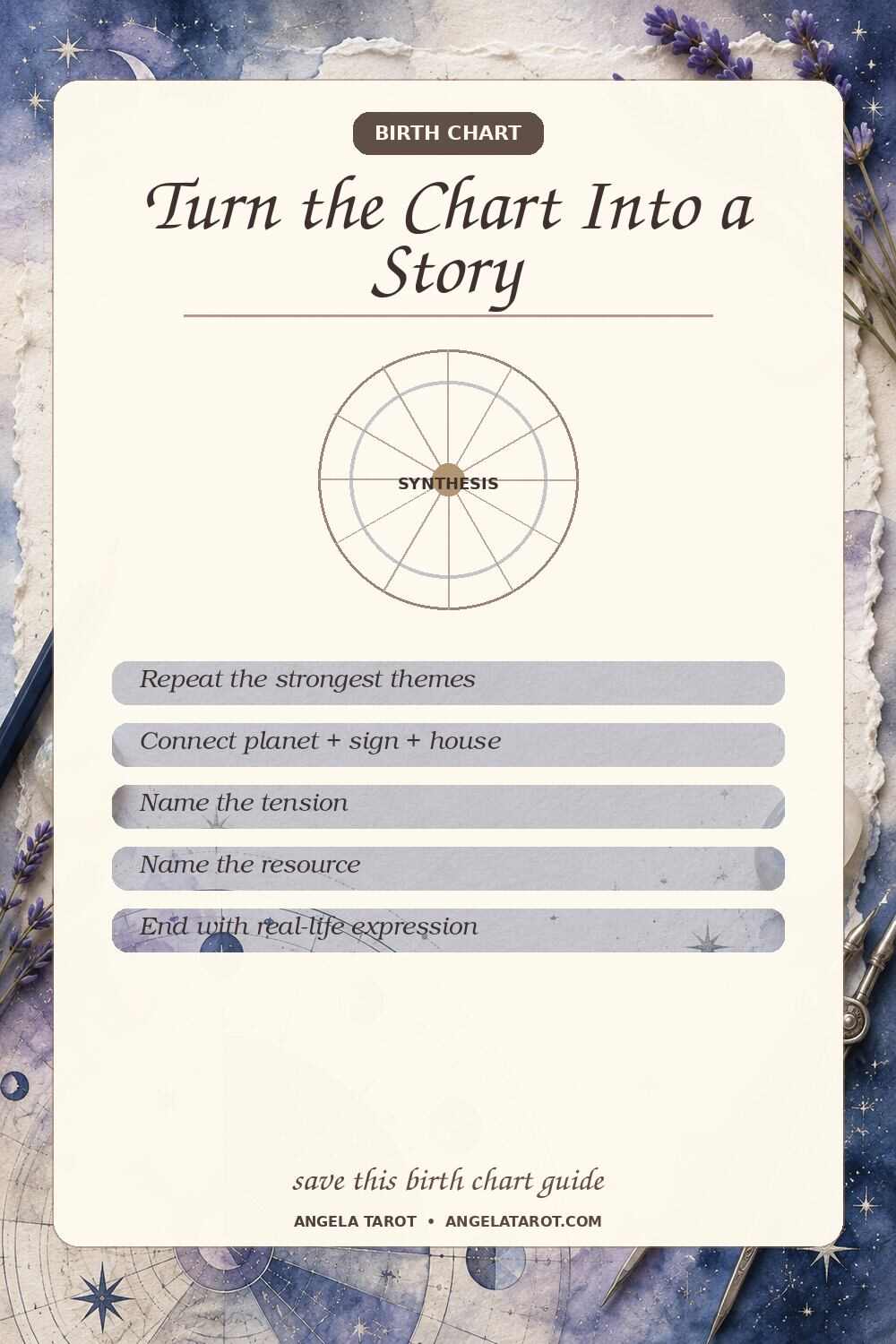
Turn the Chart Into a Story
Save this guideExplore your own birth chart
A personal analysis can connect the placements, houses and aspects that shape your individual chart.
Explore birth chart readingsQuick answers
What should I read first in a birth chart?
Begin with the Ascendant and the Sun and Moon. Then add the chart ruler, personal planets, houses and major aspects.
Do I need an exact birth time?
An exact time is important for the Ascendant, house cusps and angles. Without it, planets by sign can still be read, but house interpretation is uncertain.
What is the chart ruler?
The chart ruler is the planet that rules the Rising sign. Its sign, house and aspects often describe how a person meets life and directs energy.
Which aspects matter most for beginners?
Start with close conjunctions, oppositions, squares, trines and sextiles involving the Sun, Moon, Ascendant ruler, Venus or Mars.
Can a birth chart predict everything that happens?
No. A chart describes patterns, needs and potentials. Timing, environment, choices and lived experience shape how those patterns develop.