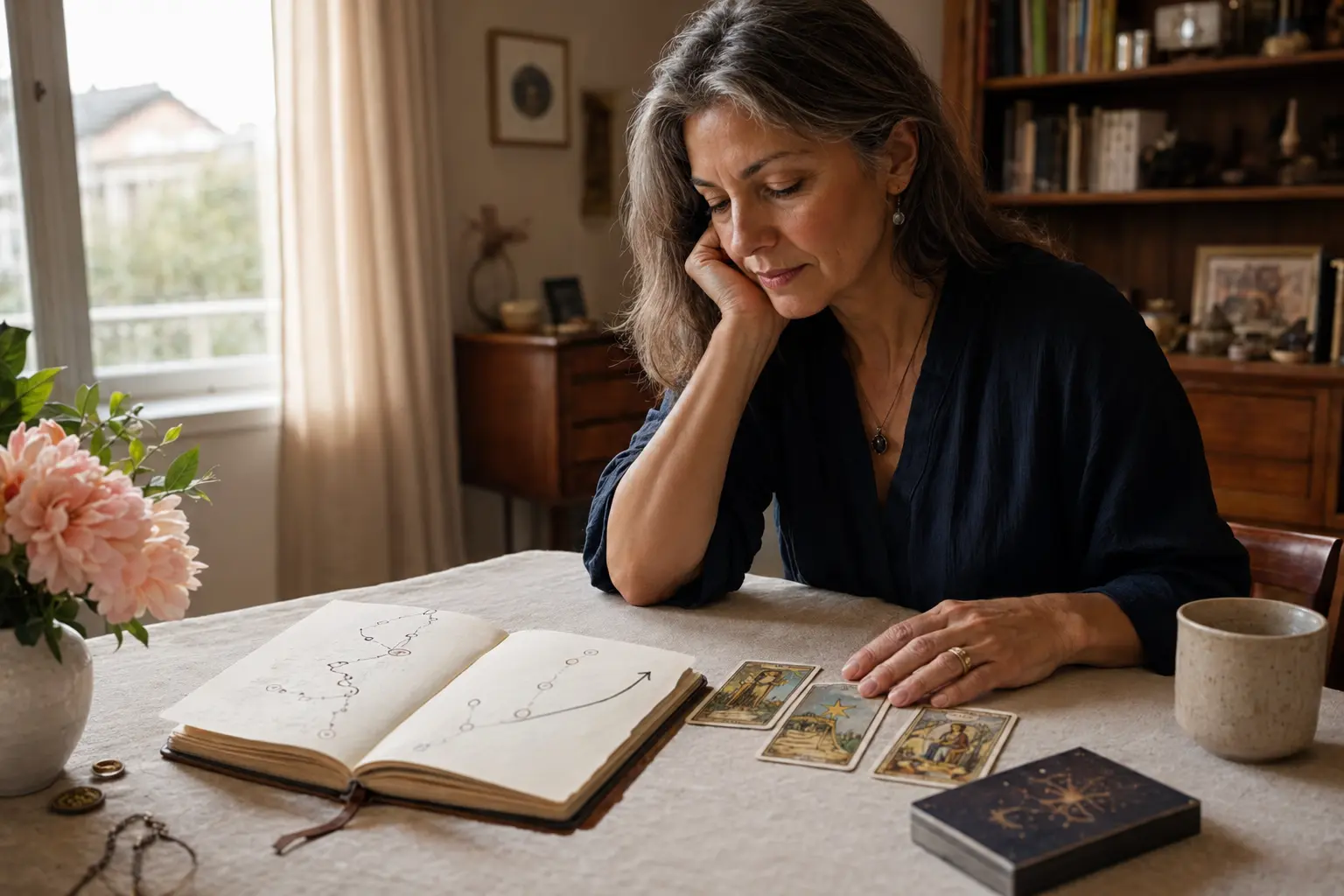
The date passed. The message never came. The offer went to someone else. The relationship that was meant to deepen remained exactly where it was. A prediction can feel luminous when you receive it and deeply confusing when life refuses to match.
Why did your tarot prediction not come true? There is no single answer that protects every reading. The circumstances may have changed, the timing may have been misread, the cards may have been interpreted too literally, or the prediction may simply have been wrong.
Honesty does not weaken tarot. It creates the trust needed to use it with maturity. The goal is not to force reality to defend the cards. The goal is to understand what the reading actually showed, what happened afterward and what you can learn without blaming yourself.
A prediction is a claim that can be reviewed
A forecast should have enough shape to be evaluated. “Important changes are coming someday” can be stretched around almost anything. “You are likely to receive contact within six weeks, after a practical issue creates a reason to speak” has a time frame, an event and a condition.
When a specific prediction misses, call it a miss before searching for a hidden victory. The contact did not occur in six weeks. The event may still happen later, but that does not make the original timing accurate.
This clear language protects both reader and client. It leaves room for spiritual meaning while keeping one foot in observable life. It also separates a changed path from an interpretation that was never strong enough to support the promise made.
A useful reading does not need reality to be edited after the fact.
1. The reading described a path that later changed
Tarot often reads momentum. At the time of the spread, a person may have been close to reaching out, an employer may have been leaning toward an offer or a relationship may have been moving toward commitment. Then a decision, conversation or outside event altered the route.
This explanation is strongest when there is a visible change. Perhaps you set a new boundary. The other person entered a different relationship. The company froze hiring. A family responsibility changed your availability. The original conditions no longer exist.
Free will belongs here, but it should not become a blanket excuse. Saying “free will changed it” without identifying any changed choice can make every prediction impossible to question. Ask what specifically shifted, when it shifted and whether the original reading named that choice point.
A forecast that includes both outcome and turning point is easier to understand later. That is why the guide to how tarot predictions really work reads trajectory and choice together.
2. The timing was wrong
A reading can identify the general development and still place it in the wrong window. The cards may have reflected the first impulse rather than the final action. Page of Cups could show someone considering a message, while the actual contact takes longer. Ace of Pentacles may mark an application or opportunity entering the field, not the day a contract is signed.
Timing traditions also vary. Numbers, suits, astrology, seasons and visual pace can produce different answers. If a reader combines them without a consistent system, precision can become more theatrical than dependable.
When the time frame closes, record the timing as inaccurate. Do not keep extending “within a month” into three months, then a year. If the event later happens, you can note that the theme appeared while the calendar did not.
For a more useful way to read dates, windows and event conditions, see how tarot timing works through pace, window and trigger.
3. The cards were interpreted too literally
Tarot speaks through image, pattern and relationship. A card can describe an outer event, an inner realization or both. The mistake is not reading symbolically. The mistake is choosing one literal event without enough support.
The Tower does not always mean a breakup, job loss or visible crisis. It may mark the collapse of an assumption. Death does not automatically predict physical death. It usually speaks to endings, transition and a form that can no longer continue. Three of Swords may describe grief, a difficult truth or separation, but the surrounding cards decide how that theme takes shape.
Suppose a reader predicted that you would leave your job because Eight of Cups appeared. If you stayed but emotionally detached, changed departments or stopped building your identity around the role, the card may have been relevant while the literal forecast was too narrow.
This distinction should not be used to claim accuracy at any cost. Ask whether the symbolic meaning was present in the original reading. A new interpretation invented after the result is known is not the same as a layered forecast given beforehand.
4. Hope or fear shaped the interpretation
Readers are human. Clients are human. Strong desire can pull attention toward one meaning while other cards fade into the background.
In a reconciliation spread, Six of Cups may feel like a clear return. Yet Six of Cups can also describe memory, nostalgia or the emotional history that keeps the question alive. If it appears beside Eight of Cups and The World, the larger story may be about honoring the past and completing it, not reopening the relationship.
Fear can distort the reading in the other direction. One difficult card may be treated as disaster while supportive cards are ignored. A spread becomes accurate through the whole pattern, not through the card that speaks most loudly to the emotion already present.
Before deciding on the prediction, ask:
- What evidence in the spread supports this outcome?
- Which cards complicate it?
- Am I reading the card, or the answer I most want to hear?
- What alternative interpretation fits the same combination?
Learning to read cards together reduces the temptation to let one beautiful symbol carry an entire future. This guide to tarot card combinations shows how the cards modify one another.
5. The question was repeated until the message became noise
One reading says contact is possible. The next says delay. A third says closure. By the fifth spread, the cards seem to be answering five different questions even though the wording never changed.
Repeated readings do not create more certainty. They often capture changing emotion, different interpretations and the reader's growing investment in finding one preferred answer. The newest spread then replaces the previous one before life has had time to move.
Set a review point when you read. If the question covers three months, let the situation develop unless something materially changes. A new mood at 11 p.m. is not a new set of conditions.
If the urge to ask again becomes difficult to resist, place the cards away for a period. Return to what is directly known: the last conversation, the action taken, the application sent, the boundary stated. Tarot should add perspective to reality, not make reality feel inaccessible without another draw.
6. Another person made a different choice
Relationship predictions contain at least two lives. A spread may show attraction, regret or the impulse to reconnect. None of those feelings guarantees behavior.
Someone can miss you and remain silent. They can feel love and still lack the capacity for partnership. They can plan to return and then choose familiarity, avoidance, another connection or no action at all. Emotion and action are different cards in the human story.
A reader should distinguish what appears to be felt from what appears likely to be done. King of Cups can hold deep emotion without outward display. Two of Swords can refuse a decision. Knight of Wands can approach with intensity and leave without consistency.
Predictions about another person's behavior deserve softer certainty because their inner process is not yours to control. The reading should still bring you back to the part of the future that belongs to you.
7. The reader was wrong
This is the explanation the tarot world can be most reluctant to say, and sometimes it is the cleanest one.
A reader can misunderstand a card, overstate a weak pattern, use an unreliable timing method or let confidence outrun evidence. Experience reduces some errors. It does not make anyone infallible.
A trustworthy reader does not blame you for “blocking the energy” every time a promise fails. They do not claim that doubt cancelled the prediction. They can acknowledge uncertainty, name the limits of the spread and accept that an interpretation missed.
Look for language that is clear about confidence. “This is the strongest path I see now” is different from “This must happen.” A reader can speak with warmth and conviction while leaving space for life to remain alive.
Changed path, missed timing or inaccurate reading?
| What you notice | Most useful interpretation | What to do |
|---|---|---|
| A visible decision or outside event changed the conditions | The earlier trajectory may have been redirected | Read the new situation only if a new decision is needed. |
| The theme appeared, but outside the stated window | The timing missed, even if part of the event was recognized | Record both the thematic hit and the timing error. |
| A symbolic theme fits, but the promised event did not | The literal interpretation may have been too narrow | Check whether the symbolic layer was stated before the outcome. |
| Nothing in the forecast matches what occurred | The prediction was inaccurate | Accept the miss and return to current facts. |
Not every reading needs to be rescued. Sometimes its value is the question it helped you face, even if its forecast did not land. That value is different from predictive accuracy, and the two should not be confused.
How to review the original reading fairly
Memory changes a reading. We remember the sentence that carried the strongest hope and forget the conditions around it. A written record brings the full message back.
- Return to the exact question. Was it about contact, reconciliation, commitment or simply emotion?
- Find the stated time frame. Was there a real deadline, a broad season or no period at all?
- Separate forecast from guidance. Which part claimed an event, and which part advised an action?
- List visible changes. What decision, information or outside event entered after the reading?
- Compare without rewriting. Use only meanings that were actually present in the original interpretation.
This method is not cold. It is kind to your mind. It releases you from endlessly wondering whether the event is still “about to happen” because someone once named it.
Should you get another reading?
A new reading can help when the situation has genuinely changed and you have a new question. Perhaps contact occurred but created a different decision. Perhaps a job opportunity closed and another opened. The next spread then reads a new landscape.
Another reading is less useful when its only purpose is to restore the old promise. If the question remains “Will the prediction still happen?” week after week, the reading can become reassurance rather than insight.
Before drawing again, ask:
- What do I know now that I did not know then?
- Is there a new choice in front of me?
- Would any answer change what I need to do today?
If the answer is no, waiting for more cards may keep you tied to a future that has stopped participating in the present.
A four-card spread for what changed
- The original trajectory: What path was active at the time of the first reading?
- The change: Which choice, event or misunderstanding altered the forecast?
- The truth now: What is observable and available in the present?
- Your next step: What choice restores clarity without waiting for the old prediction?
Use this spread once, after enough time has passed to evaluate the original reading. Do not use it to keep the same date alive. Its purpose is closure, learning and a clean relationship with the current moment.
A missed prediction is information too
Sometimes the most powerful thing a reading can reveal arrives after the cards. You notice how much of your life you placed around one forecast. You see the difference between potential and participation. You learn which kind of certainty makes you abandon what your own eyes are showing.
Tarot does not become meaningful only when every event lands exactly on schedule. Its meaning can live in symbol, reflection, spiritual connection and the moment a hidden pattern becomes visible. Prediction is one part of the practice, and it deserves honest standards.
If a forecast did not happen, you are not at fault for failing to believe hard enough. Review it clearly. Keep what was true. Release what was not. The future in front of you is more important than defending the future someone once described.
Read the path that exists now
If circumstances have changed and a new decision is genuinely in front of you, a fresh reading can explore the current trajectory without forcing an old prediction to remain alive.
Explore personal tarot readingsMissed tarot predictions: quick answers
Does a missed prediction mean tarot does not work?
A missed prediction means the specific forecast should be reviewed honestly. The path may have changed, the timing or interpretation may have been inaccurate, or the reader may have been wrong. One result cannot prove every possible claim about tarot.
Can free will change a tarot prediction?
Choices can change a predicted trajectory, especially when the reading involved behavior, contact, relationships or an opportunity that still required action. Free will should not be used as an automatic excuse for every inaccurate forecast.
Should I get another reading when a prediction does not happen?
First review the original wording, time frame and observable changes. One fresh reading may help if the situation is genuinely different. Repeating the question until a preferred answer appears usually creates more confusion.
Can tarot timing be wrong while the event is still right?
Yes. A reading may identify a likely development but place it in the wrong window, or the cards may have marked the beginning of a process rather than its final result. The original time frame should still be treated as missed rather than endlessly extended.
How can I test the accuracy of a tarot prediction?
Write down the exact question, cards, interpretation, time frame and conditions before events unfold. Later compare the forecast with observable results without adding meanings that were not present in the original reading.
Tarot offers spiritual guidance, symbolic reflection and possible future trajectories. It cannot guarantee events and does not replace medical, legal, financial or mental health advice.