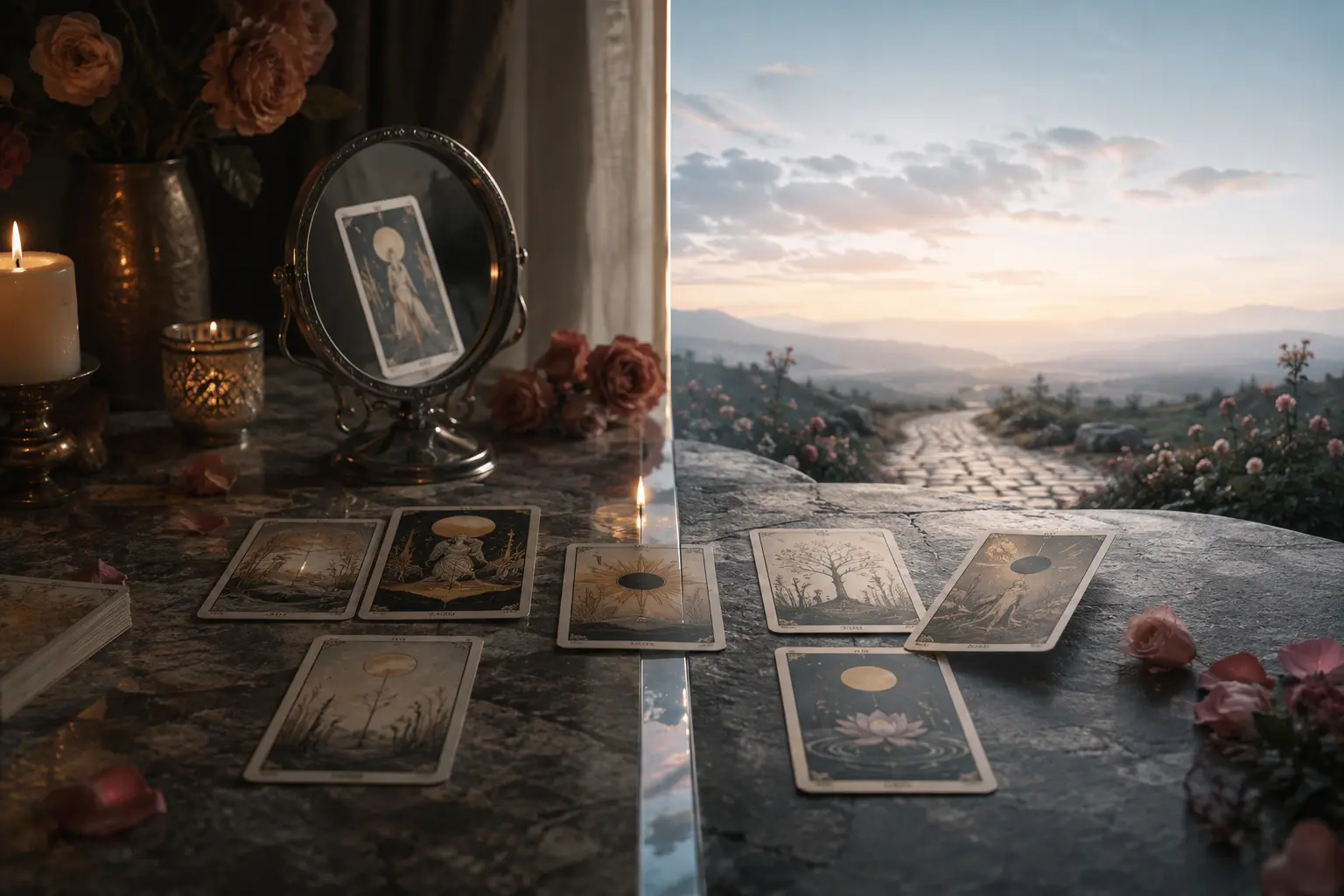
A card can feel predictive simply because its image is strong. Yet many readings called “future” are actually describing what is already happening beneath the surface.
The difference matters. If The Tower names a present realization, waiting for an external crisis misses the message. If Two of Cups describes a likely future connection, treating it as proof of a current mutual bond moves too far ahead of the evidence.
1. Start with the exact spread position
Position gives the card its tense. A card under “current energy” should be read in the present unless there is a strong reason not to. A card under “likely outcome” describes direction, not certainty.
Avoid layouts where every position is vague. “What surrounds me” can absorb past, present and future until the interpretation becomes impossible to test.
2. Compare the card with observable facts
Write what is already known before you read. Messages have stopped. An application has been submitted. A person has made an offer. These facts help you see whether the card reflects the existing state or adds a plausible next development.
If Eight of Wands appears after messages have already increased, it may describe the present. If communication has been still for months and the card falls in a future position, it may point to upcoming movement.
3. Listen for the tense in your language
Notice whether you say “is,” “has been” or “will.” Readers often slide into future tense because it feels more important. Change the sentence deliberately:
- Present: “The Hermit shows that distance is shaping the connection now.”
- Pattern: “The Hermit shows a repeated tendency to withdraw before speaking.”
- Future: “The Hermit shows a likely period of distance ahead.”
Only one sentence will usually fit the position and evidence best.
4. Separate energy from event
Energy is a quality or direction. An event is something observable. The Empress may show receptive, creative energy without predicting pregnancy. The Chariot may show focused determination without predicting travel.
To move from energy to event, ask what concrete form is supported by the question and neighboring cards.
5. Look for a bridge card
In a three-part spread, the middle card often shows how the present becomes the future. Present Five of Pentacles, bridge Six of Pentacles and future Ace of Pentacles tell a different story from Five of Pentacles, bridge Four of Pentacles and future Eight of Swords.
The bridge protects you from treating the final card as disconnected fate.
Cards that often describe the present
Four of Swords, Two of Swords, Seven of Pentacles and The Hanged Man commonly name a current pause or waiting period. The Moon may name uncertainty that already exists. The Devil may expose an attachment operating now.
This is not a fixed rule. The spread position still comes first.
Cards that often show development
Aces begin, Knights move, Eights build momentum and Tens complete. Wheel of Fortune, Death and Judgement often describe transition from one phase into another. These cards can act like verbs in the reading.
Outcome is not the same as destiny
An outcome card answers: “Where does this lead if the present pattern continues?” It is the end of the spread’s sentence, not the end of all choice.
If the outcome is difficult, identify the bridge and advice cards that can alter it. If the outcome is hopeful, identify what supports it. A positive card without the required action can remain potential.
A five-card tense check
- What is factually present?
- What pattern is continuing from the past?
- What is beginning but not yet visible?
- What future is most likely if nothing changes?
- What choice can influence that direction?
Example: Two of Cups in a future love reading
Two of Cups can indicate future mutuality, but first check the present. Are you already building a bond with someone, or is the card describing the kind of exchange becoming available? An Ace nearby may point toward a new person. Six of Cups or Judgement may connect the message with the past.
Continue with Can Tarot Predict the Future? and why a tarot prediction may not come true for a wider view of choice, timing and changing conditions.
Tarot can describe present patterns and likely developments. It does not establish a fixed future or remove the effect of choice and changing circumstances.
Separate what is happening from what may happen next
A personal reading can clarify the present pattern, the likely direction and the choices that still remain open.
Explore tarot readingsQuick answers
Does every outcome card predict the future?
No. An outcome card shows the likely direction if the current pattern continues. It can also summarize what the situation is already becoming.
Can a future card describe the present?
Yes. A card in a future position may show an energy already beginning now, especially when the transition is gradual.
How can I stop projecting onto a future reading?
Write down the observable facts before interpreting, use defined spread positions and separate what you know from what the card adds.
Why do repeated cards appear in present and future positions?
Repetition can show that the current pattern is likely to continue unless a choice or outside condition changes it.
Can tarot predictions change?
Yes. Tarot reflects current momentum and conditions. New choices, information and outside events can change the likely development.