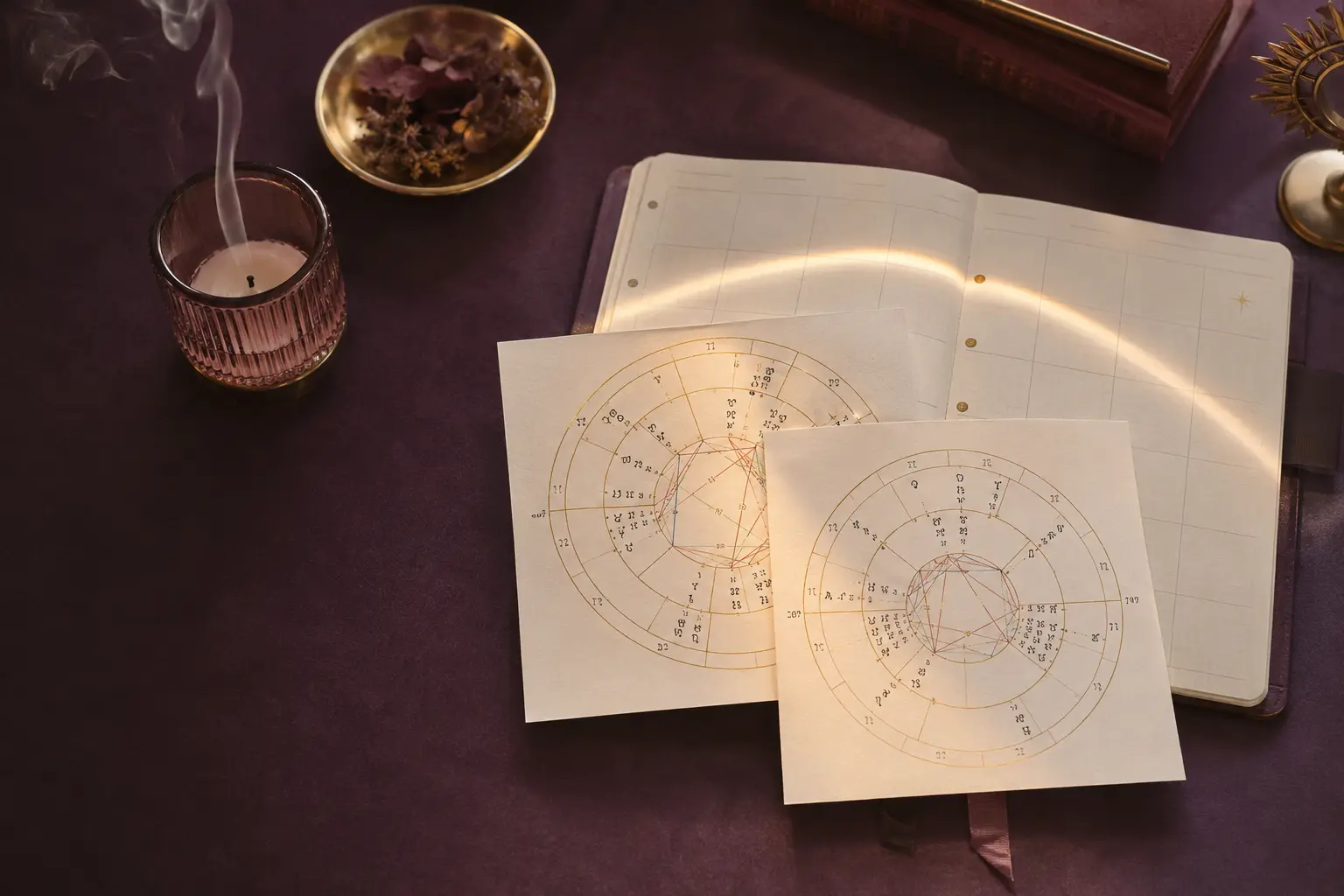
Once each year, close to your birthday, the Sun returns to the exact zodiacal degree and minute it occupied when you were born. Astrologers cast a new chart for that moment. This is your Solar Return, a symbolic map of the themes asking for attention from one birthday to the next.
The natal chart remains the foundation. It describes the lifelong architecture. The Solar Return does not replace it. It places a transparent layer over that foundation and shows which rooms may become busier during this particular year.
Some years turn attention toward work and visibility. Others bring home, relationships, study, healing or a complete change in pace to the foreground. The Solar Return helps name the emphasis before the year has finished telling its story.
How a Solar Return chart is calculated
Your birthday follows a calendar. The Solar Return follows the Sun's position. Because the calendar year and the solar cycle do not align perfectly, the return may occur on your birthday, the day before or the day after, and at a different clock time from your birth.
The chart is calculated for the precise moment the transiting Sun reaches the same zodiacal longitude as your natal Sun. The planets continue moving through the sky, so each annual return has a new Moon, Rising sign, house pattern and network of aspects.
Astrologers use the location where the person is physically present for the return, the birthplace, or another chosen method depending on their school. Location can change the angles and houses, so a responsible reading should state which location was used. I do not treat birthday travel as a way to manufacture a guaranteed outcome. A chart is interpretive context, not a loophole around life.
What a Solar Return can reveal
A Solar Return is most useful for emphasis. It can show where energy, responsibility, desire or change may collect during the year. It can also reveal the inner posture with which you are meeting that period.
It may help you explore:
- the central life area seeking conscious attention,
- the emotional tone and changing needs of the year,
- where growth may require visibility, courage or structure,
- which relationships or responsibilities move toward the foreground,
- and how the year's themes connect with your natal patterns.
It cannot guarantee that a promotion, marriage, move or breakup will occur. A prominent seventh house may bring partnership to the center, but that could mean beginning a relationship, redefining one, negotiating a contract or learning through another person's presence.
The Solar Return does not hand you a list of events. It shows where the year is likely to become personally meaningful.
Begin with the Solar Return Ascendant
The Solar Return Rising sign describes the approach, pace and lens of the year. It is not a new permanent personality. It is more like the style of movement the year asks you to practice.
A fire Ascendant may bring visibility, initiative and a need to act. Earth can emphasize building, simplifying and making choices tangible. Air may increase conversation, mobility, learning or social contact. Water can turn attention toward emotional reality, intuition, family or inner repair.
The planet ruling the Rising sign becomes especially important. Its sign, house and aspects show where the year's approach is carried. If Libra rises, Venus is the annual chart ruler. Venus in the tenth house would tie the relational, aesthetic or value-based tone of the year to career, reputation or public direction.
The house of the Solar Return Sun
The Sun always returns to its natal sign and degree, so its annual sign does not change. Its house does. That house often reveals where identity, vitality and conscious development want to become visible.
A second-house Sun may bring questions of income, self-worth, resources and the value of your own abilities. A fourth-house Sun can focus the year on home, family, belonging and emotional foundations. A seventh-house Sun makes relationship and agreement central. A tenth-house Sun can increase visibility, ambition and responsibility.
House meaning should remain broad enough for life to answer. A ninth-house Sun may express through travel, education, publishing, faith or a major expansion of perspective. The rest of the chart clarifies which form is most likely to matter.
The Moon describes how the year feels
The Solar Return Moon changes sign and house each year. It can describe emotional weather, instinctive priorities and where needs fluctuate.
A Moon near an angle often makes the year feel personally immediate. In the fourth house, home and emotional security may require attention. In the sixth, the rhythm of work, health habits or daily care may become more sensitive. In the eleventh, community, friendship and future plans may carry greater emotional weight.
Aspects to the Moon show what joins the emotional story. Saturn can add responsibility, restraint or the need for mature boundaries. Jupiter may widen the emotional field and increase hope, family developments or the desire for growth. Uranus can bring a need for freedom and a changing inner rhythm.
No aspect should be translated into one guaranteed event. Its value is in describing the quality of experience and the needs that may require a conscious response.
Planets on the angles speak loudly
The Ascendant, Descendant, Midheaven and IC are the four main angles of a chart. Planets close to them often become prominent in the year.
- Near the Ascendant: the planet may shape identity, body, approach and personal beginnings.
- Near the Descendant: its themes may arrive through partnership, clients, agreements or significant others.
- Near the Midheaven: public life, career, visibility and direction may carry the planet's tone.
- Near the IC: home, family, memory and private foundations may become the place where its work unfolds.
Venus near the Midheaven could support creative visibility, relational work or the need to align career with values. Saturn there may bring authority and achievement through greater responsibility, while also asking what kind of success is sustainable.
House emphasis is more important than one isolated placement
A cluster of planets in one area creates volume. Several planets in the third house could emphasize writing, learning, communication, siblings or a changing local environment. A full sixth house may make daily systems, service, work and the relationship with the body impossible to ignore.
Empty houses are not absent from life. They simply may not carry the same concentration of planetary activity in the return chart. The ruler of an empty house can still connect it to the larger story.
Look for repetition. If the chart ruler, Sun and several planets all point toward the tenth house, public direction is not a minor footnote. If the Moon, fourth house and IC repeat home themes, the year may ask for a new foundation even if career remains active.
Read the Solar Return with the natal chart
A Solar Return gains depth when placed beside the natal chart. The annual Ascendant may fall into a natal house, showing where the year's approach activates your lifelong map. Solar Return planets may closely contact natal planets. A yearly theme can echo a natal tension that is ready for a new response.
Suppose the Solar Return Sun is in the seventh house and lands near natal Saturn. Partnership may be central, but the deeper story could concern standards, boundaries, commitment or the responsibility you carry in one-to-one bonds.
The natal chart prevents the annual chart from becoming generic. The Solar Return shows the chapter. The natal chart shows the book it belongs to.
Solar Return versus transits
A Solar Return is a single chart that describes the tone and structure of the year. Transits track the ongoing movement of planets as they form aspects to your natal chart. They are better suited to showing when a broader annual theme becomes activated.
If the Solar Return highlights career, a later Mars or Jupiter transit may bring a period when decisions, openings or conflict become more visible. If relationships dominate the return, Venus retrograde or an eclipse season may coincide with review or turning points, depending on the individual chart.
Other astrologers may also use progressions, annual profections or time-lord techniques. These systems should not be mixed mechanically. The clearest reading looks for a theme repeated across methods rather than forcing every symbol into a prediction.
A Saturn Return is different again. It is a major maturity cycle that occurs roughly every twenty-nine and a half years, while the Solar Return describes one personal year inside the larger life story.
When does the Solar Return year begin?
The technical beginning is the exact return moment. In lived experience, themes may become noticeable in the weeks around the birthday, especially when they continue a process already underway. Some parts of the chart unfold early. Others wait until later transits activate them.
Do not assume each house equals one month unless you are deliberately using a method that assigns timing that way. Astrology contains several timing traditions, and consistency matters more than borrowing whichever rule produces the desired date.
A Solar Return is not a twelve-item checklist. It is an annual pattern with seasons inside it.
What a Solar Return cannot responsibly predict
It cannot guarantee marriage, pregnancy, loss, illness, wealth or a career outcome. It cannot diagnose physical or mental health. Difficult aspects do not prove that something terrible will happen, and harmonious aspects do not remove the need for action or judgment.
When a chart raises medical, legal, financial or safety concerns, use qualified professional support. Astrology may help you reflect on how you are meeting a period. It should not replace evidence or expertise.
The same principle applies to fear. A strong eighth house does not automatically mean death. It can describe shared finances, intimacy, trust, debt, inheritance, psychological depth or the process of releasing an old attachment. Symbolism must remain larger than catastrophe.
When to order a Solar Return reading
The weeks before your birthday are a natural time because you can review the closing year and enter the new one with context. The first months after the birthday are equally useful if you already feel a shift and want language for it.
You do not need to wait if your birthday has passed. The chart remains relevant until the next Solar Return. The right moment is when you are ready to work with the year that is actually unfolding.
Helpful questions include:
- What is the central theme of this personal year?
- Which area of life needs more conscious participation?
- What emotional need is changing?
- Where may opportunity require preparation?
- What old natal pattern is being asked to mature?
Your birthday is a threshold, not a verdict
A Solar Return can make the year feel less random. It offers a structure for noticing what is becoming important, what wants development and where your attention may have the greatest meaning.
It does not lock the door behind you. The chart shows the room you are entering. You still decide how to live inside it.
Meet your personal year with context
Angela's Solar Return reading connects the annual chart with your natal foundation to explore the priorities, emotional tone and growth themes unfolding from one birthday to the next.
Explore the Solar Return readingSolar Return charts: quick answers
What is a Solar Return chart?
A Solar Return chart is calculated for the exact moment each year when the transiting Sun returns to the same zodiacal position it held at birth. Astrologers use it to interpret themes and areas of emphasis for the year ahead.
Does the Solar Return happen on my birthday?
It happens close to the birthday, but not always on the same calendar day or at the birth time. The return is calculated for the exact moment the Sun reaches its natal longitude.
How long does a Solar Return chart last?
It is generally read from one Solar Return to the next, roughly a year. Themes may become noticeable around the birthday period and unfold at different points rather than arriving all at once.
Can a Solar Return chart predict exact events?
It can highlight themes, priorities and periods of activation, but it does not guarantee exact events. The natal chart, transits, circumstances and personal choices provide essential context.
Is a Solar Return the same as a transit reading?
No. A Solar Return is one complete chart for the Sun's annual return and describes the tone of a personal year. Transit work follows current planets as they move in relation to the natal chart throughout time.
Astrology is an interpretive practice offered for personal reflection and entertainment. It does not guarantee events or replace medical, psychological, legal or financial advice.