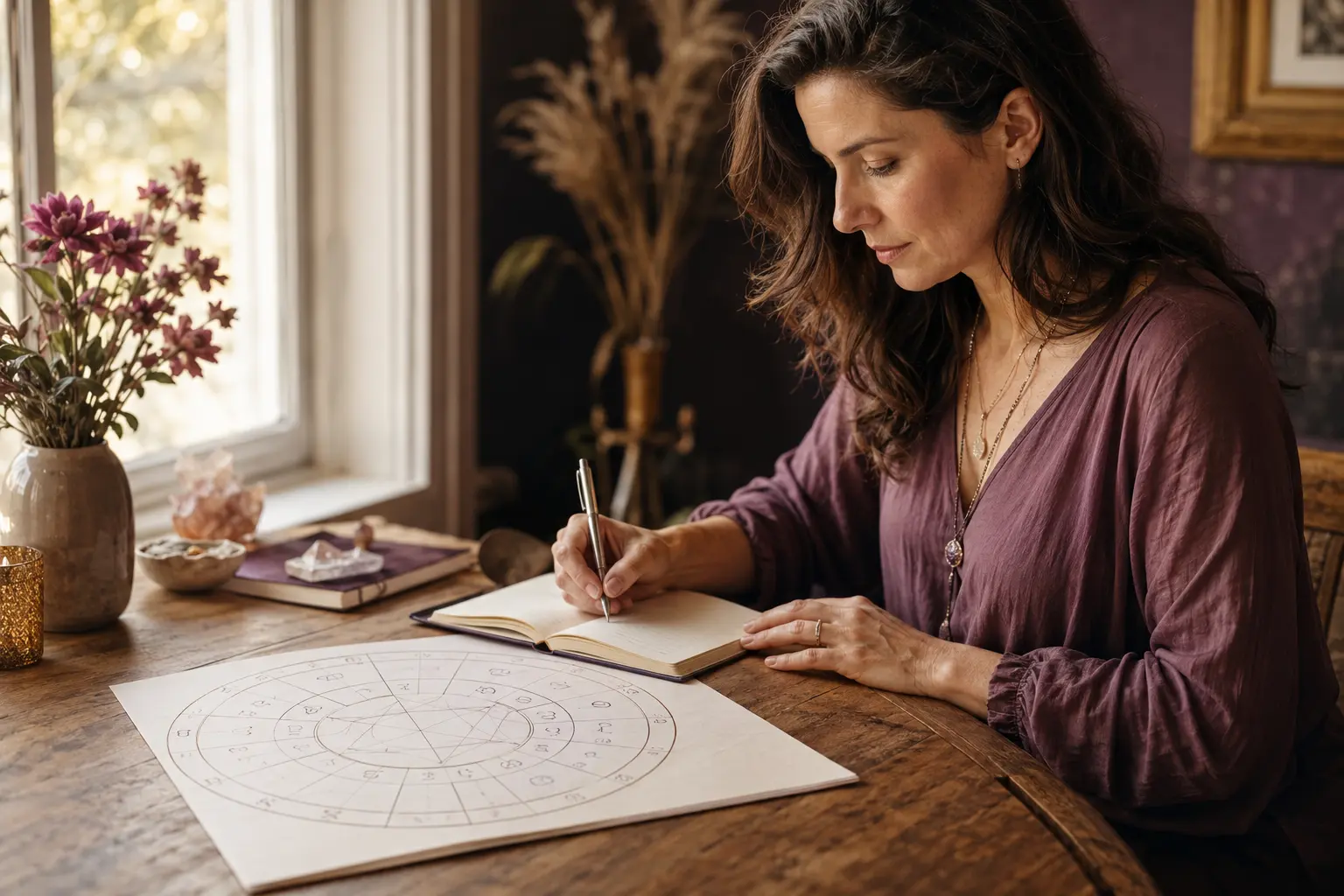
A birth chart reading begins with one specific moment: the date, time and place you were born. Astrology turns that moment into a circular map of the sky, then asks what becomes visible when its planets, signs, houses and angles are read as one system.
You may already know your Sun sign. Perhaps you also know your Moon and Rising. Those three placements are useful, but they are the doorway, not the whole house. A complete natal chart includes every planet, twelve areas of life and a web of relationships between the planets called aspects.
The purpose of a reading is not to recite all of those pieces. It is to find the story they are forming together.
What exactly is a birth chart?
A birth chart, also called a natal chart, is an astrological diagram calculated for your birth data. The wheel shows where the Sun, Moon and planets appeared within the zodiac from the perspective of Earth at that time and location.
Astrologers read four main layers:
- Planets describe functions or drives, such as identity, emotion, communication, desire and responsibility.
- Signs describe the style through which each function tends to express itself.
- Houses place those themes into areas of lived experience, from self and resources to relationships, work, community and inner life.
- Aspects show how different parts of the chart cooperate, intensify or challenge one another.
Imagine Venus in Capricorn in the fourth house. Venus speaks to relating, value and attraction. Capricorn adds reserve, seriousness and a need for something dependable. The fourth house brings the theme into home, belonging and private emotional foundations. An aspect from Uranus could add a strong need for freedom or an unconventional family pattern. The meaning is created by the combination, not by one phrase copied from a list.
A chart becomes personal when the pieces stop sounding like definitions and begin explaining one another.
The Sun, Moon and Rising are three different questions
The Sun is often treated as the whole personality because it is the sign most people know. In a chart reading, it answers a more focused question: what are you learning to become consciously? It can describe vitality, purpose and the kind of self-expression that helps you feel fully present in your own life.
The Moon speaks to emotional regulation, instinct, familiarity and what restores a sense of safety. A person may have a sociable Libra Sun and a private Scorpio Moon. That is not a contradiction to fix. It may describe someone who appears easy to approach but needs far more depth, loyalty and privacy than others initially realize.
The Rising sign describes how you enter experience and how life first meets you. It also sets the entire house structure, which is why birth time matters so much. The Rising sign can show approach, rhythm and the qualities you develop through direct contact with the world.
Together, these placements can explain why the person you are in public, the person you need to be at home and the person you are growing into do not always move at the same pace.
What a birth chart reading can reveal
Astrology is an interpretive practice. It is not a clinical assessment or a scientifically validated personality test. Within that boundary, a thoughtful chart reading can offer a rich language for self-reflection.
1. The needs beneath your behavior
Two people can make the same choice for very different reasons. One may work constantly because achievement creates identity. Another may do it because predictability creates safety. The Moon, Saturn, the second, sixth and tenth houses, and their aspects can help distinguish the visible behavior from the need underneath it.
This is often where a chart begins to feel personal. It does not only say that you are disciplined or sensitive. It asks what your discipline is protecting, what your sensitivity notices and what happens when those qualities are unsupported.
2. Your relationship patterns
Relationship astrology is much larger than Venus. Venus can describe attraction and the way affection is expressed. The Moon shows emotional needs. Mercury shapes how difficult conversations happen. Mars shows pursuit, desire and conflict. The fifth, seventh and eighth houses add romance, partnership and intimacy.
A reading can reveal that you want consistency but become interested in people who bring unpredictability, or that you communicate care through practical help while longing to receive emotional reassurance. It cannot tell you that one placement condemns you to a certain type of partner. It can show the pattern clearly enough for you to relate to it with more choice.
For a closer look at these layers, read Can Your Birth Chart Reveal Your Love Language?
3. Work, purpose and the shape of ambition
A career reading does not simply match each sign with a job title. It looks at how you use energy, what motivates sustained effort, whether you need autonomy or collaboration, how visible you want your work to be and where competence develops over time.
The Midheaven and tenth house are important, but they are not alone. The second house speaks to resources and value. The sixth describes daily work and craft. Saturn shows where mastery may require patience. Jupiter can show how confidence and opportunity expand. Mercury and Mars reveal how the mind acts under pressure.
The useful question is not “What single career am I destined to have?” It is “What qualities must my work make room for if I am going to remain engaged with it?”
Explore the full method in What Does Your Birth Chart Say About Your Career?
4. Strengths that feel too normal to count
People often overlook what comes naturally. A strong Mercury may make it easy to translate complex ideas. A grounded Moon may create steadiness during other people's emotional weather. A prominent Mars can bring initiative that the person simply calls “doing what had to be done.”
A reading can name these patterns and also show their overextended form. Communication becomes overthinking. Steadiness becomes carrying everyone. Initiative becomes difficulty resting. A strength is not diminished by understanding where it needs a boundary.
5. Inner tensions that keep repeating
Squares and oppositions are sometimes described as bad aspects. I see them as active conversations. A Moon-Saturn tension may describe the wish to be held and the habit of becoming self-contained. Venus-Uranus may want both commitment and enough space to remain fully alive.
These patterns do not predict failure. They show where two valid needs can pull in different directions. When the pattern is unconscious, life may keep arranging situations that reproduce it. When it is recognized, a person can build choices that honor more than one side.
What a birth chart cannot responsibly promise
A chart should never be used as a verdict on your worth, intelligence, mental health or capacity to love. It cannot diagnose illness. It cannot replace medical, psychological, legal or financial guidance. It does not prove that a future event must occur.
It also cannot remove context. Family, culture, opportunity, trauma, education, disability, money and personal decisions all shape a life. Two people born with similar charts do not become the same person.
Predictive techniques such as transits and Solar Returns can explore periods of emphasis, but they should be read as weather and timing themes, not as a sentence handed down in advance. A chart offers symbols. The reader, the client and the life itself supply context.
Why exact birth time matters
Your date sets most planetary positions, but birth time determines the Ascendant and the house cusps. A difference of minutes may matter when the Rising sign or a house boundary is close to changing. The Moon can also change signs during a day.
If possible, use a birth certificate or official record rather than a family estimate. If your time is approximate, say so. A responsible reader can place less weight on uncertain angles and houses instead of treating a guess as exact.
If no time is available, astrology does not become useless. The planetary signs and many aspects remain readable. The chart simply answers fewer house-based questions with confidence. The limitation should be visible in the interpretation, not hidden.
Personal reading versus an automated report
An automated report can be helpful for learning vocabulary. It may tell you what Moon in Taurus means, then what Moon square Mars means, then what Mars in Leo means. The problem is that each section often speaks as if it were the only placement in the chart.
A personal reading asks different questions. Which theme appears three or four times? Which placement changes the way another one is expressed? Where does the chart describe ease, and where does it describe growth through friction? Which part connects directly to the reason you requested the reading?
The difference is synthesis. Your report should not sound like a stack of paragraphs that could belong to strangers. It should help you recognize how your own patterns fit together.
How to prepare for your reading
- Confirm your date, time and place of birth as carefully as possible.
- State whether the birth time is exact, approximate or unknown.
- Choose one or two areas you want the reader to hold in mind, without trying to control every conclusion.
- Approach the reading as a conversation with patterns, not a test you must pass.
- Keep the report. A strong natal reading often reveals different layers when you return to it later.
Useful questions include: What need is hidden inside the pattern I keep repeating? What kind of work supports both my strengths and my values? How do I communicate when I feel unsafe? Where am I more capable than I give myself credit for?
A birth chart is a map, not an instruction
The best astrology does not make your life smaller by telling you who you are allowed to be. It gives language to the design already moving through you. It can show why two opposite needs both feel true, why one area of life asks for more time and why a strength may have been hiding inside something you judged.
You remain larger than the chart. The chart becomes valuable when it helps you meet that larger self with more recognition.
Read your chart as one connected story
Angela's personal birth chart reading brings your Sun, Moon, Rising, planets, houses, aspects, love and career patterns together in a written PDF made from your own birth details.
Explore the birth chart readingBirth chart readings: quick answers
What is included in a birth chart reading?
A full reading usually connects the Sun, Moon, Rising sign, planets, houses and major aspects. A personal interpretation also looks for themes that repeat across the chart and explains how apparently conflicting placements may work together.
What can a birth chart reveal?
Within astrology, a birth chart is used to explore identity, emotional needs, communication, relationship patterns, motivation, work, strengths and recurring tensions. It offers an interpretive map, not a scientific diagnosis or fixed verdict.
Do I need an exact birth time?
An exact time is strongly preferred because it determines the Rising sign, angles and house structure. Without it, planetary signs may still be useful, but house-based conclusions and sometimes the Moon or Rising sign must be treated more cautiously.
Can a birth chart predict my future?
A natal chart describes enduring patterns and potentials rather than guaranteeing future events. Timing techniques can explore periods of emphasis or change, but choices, circumstances and other people still matter.
Is a personal birth chart reading different from a free online report?
A free report commonly defines placements one by one. A personal reading synthesizes them, notices repetition and contradiction, and connects the chart to the questions and life areas that matter to the individual.
For a practical reading order, use the step-by-step birth chart analysis guide.
Astrology is an interpretive practice offered for personal reflection and entertainment. It is not a scientific assessment, does not guarantee outcomes and does not replace medical, psychological, legal or financial advice.