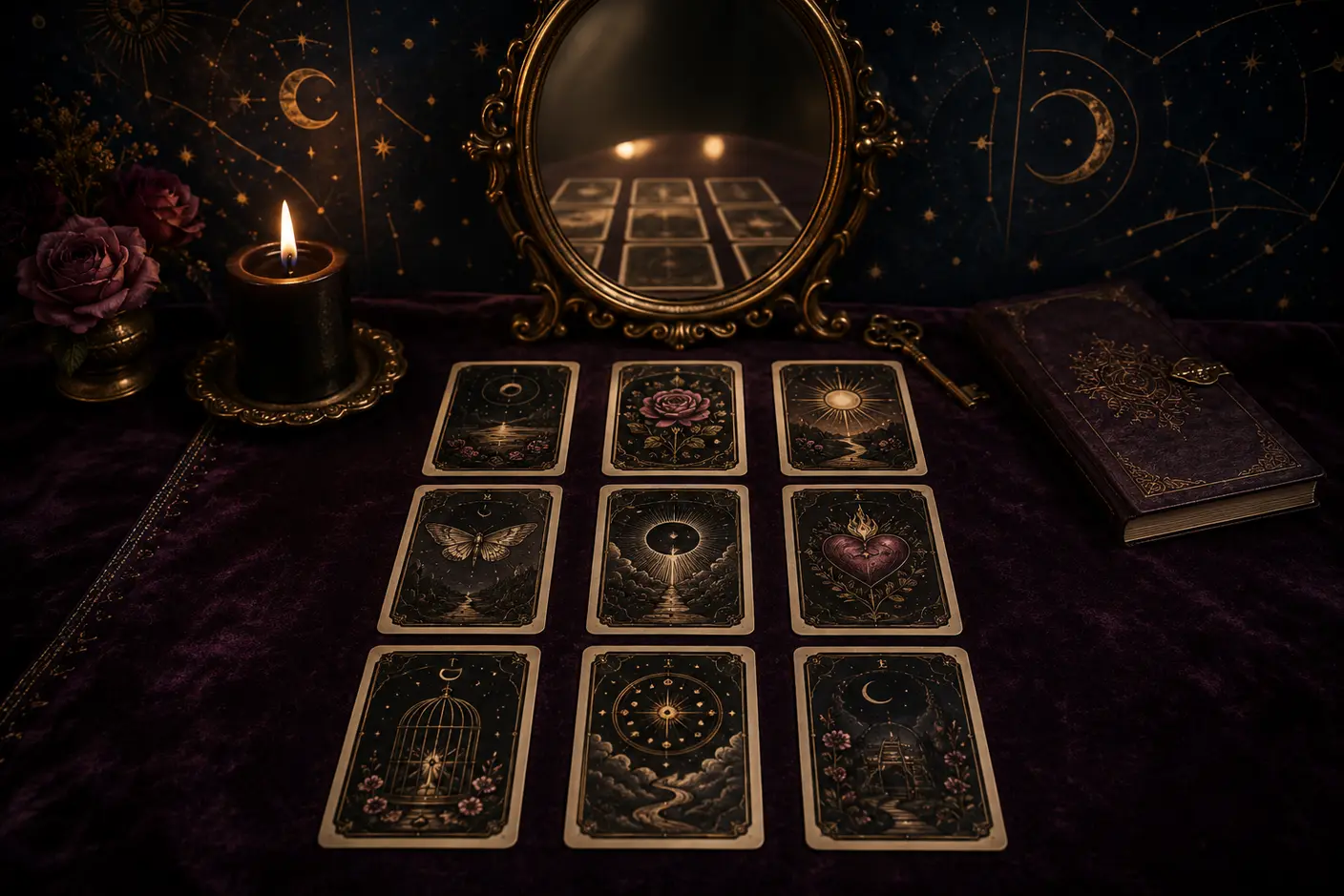
Shadow work is not a search for something wrong with you. It is a way of meeting the feelings, needs and strengths that became difficult to show because they once carried a cost.
Tarot can help because an image creates a little distance. Instead of asking “Why am I like this?” you can ask what the pattern protects, when it appears and what healthier form the hidden need might take.
These nine questions create one complete spread, but you do not have to answer them all in one sitting.
Choose one pattern, not your entire history
Name one repeated response you can observe. Perhaps you withdraw when you need reassurance, overexplain a boundary, become attached to unavailable people or abandon an idea when it begins to matter.
Write one recent example. Shadow work becomes safer and more useful when it stays connected with a real situation instead of turning every symbol into a judgement about your whole identity.
Before drawing the nine cards
- Set a time limit for the session.
- Keep water, a notebook and an ordinary object nearby.
- Decide what will tell you it is time to stop.
- Do not use the spread while in immediate crisis.
- Plan a simple closing activity after you write.
Nine shadow-work tarot questions
- What pattern is asking for my attention? Name the behavior or emotional loop without turning it into an identity.
- What tends to activate this pattern? The situation, feeling or expectation that brings it forward.
- What is the pattern trying to protect? The fear, need or former experience beneath the response.
- What do I avoid feeling when the pattern appears? The emotion that feels harder to hold directly.
- What hidden need deserves an honest name? Reassurance, recognition, rest, control, belonging or another unmet need.
- What strength is trapped inside the shadow? The quality that can return without the old defense.
- What belief keeps the cycle in place? The sentence about yourself, others or safety that organizes the response.
- What boundary or support changes the pattern? The condition that makes a different choice possible.
- What is one grounded step toward integration? A small action that allows the hidden need and mature strength to coexist.
Arrange the spread around a center
Place Card One in the center. Put Cards Two through Eight around it in a circle, then place Card Nine beneath the spread as the practical step. This arrangement keeps the pattern visible without letting it become the final word.
You can also use a three-by-three grid. Read the first row as activation, the second as the hidden need and the third as integration.
Read protection before judging the behavior
Card Three changes the tone of the whole spread. Four of Pentacles may show control protecting against loss. Seven of Swords may show avoidance protecting privacy or independence. The Hermit may show withdrawal protecting the need for space and internal clarity.
Understanding the protection does not mean every behavior should continue. It means change begins from a more accurate question: how can the real need be met without repeating the same cost?
The hidden need is not an instruction
Card Five may reveal a need for love, attention, power, rest or certainty. A need deserves recognition, but it does not decide what another person must provide.
If The Emperor appears, the hidden need may involve structure and agency. Two of Cups may reveal mutuality. The Star may reveal hope and honest renewal. Ten of Cups may show belonging or an ideal of emotional safety.
Finding the golden shadow
Shadow work is not limited to feared traits. Sometimes the hidden material is a strength you learned to reduce because it attracted judgement or responsibility.
- Queen of Wands: visibility, confidence and creative authority.
- King of Swords: clear standards and intellectual leadership.
- Strength: steady courage that does not need force.
- The Magician: initiative, skill and the willingness to begin.
- Queen of Cups: emotional depth with discernment.
Card Six asks how the quality can return in a form that respects both you and the people around you.
Beliefs that keep the pattern alive
Card Seven often reveals a sentence rather than an event. Eight of Swords may sound like “I have no choice.” Five of Pentacles may sound like “Support will not be available.” Seven of Wands may sound like “I must defend myself before anyone asks.”
Write the belief in your own words. Then ask what evidence supports it, what evidence complicates it and what more accurate sentence could guide the next response.
Boundary and support are part of integration
Card Eight prevents shadow work from becoming endless self-analysis. Justice may ask for accountability and a clear agreement. Three of Pentacles may ask for help. Four of Swords may ask for space. Queen of Swords may ask for a direct boundary.
A pattern formed in relationship may need a relational support, not only private insight.
A short example
Imagine the pattern is withdrawing after conflict. The spread shows The Hermit, Five of Wands, Four of Pentacles, Three of Swords, Two of Cups, Queen of Swords, Eight of Swords, Temperance and Page of Cups.
Conflict activates withdrawal. The response protects against further hurt and avoids the vulnerability of wanting mutuality. The hidden strength is clear communication. The cycle is held by the belief that there is no safe choice. Temperance asks for a more measured exchange, and Page of Cups offers one sincere message as the next step.
Know when to stop
If you feel detached from your surroundings, unable to settle after the reading or drawn to pull more cards until the answer changes, close the session. Tarot should not be used to force access to memories or to diagnose trauma.
The existing guide to three practical shadow-work methods offers shorter exercises. For a seasonal version, try The Haunted House five-card spread.
Tarot can support self-reflection and journaling. It cannot diagnose mental health conditions, recover memories reliably or replace qualified therapy and crisis support.
Look beneath the pattern with steady guidance
A personal reading can explore what the pattern protects, what remains yours to choose and the boundary that supports change.
Explore personal readingsQuick answers
What is shadow work in tarot?
Shadow work uses tarot images to explore qualities, needs, fears and protective patterns that are difficult to acknowledge directly.
How many cards are in this shadow-work spread?
The spread uses nine cards, one for each question. You can divide it into three shorter sessions if the full layout feels too wide.
Can tarot replace therapy for shadow work?
No. Tarot can support reflection and journaling, but it cannot diagnose, process trauma safely for everyone or replace qualified mental health care.
What if a reading becomes overwhelming?
Stop the session, put the cards away and return to ordinary surroundings. Speak with a trusted person or qualified professional when the material is difficult to hold alone.
Should I use reversed cards for shadow work?
Only if reversals are already part of your practice. The questions create enough contrast without requiring reversed cards.