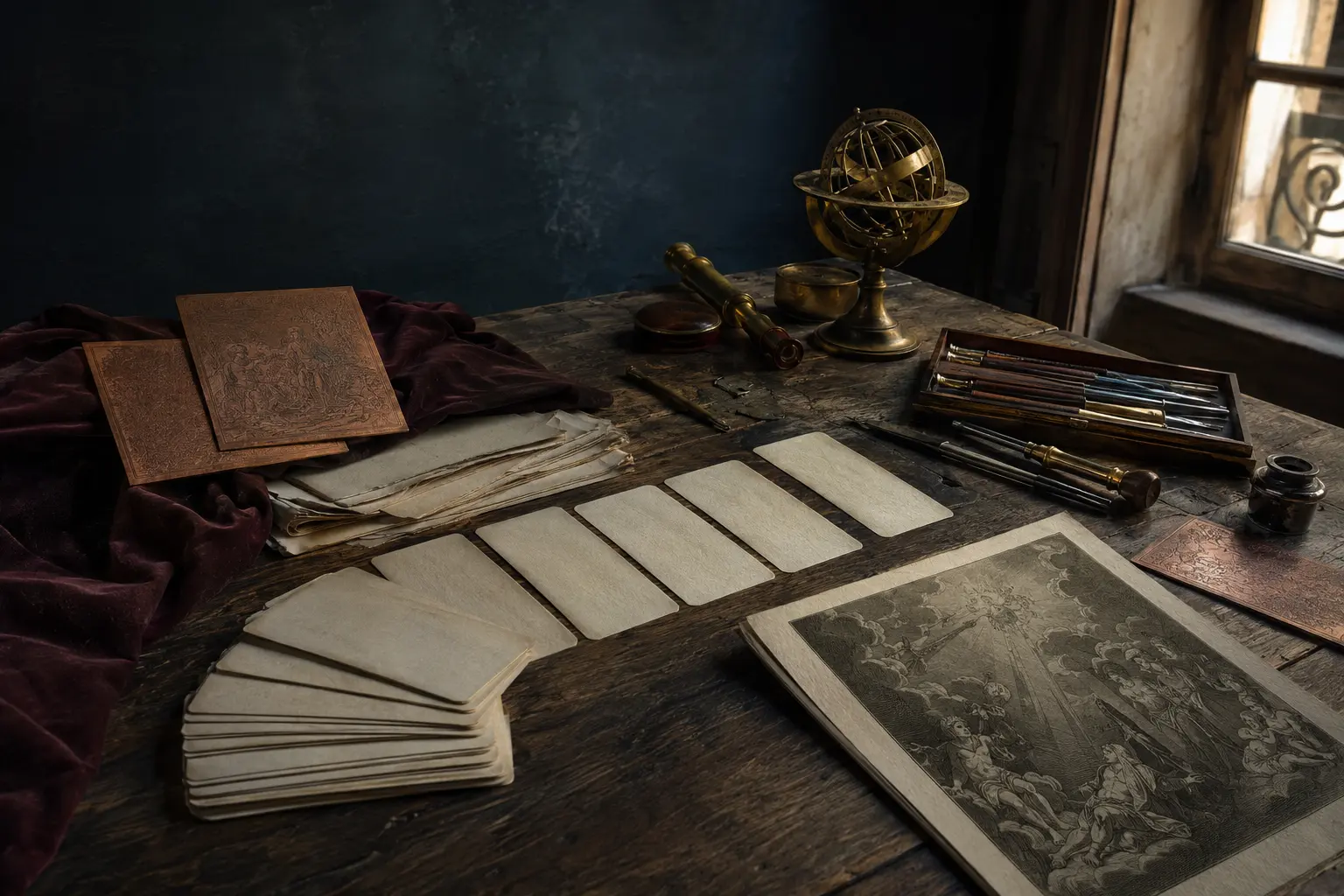
Grand Etteilla can feel like meeting an ancestor who speaks in a familiar voice but uses entirely different grammar. There are seventy-eight cards. We still find suits, trumps, court figures and reversals. Yet the moment we ask where the Fool, Sun or World belongs, the structure moves beneath our feet.
This is not an early version of Rider-Waite-Smith waiting to become modern. It is a complete divination system with its own order, cosmology and method. To understand it, we have to let it speak before translating it.
Who was Etteilla?
Etteilla was the professional name of Jean-Baptiste Alliette, a French cartomancer and occult writer born in 1738. The name is Alliette written approximately in reverse. In 1770 he published a method for divination with a shortened pack of ordinary playing cards. More than a decade later, between 1783 and 1785, he issued a multi-part method devoted to tarot.
By the end of the 1780s he was teaching, consulting and organizing students around what he called the Book of Thoth. A surviving application from January 1789 sought permission to print a French edition of that work. The complete deck associated with this system appeared around the revolutionary period, with surviving examples and catalogues dated around 1789 to 1791.
The British Museum describes him as the first professional tarotist known by name. That does not mean nobody read cards before him. It means Etteilla made the practice visible through books, teaching and a deck organized specifically around divination.
Why this deck changed tarot history
Earlier tarot packs were designed for games. Their images were later interpreted for divination. Grand Etteilla reversed that relationship. Its design, numbering and written vocabulary were shaped around occult and predictive use from the beginning.
The cards carried words that could be read in either orientation. Upright and reversed meanings were not simply positive and negative. They could name different substances, people, actions or conditions. A card might speak of explanation in one direction and fire in the other. Another might shift from support to protection. The reversal did not merely dim the upright meaning. It opened a second door.
Grand Etteilla does not ask the reader to invent a reversal from the upright image. It gives the reversed card a vocabulary of its own.
The Egyptian story and the historical record
Etteilla believed tarot preserved an ancient Egyptian book connected with Thoth and the temple of Memphis. He was not alone. In 1781 Antoine Court de Gébelin had argued that tarot carried Egyptian wisdom, and the idea caught the occult imagination of France.
There is no historical evidence that tarot originated in ancient Egypt. The documented cards emerged in fifteenth-century northern Italy as a game. Egypt, Thoth and Memphis belong to the later story people told about tarot.
That distinction matters, but it does not make Etteilla's work irrelevant. His history was mistaken. His creative act was still enormous. He took cartomantic practice, Renaissance cards, astrology, elemental philosophy and a Hermetic creation narrative, then formed them into a system that later readers could learn.
One name, several Grand Etteilla traditions
Modern reproductions can create the impression that there is one fixed Grand Etteilla deck. In practice, collectors distinguish several related types, often called Grand Etteilla I, II and III. Images, titles, colors and some correspondences changed across nineteenth-century editions.
The Etteilla Foundation preserves high-resolution scans of a complete early Type I pack associated with Etteilla and engraver Pierre-François Basan. The Wellcome Collection holds a public-domain collage arranged as leaves of the Book of Thoth. Later Grand Etteilla decks may look more Egyptian, more decorative or more familiar to modern readers.
This series follows the common Grand Etteilla I numbering used in later reference traditions. When early sheets, museum catalogues and later decks disagree, the difference will be named instead of smoothed away.
The first eight cards form a creation sequence
In the common numbering, cards 1 through 8 carry a creation narrative. Card 1 stands before creation, in Chaos. Cards 2 through 8 move through light, elements, living creatures, humanity and rest. The order is not a simple retelling of Genesis. Days appear out of sequence, and each card also carries a separate cartomantic identity.
- Card 1: Etteilla / Questionnant, linked with the condition before creation and used as the male questioner's significator.
- Card 2: Éclaircissement / Feu, the arrival of light and the power of fire.
- Card 3: Propos / Eau, connected with water, land, plants, speech and intention.
- Card 4: Dépouillement / Air, the division of space and the atmosphere.
- Card 5: Voyage / Terre, matter, land, living creatures and movement through the world.
- Card 6: Nuit / Jour, the lights of heaven and the division between night and day.
- Card 7: Appui / Protection, the creatures of sea and sky, foundation and shelter.
- Card 8: Etteilla / Questionnante, rest and nature, also used as the female questioner's significator.
Some modern descriptions call this seven stages of creation because Chaos stands before the seven days. Others call cards 1 to 8 the creation group. Both phrases point toward the same practical structure, but they count its threshold differently.
What happens after creation?
Cards 9 to 12 bring the cardinal virtues into view: Justice, Temperance, Strength and Prudence. Cards 13 to 21 turn toward marriage, force, illness, judgment, mortality, betrayal, hardship, fortune and conflict. The Fool appears at the opposite end of the numbered sequence as card 78, Folie.
The Minor Arcana retain Italian-style suits, but their numbering continues through the full pack. Batons, Cups, Swords and Coins are not merely illustrated stories. Their meanings grow from a cartomantic vocabulary of people, money, news, pleasure, obstacles, alliances and material events.
Grand Etteilla and Rider-Waite-Smith are different languages
- Card order: Etteilla reorganizes the trumps; Rider-Waite-Smith largely follows the Golden Dawn sequence.
- Starting point: Etteilla begins with creation and the questioner; Rider-Waite-Smith is often taught through the Fool's Journey.
- Reversals: Etteilla assigns distinct words to each orientation; modern readers often treat reversals as blockage, shadow or reduced expression.
- Reading style: Etteilla leans toward concrete conditions and predictive combinations; Rider-Waite-Smith supports narrative and visual intuition through scenic pip cards.
- Correspondence: Similar images do not guarantee identical meaning. Etteilla Card 2 relates to the traditional Sun trump, but Éclaircissement and Feu create a different reading field.
Comparison can help once both systems are understood. Used too early, it makes Etteilla look like a deck with its cards in the wrong places. Nothing is misplaced. The organizing idea is different.
Why the significators matter
Cards 1 and 8 can represent the person asking the question. Historical methods separated them by gender, with Card 1 for a male questioner and Card 8 for a female questioner. A modern reader does not have to preserve that binary rule.
The deeper technique is positional. A significator gives the reading a center of gravity. Cards close to it can describe what touches the questioner directly. Cards farther away may speak of background influences, other people or conditions still developing.
You can assign Card 1 to the active voice of the question, Card 8 to the receptive voice, choose either through personal resonance, or leave both inside the deck and read their appearance. Historical awareness gives us options. It does not require pretending that an eighteenth-century social rule is timeless.
How to begin reading Grand Etteilla
- Choose one edition. Do not mix titles from three variants without noting where they came from.
- Learn both orientations together. Treat them as two related entries, not an upright meaning plus a punishment.
- Begin with three cards. Read condition, development and result before attempting a large historical spread.
- Keep the printed nouns concrete. If a card says fire, consider heat, urgency, passion and actual combustion before turning it into a vague spiritual metaphor.
- Watch combinations. Etteilla's vocabulary becomes more precise when one card qualifies another.
- Record the edition and orientation. Your journal will become more useful than a generic list copied from several sources.
What this series will explore
We will begin with the creation sequence, card by card. Each article will separate five layers: the historical image, the printed terms, the creation correspondence, the upright and reversed reading, and the nearest Rider-Waite-Smith comparison.
The next part is Etteilla Card 1: Chaos, the Questioner and the Beginning Before Form. After that comes Card 2: Light, Fire and the Moment Meaning Becomes Visible.
Sources and further viewing
For the historical record and surviving images, see the British Museum biography of Etteilla, the Wellcome Collection's public-domain Book of Thoth collage, the Public Domain Review overview and the Etteilla Foundation's complete early deck.
Bring the cards back to a living question
History teaches us how tarot became a language. A personal reading brings that language into the choice, relationship or turning point you are living now.
Explore Angela's tarot readingsGrand Etteilla: quick answers
What is the Grand Etteilla Tarot?
It is a 78-card tarot system developed for divination in late eighteenth-century France, with a reordered trump sequence and distinct upright and reversed terms.
Was Etteilla the first tarot reader?
We cannot identify the first person ever to read tarot, but Etteilla was among the earliest to publish a complete method and is often described as the first known professional tarot reader.
Is it the same as Rider-Waite-Smith?
No. The decks share the 78-card format, but their trump order, imagery, correspondences and reading logic are different.
Did tarot come from ancient Egypt?
No historical evidence supports an Egyptian origin. Tarot emerged in fifteenth-century northern Italy. Egypt belongs to the later occult story attached to the cards.
Can a beginner read Grand Etteilla?
Yes. It is easier when you treat it as its own language and begin with a few cards, both orientations and one clearly identified edition.
This article treats tarot as a historical and interpretive practice for education, reflection and entertainment. Deck titles and correspondences vary between Grand Etteilla editions.