Two people can share supposedly compatible Sun signs and feel unseen by each other. Another couple may have signs described as difficult, yet build a relationship with humor, honesty and deep respect. The difference is not that astrology failed. It is that Sun-sign matching was never the whole relationship.
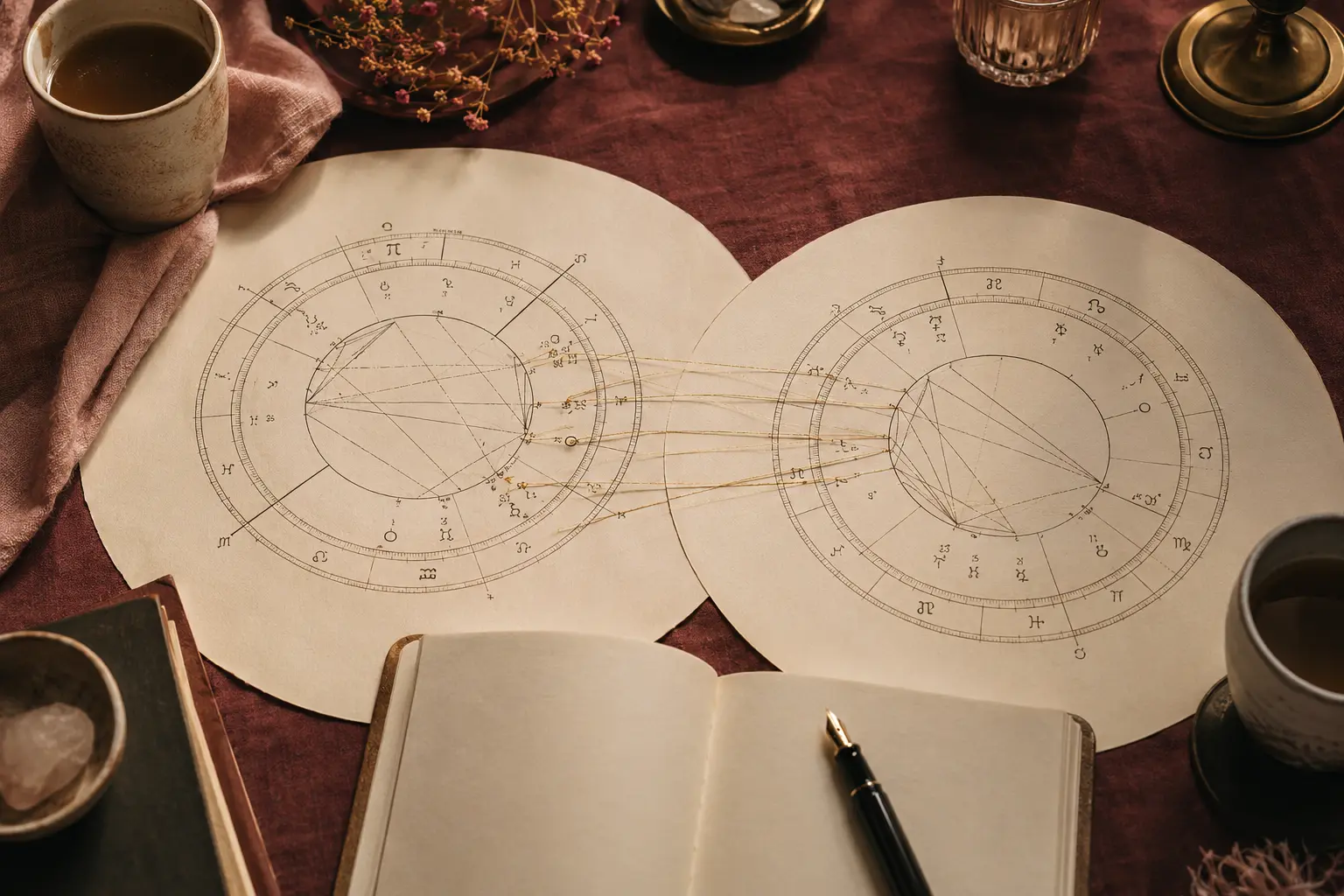
Birth chart compatibility is usually explored through synastry, the comparison of two natal charts. One person's planets are placed in relationship with the other's planets, angles and houses. The result is not a grade. It is a map of what becomes activated when these two people meet.
Some connections feel immediate. Some feel safe. Some bring growth through friction. The strongest synastry reading separates those experiences instead of treating chemistry as proof of compatibility.
Synastry asks how two complete charts interact
Your natal chart already contains a relationship pattern. It describes how you receive care, what helps you trust, how you speak under stress, what attracts you and which needs may pull in different directions. Another person does not create that architecture. Their chart touches it.
A partner's Venus may support your Moon, making affection feel emotionally recognizable. Their Mars may square your Mercury, creating spark alongside arguments about tone and timing. Their Saturn may stabilize your Sun or make you feel judged, depending on the wider pattern and how the aspect is lived.
Synastry does not tell you whether two people are good or bad. It shows what the relationship asks each person to feel, learn and practice.
The Sun shows recognition, not the whole bond
Sun contacts can create a strong sense of recognition. Harmonious aspects may support shared vitality and mutual encouragement. Challenging aspects can bring fascination, competition or different ways of expressing identity.
Yet two compatible Suns can still have Moons that need different kinds of care, Mercuries that misread one another and Saturn contacts that make the relationship heavy. Sun compatibility can help, but it cannot carry the entire connection.
The Moon reveals emotional compatibility
The Moon describes instinctive needs, emotional rhythm and what feels like home. In synastry, Moon contacts often show whether two people recognize each other's inner weather.
Moon-Moon harmony may create an easy rhythm around daily closeness. One person knows when the other needs conversation, space, reassurance or practical help. Difficult Moon contacts do not make love impossible, but they can mean that care is offered in a form the other person does not immediately register.
House overlays matter too. Someone's Moon in your fourth house may feel familiar and private. In your tenth, their emotions may become connected with your public life or ambition. In your eighth, the bond can feel intimate, exposing and difficult to keep superficial.
Venus describes affection, value and attraction
Venus is central to how love is expressed and what a person finds pleasing, valuable or relationally graceful. Venus-Venus aspects can show whether affection styles cooperate. Venus to the Sun or Ascendant often brings appreciation and visible attraction.
But Venus is not enough. A beautiful Venus contact may create sweetness without the emotional safety of the Moon, the honest conversation of Mercury or the long-term structure of Saturn.
Your own Venus is also only one part of your astrological love language. How you love and how you need to be loved may be described by different placements.
Mars shows desire, pursuit and conflict
Mars contacts can create chemistry, movement and the feeling that something happens when two people are together. Venus-Mars aspects are famous for attraction, but the same intensity can sharpen conflict if the relationship lacks emotional or communicative support.
Mars also describes how each person acts when frustrated. One may want immediate resolution. The other may need time to process. Synastry can reveal this mismatch, but awareness does not remove responsibility. Anger, coercion or disrespect should never be romanticized as passion because two Mars placements are strong.
Mercury determines whether meaning survives the conversation
Mercury contacts describe how minds meet. Harmonious aspects can make conversation flow, support humor and help people understand each other's logic. Difficult contacts may produce stimulating debate or repeated misinterpretation.
Mercury-Moon connections are especially revealing. One person may be able to name what the other feels. Or words may touch emotional vulnerabilities before either person understands why the conversation became charged.
Good communication is not the absence of disagreement. It is the ability to repair meaning after disagreement has changed the atmosphere.
Saturn can support longevity, but it is not a guarantee
Saturn is associated with time, commitment, responsibility and form. Strong Saturn contacts often appear in relationships that feel consequential or difficult to leave casually. They can support loyalty, endurance and the willingness to work through real life.
They can also feel restrictive. One person may become the authority, critic or keeper of the rules. The relationship may endure because it is healthy, or because fear and obligation make change difficult. Duration is not the same as quality.
A thoughtful reading asks whether Saturn creates reliable structure for both people, and whether responsibility is shared.
Jupiter brings growth, meaning and proportion
Jupiter contacts can bring generosity, encouragement and a sense of possibility. One person may help the other believe in a larger future. Shared learning, travel, faith or humor can become part of the bond.
Jupiter can also enlarge what is already present. Optimism may become overpromising. Generosity may avoid necessary boundaries. Like every planet, Jupiter needs the wider chart to show whether expansion has a container.
Uranus, Neptune and Pluto intensify the story
Outer-planet contacts are often powerful, especially when they touch personal planets or angles.
- Uranus can bring excitement, freedom and a relationship that changes both people's expectations. It can also make rhythm unpredictable.
- Neptune can create empathy, spiritual closeness and idealization. It asks for clarity so that longing does not replace reality.
- Pluto can deepen intimacy and transformation. It also requires awareness around control, obsession and power.
Intensity is information, not proof that a relationship is destined. The more compelling the contact, the more important it becomes to observe behavior.
House overlays show where the person enters your life
When someone's planets fall into your houses, they activate particular areas of experience. Their Sun in your fifth may awaken play, creativity and romance. Their Venus in your seventh can make partnership feel natural. Their Saturn in your second may bring structure or pressure around money and self-worth.
The twelfth house can create compassion, mystery or projection. The eighth can deepen trust, shared resources and vulnerability. The fourth can feel like home, while also touching family patterns that existed before the relationship.
House overlays are not inherently positive or negative. They show where the connection becomes personally meaningful.
Easy aspects are not always easy relationships
Trines and sextiles can create flow. People may feel accepted and move together with less friction. But ease can become passive if neither person develops the relationship consciously.
Squares and oppositions create contrast. They can produce conflict, but also movement, attraction and growth. A couple with difficult Mercury aspects may learn exceptional communication because they cannot rely on assumption. Another couple may repeat the same argument for years.
The aspect describes the pattern. Character, awareness and choice describe what happens with it.
No compatibility score can measure relationship health
Apps and automated reports often reduce synastry to a percentage. That makes a complex chart easy to consume, but it hides the central question: compatible for what?
Two people may share creative excitement and have little capacity for practical partnership. They may communicate beautifully but want different futures. They may feel secure as family and uninspired as lovers. Compatibility has several dimensions:
- emotional recognition,
- affection and attraction,
- communication and repair,
- sexual and motivational rhythm,
- shared values and future direction,
- boundaries, responsibility and practical life.
Synastry does not replace consent, safety or observation
No chart contact excuses manipulation, disrespect, violence or coercion. Pluto intensity is not permission for control. Neptune is not a reason to ignore deception. Saturn is not a command to remain in a harmful relationship.
Astrology can help name a pattern. It cannot decide whether someone is safe, truthful or willing to change. Trust repeated behavior. Seek qualified support when a relationship affects your safety, health, legal position or financial security.
Birth time matters for both people
Exact birth times set the Ascendants, angles and house overlays. Without them, planetary aspects can still be compared, but conclusions about house placement and angle contacts become uncertain. The Moon may also change signs during a day.
A responsible reading should state the limitation. It is better to interpret fewer layers accurately than to build a confident story on an estimated time.
Better questions for a compatibility reading
- How do we each recognize and receive care?
- Where does communication flow, and where do we make different assumptions?
- What creates attraction, and what supports trust after attraction?
- How do we respond to conflict and repair?
- Which responsibilities are likely to become central?
- What does this relationship need from both people to remain respectful and alive?
These questions work for romantic partners, family members, close friends and other important bonds. The meaning of each contact changes with the kind of relationship being lived.
Compatibility is participation
Synastry can explain why someone feels familiar, why one conversation goes deeper than expected or why a recurring conflict carries so much charge. It can reveal gifts and places that require more consciousness.
It cannot love on your behalf. It cannot apologize, listen, maintain a boundary or make two futures compatible. The charts show the relationship field. The people inside it decide how that field is treated.
See the relationship as more than two Sun signs
Angela's personal astrology readings explore the emotional language, attraction patterns, relationship houses and deeper architecture carried by your own chart or shared family bond.
Explore relationship astrology readingsBirth chart compatibility: quick answers
What is birth chart compatibility?
Birth chart compatibility, often explored through synastry, compares two natal charts to study how the planets, angles and houses interact. It can describe attraction, emotional needs, communication, conflict and areas of support or growth.
Do compatible Sun signs guarantee a good relationship?
No. Sun signs describe only one layer. Emotional fit, communication, desire, values, boundaries, timing and behavior depend on many chart factors and on both people's choices.
Which planets matter most?
The Moon, Venus, Mars and Mercury are especially useful for emotional needs, affection, desire and communication. The Sun, Saturn, Jupiter, outer planets, Ascendant and house overlays add further context.
Are difficult synastry aspects a sign to end a relationship?
Not automatically. Squares and oppositions can create friction and growth, while easy aspects can become passive. The key is how the pattern is handled and whether the relationship remains safe and respectful.
Can compatibility predict whether a relationship will last?
Synastry can describe dynamics and the kinds of work a relationship may require, but it cannot guarantee duration. Communication, circumstances, shared values and repeated behavior remain essential.
Begin with the main love indicators in a natal chart before comparing two charts.
Astrology is an interpretive practice offered for personal reflection and entertainment. It does not guarantee relationship outcomes and does not replace medical, psychological, legal or safety support.